
November 2025 - Text and drawings: Rik de Reuver (The Netherland).
1 – La Necessità di Velocità: THE JOURNEY.
This is a story about three speed record cars: 'NIBBIO', 'NIBBIO 2' and 'COLIBRI', which were powered by 'Moto Guzzi' engines. It took place between 1935 and 1963.
My curiosity for this story was aroused by a photo of one of the record cars on the internet and I thought: "Huh?... is that a Moto Guzzi?". But it was really written on its bodyside! After further searching the web, I found quite a bit of information, which, however, often turned out to be incomplete or downright contradictory. I also found that in 2017, among the very expensive classic cars of the major car brands, 'NIBBIO' won the ‘Coppa d’Oro’ of the world-renowned and very prestigious 'Concorso d'Eleganza Villa d' Este'! But I'm getting ahead of myself, let me first introduce myself:
My name is Rik de Reuver, 64 and retired. When I walked to school, around the age of 10, via the street in Utrecht (NL) where my grandparents lived, both an 'Alfa Romeo 2000 Spider Veloce' and a 'Moto Guzzi V7 Sport' were parked there. They made an indelible impression on me! In '91 I bought a '79-er 'Spider' (which I still own; 'daily drivers' have only been Alfas since then). The memory of the 'Guzzi' only came back to life when my son bought the wreck of a 'Zündapp C50 Sport' at the age of 14. After he refurbished it by himself, he let me ride it and that tasted like more. Not much later, I took motorcycle riding lessons, passed the exam and purchased an '82 ‘Street Tracker’ converted 'Moto Guzzi V35C'. It went to my son when I bought a brand new 'V7 II Stone' in 2016.
Through further research, I discovered information about the initiator behind the 3 record cars: Giovanni 'Johnny' Lurani Cernuschi, VIII Count of Calvenzano. Born (1905) and passed away (1995) on the family estate in Cernusco Lombardone. Lurani was a northern Italian nobleman with ‘petrol running in his veins’. He was also a true 'Uomo Universale': Engineer, race driver, writer, journalist, editor and as director he was member of the supervisory board of Moto Guzzi and held important positions within the FIM (Fédération Internationale de Motocyclisme) and the FIA (Fédération Internationale de l'Automobile), the organizers of MotoGP and F1.
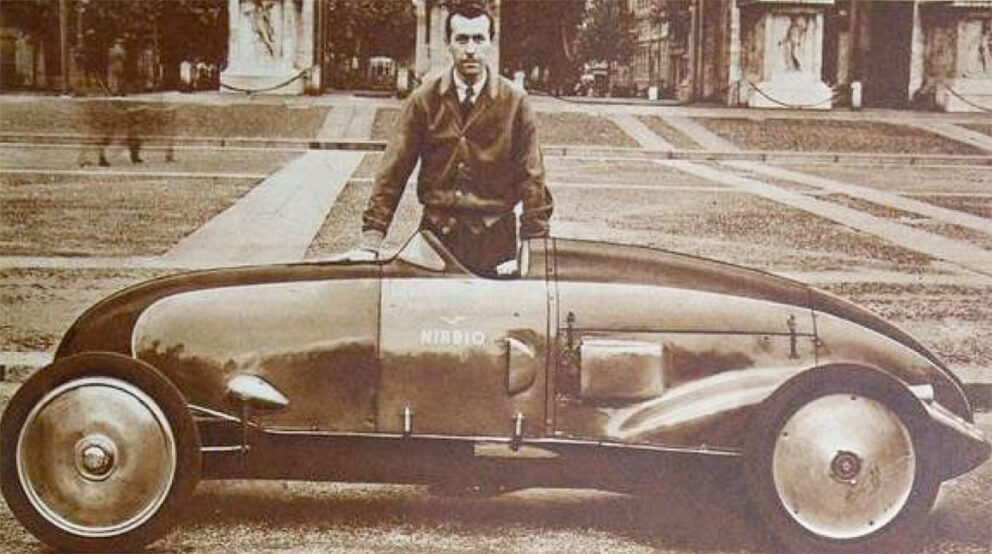
Giovanni Lurani with his 1939 NIBBIO.
I collected as much information as I could but soon found out that real facts would have to be collected in Italy. An itinerary along places where something could be gained was made and at the end of May I jumped on the 'V7 II' for my very first solo motorcycle trip. 4 mates, including my son (on '24 V7 IV 850 Stone, '24 Stelvio, '82 California II & BMW F650GS), accompanied me to Mandello. On the way there we were treated on heavy rainfall, so the tents stayed packed, and we took hotel rooms in Lemberg and the next day in Lindau.
When we arrived in Lecco it still looked bad, so we rented an apartment for 2 nights. The next day, of course, we went to the 'Moto Guzzi Museum', especially to see and photograph the engines used in the record cars: the 120° 500cc V2, the 350cc single-cylinder and the 250cc single-cylinder with and without compressor. In the museum, a young German Guzzi-rider (V85TT) joins us. The six of us made a nice tour in the afternoon along the banks and on the slopes around the lake.
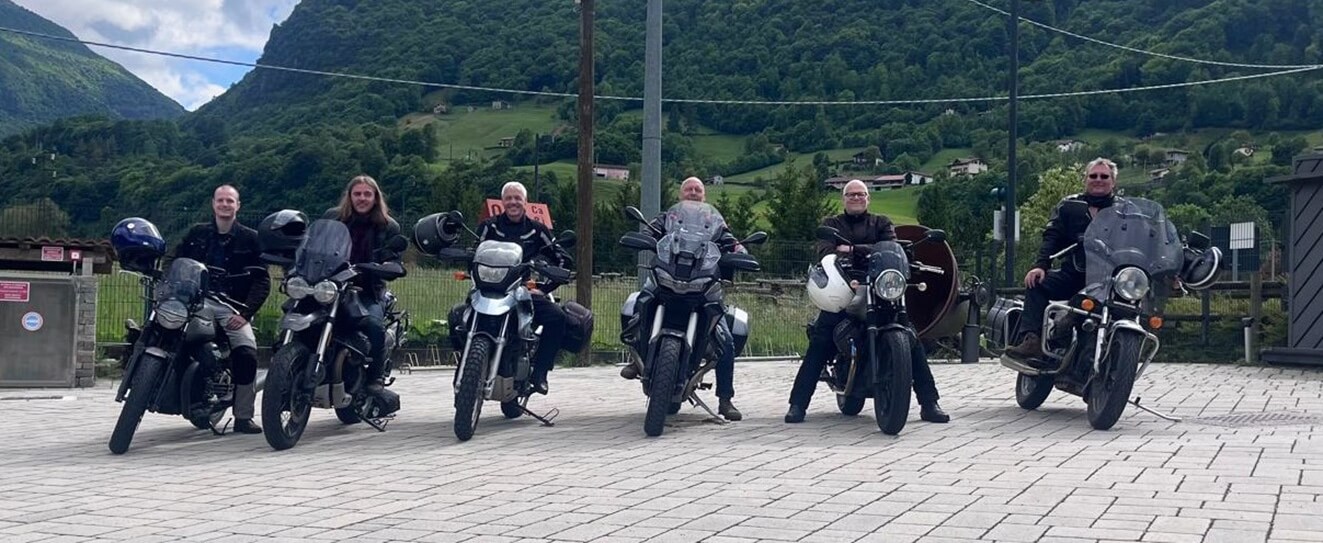
Surroundings of Mandello del Lario: Henk, Lucas (D), Peter, Martien, me & Jan. Photo RdR.
The next day, the 5 of us drove to 'Campeggio Rivabella' on Lake Como. Because the weather had finally improved, I decided to camp there for another 2 nights. After a joint breakfast at the campsite, my travel companions said goodbye and left for home. A place for my tent right on the waterfront, sun and blue sky: it just doesn't get any better than that! A little later I got into a conversation with an Australian who was exploring Europe with his wife, by camper. He was attracted by my Guzzi, is a fanatic motorcyclist himself and knows Teo Lamers (famous Dutch Guzzi specialist, now living in Australia), so we had a very pleasant afternoon.
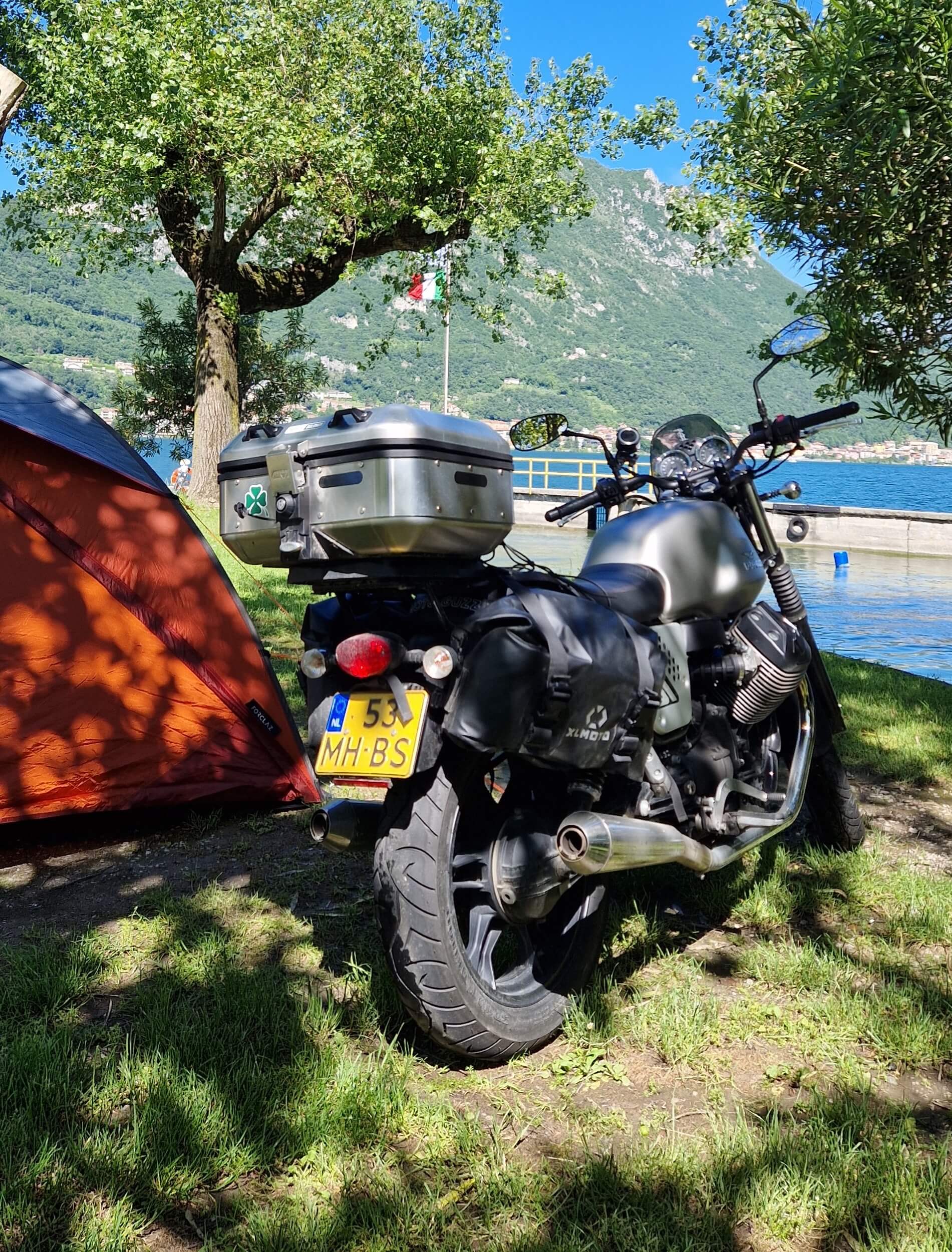
Campeggio Rivabella, Lecco. Photo RdR.
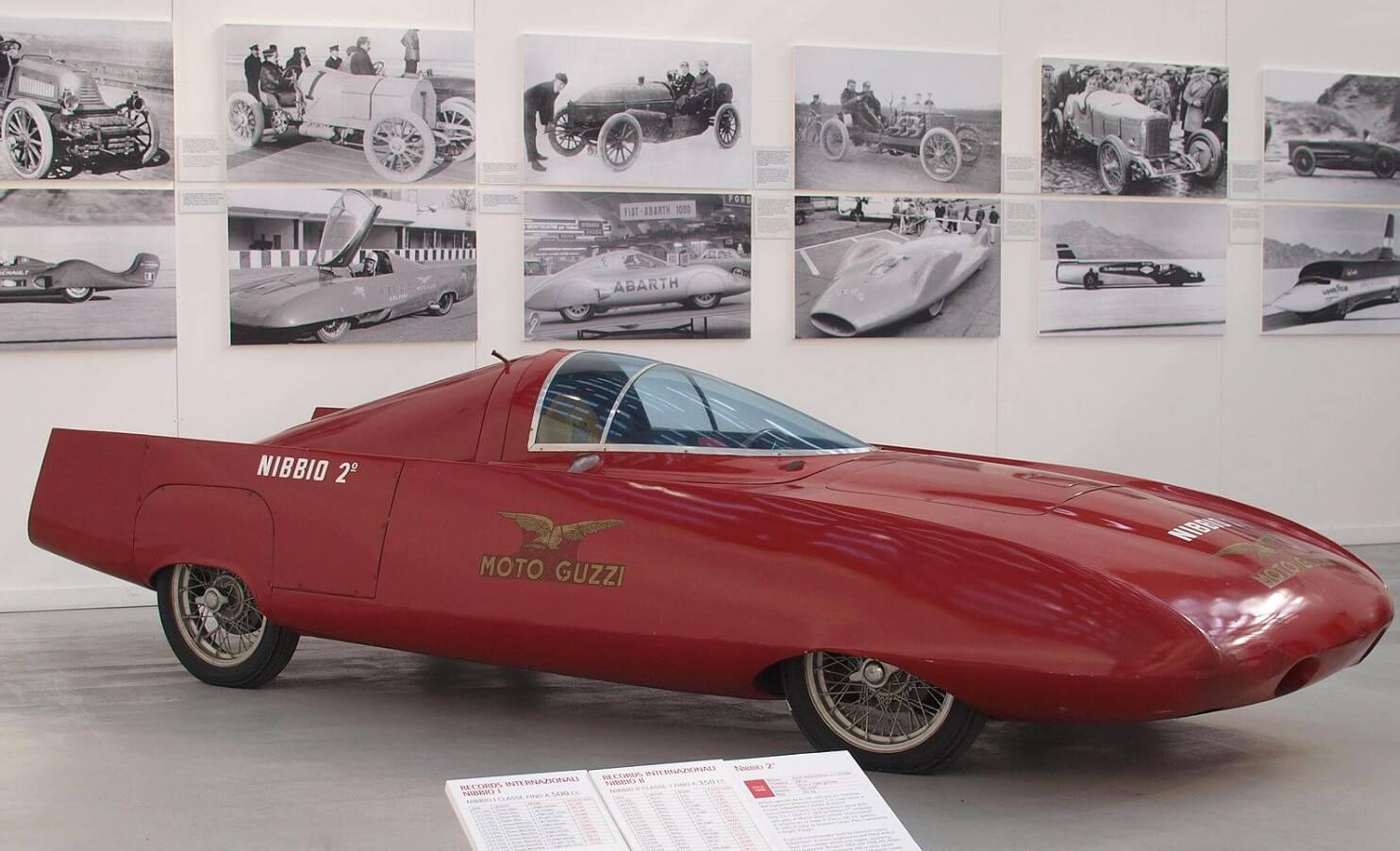
Next stop was Turin, to be precise: 'MAUTO' (Museo Nazionale dell' Automobile Torino), where 'NIBBIO 2' can be admired. I camped at the city campsite (Campeggio Grinto). While setting up my tent, some bunnies frolic happily around me. 'MAUTO', 'Lingotto' (the former FIAT factory, known for the test track with banked curves on the roof) and the city centre are within walking distance by a footpath along the river Po. Although the museum showed 'NIBBIO 2', I couldn't find any additional information. Somehow one hopes for an older attendant with great stories from the past.
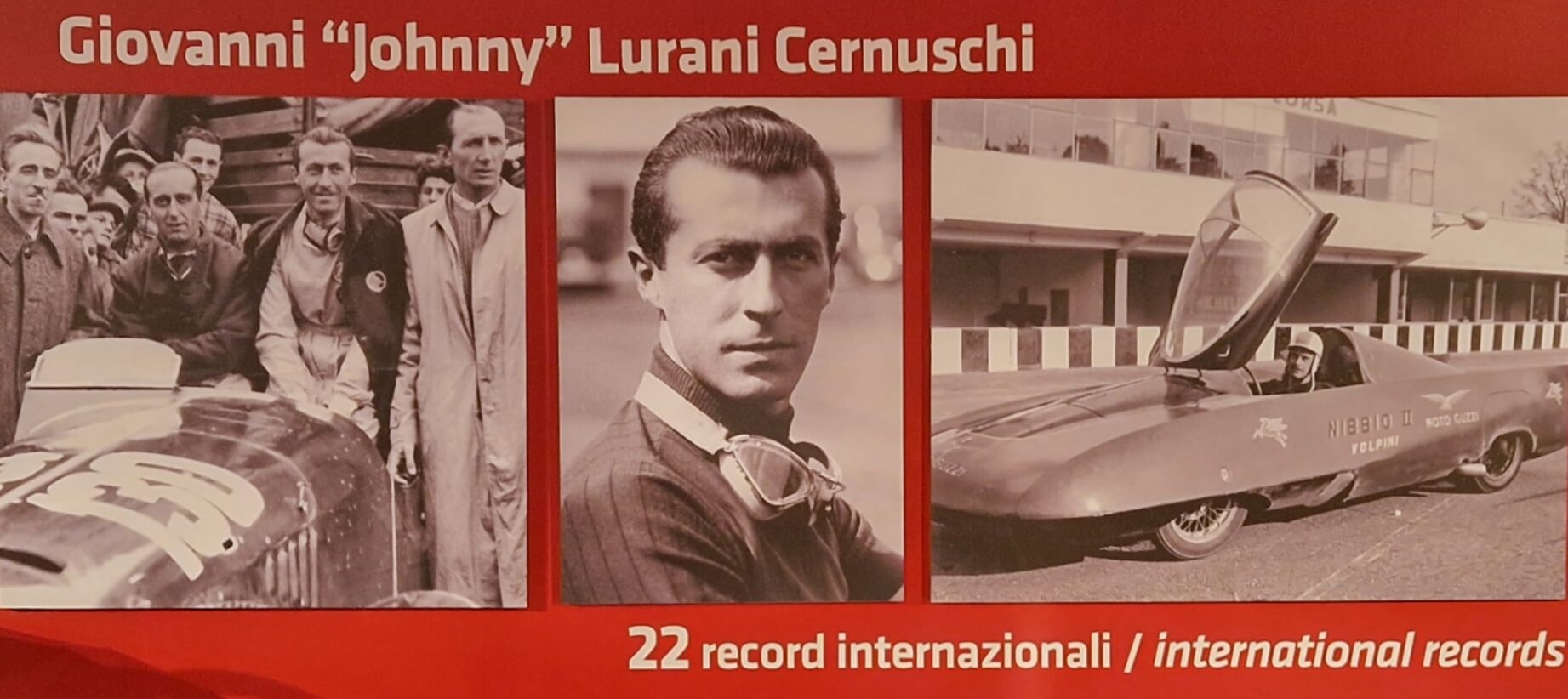
Museo Nazionale dell’Automobile Torino (MAUTO). Photo RdR.
Unfortunately, almost all employees are in their twenties: "Non lo so......" I am told several times. I discovered that the car on display differs from the photos on the wall behind it: The car has apparently been further developed during its lifetime. In 'MAUTO' I was able to take a set of good photos. The next day I borrowed a bicycle from the Campsite, to explore Turin further: What a lovely city!
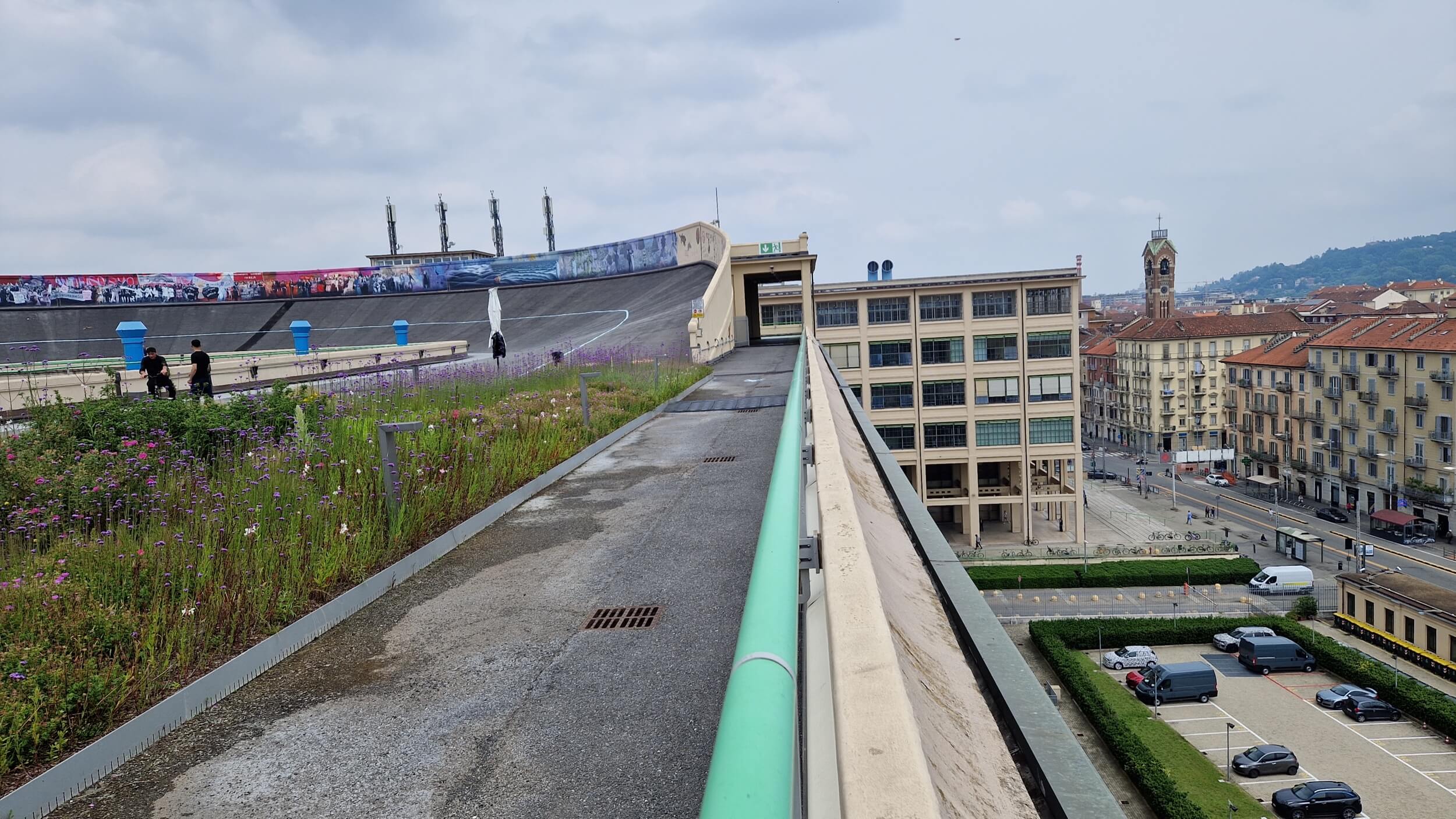
Lingotto (roof, test track), Turin. Photo RdR.
My third destination was purely touristic: Sestri Levante on the Ligurian coast. The drive there, crossing the Po Valley to Alessandria wasn’t too bad, the road after that across the Northern Apennines is nothing short of fantastic: Beautiful tarmac, fantastic curves. And then, riding out of a tunnel: 'BAM': There she is: The azure blue Mediterranean Sea. Unreal!
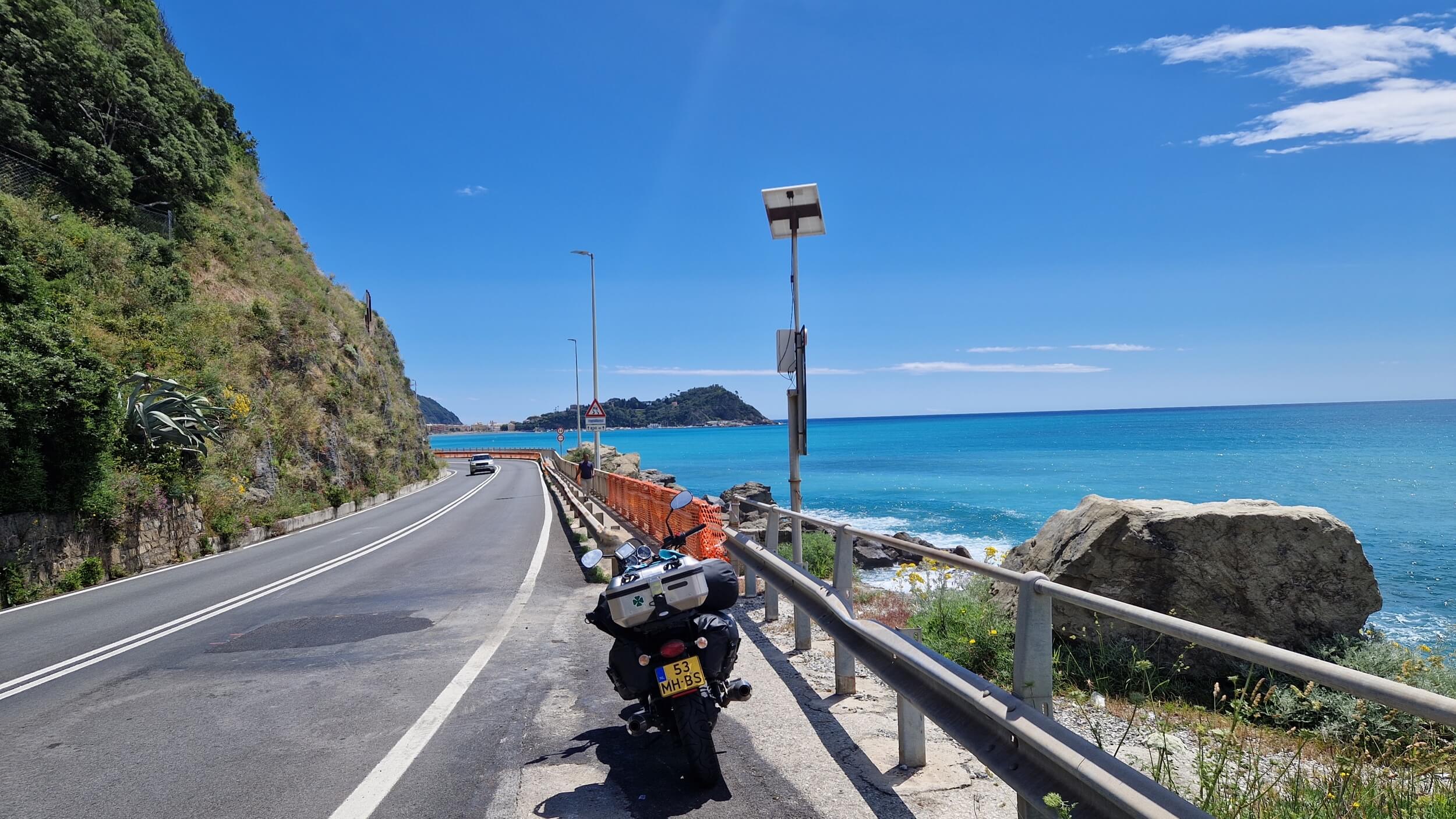
The Ligurian coast. Photo RdR.
The pre-selected campsite turned out to be at a greater distance from the town than I had hoped. I found an alternative in a former Catholic shelter (Villa Glauer-Massone-D'Amico), which is still run by nuns... I was allowed to park my motorcycle in the garden, so I won't complain. The town is very charming! I had a nice conversation with Mario from beach club 'Villa Balbi' where I drink a beer while the sun sets into the sea. His mate runs pizzeria 'la Vita è Bella' in Eindhoven, close to where I live now. I’ll have to check that out!
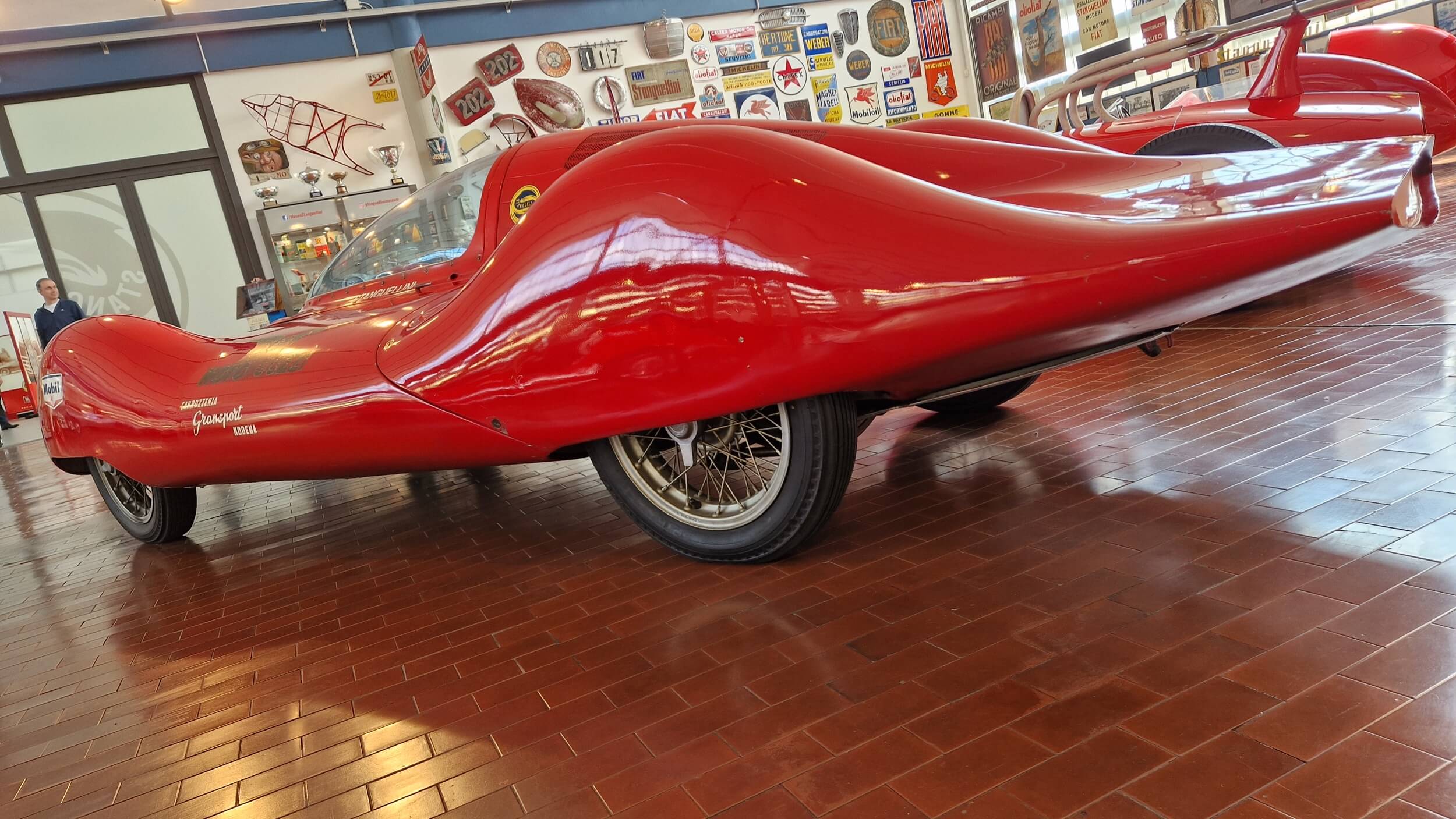
COLIBRI’ in Museo Stanguellini, Modena. Photo RdR.
Then it was party time again, I was going to cross the Northern Apennines for a second time, this time towards Modena. And again, the route did not disappoint. Around noon I report to my hotel. Plenty of time for the 'Museo Enzo Ferrari', at the place where it all started for Enzo. Unfortunately, this museum is, as far as I'm concerned, too clinical to be really interesting. The next day I walked to the place I came to Modena for: At 10 o'clock I had an appointment at 'Museo Stanguellini': Here is 'COLIBRI', the 3rd and last of the Guzzi record cars. This visit was one of the highlights of my trip. I was the only guest in the small museum and get a tour from Erina Fukui, a Japanese lady who works there as a historian: As expected, there was valuable information to be collected. Unlike MAUTO, the cars here are not fenced off, and they can be viewed from all sides and photographed up close. 'COLIBRI' is magnificent!
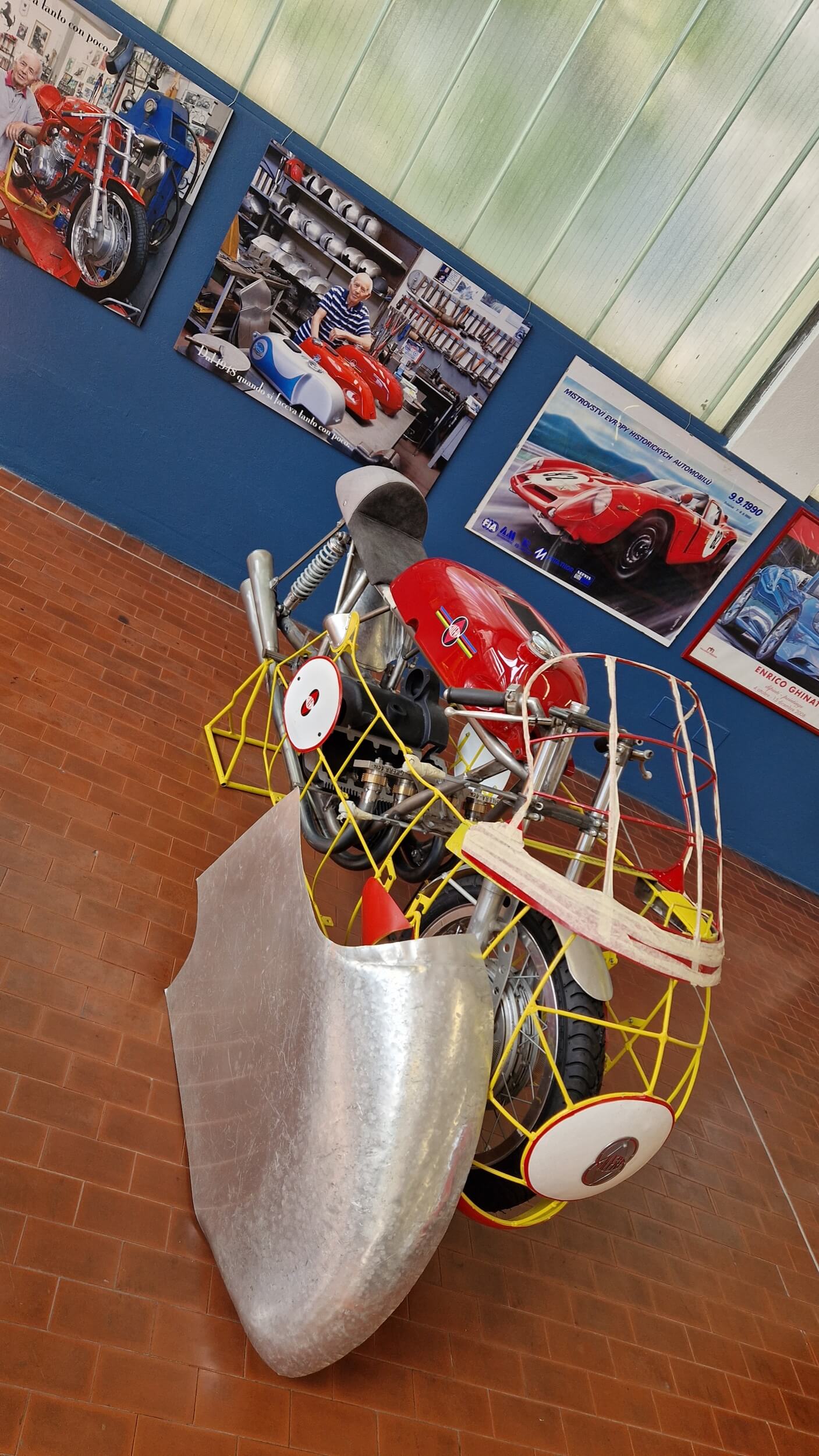
Forming metal sheet Stanguellini. Photo RdR.
Unfortunately, the canopy and the bonnet cannot be opened: Due to the extremely thin and aged aluminium, the risk of cracking is just too great. Amazing to think that this car (and 'NIBBIO' &
'NIBBIO 2' too) are completely hand-beaten from flat sheets of aluminium, what craftsmanship! In the afternoon I rode the 20 km on my motorcycle to Maranello for the 'Museo Ferrari'. The contrast couldn’t be greater, such crowds and total commercial madness! The whole world seems to be visiting! But of course, there are some very nice cars on show...
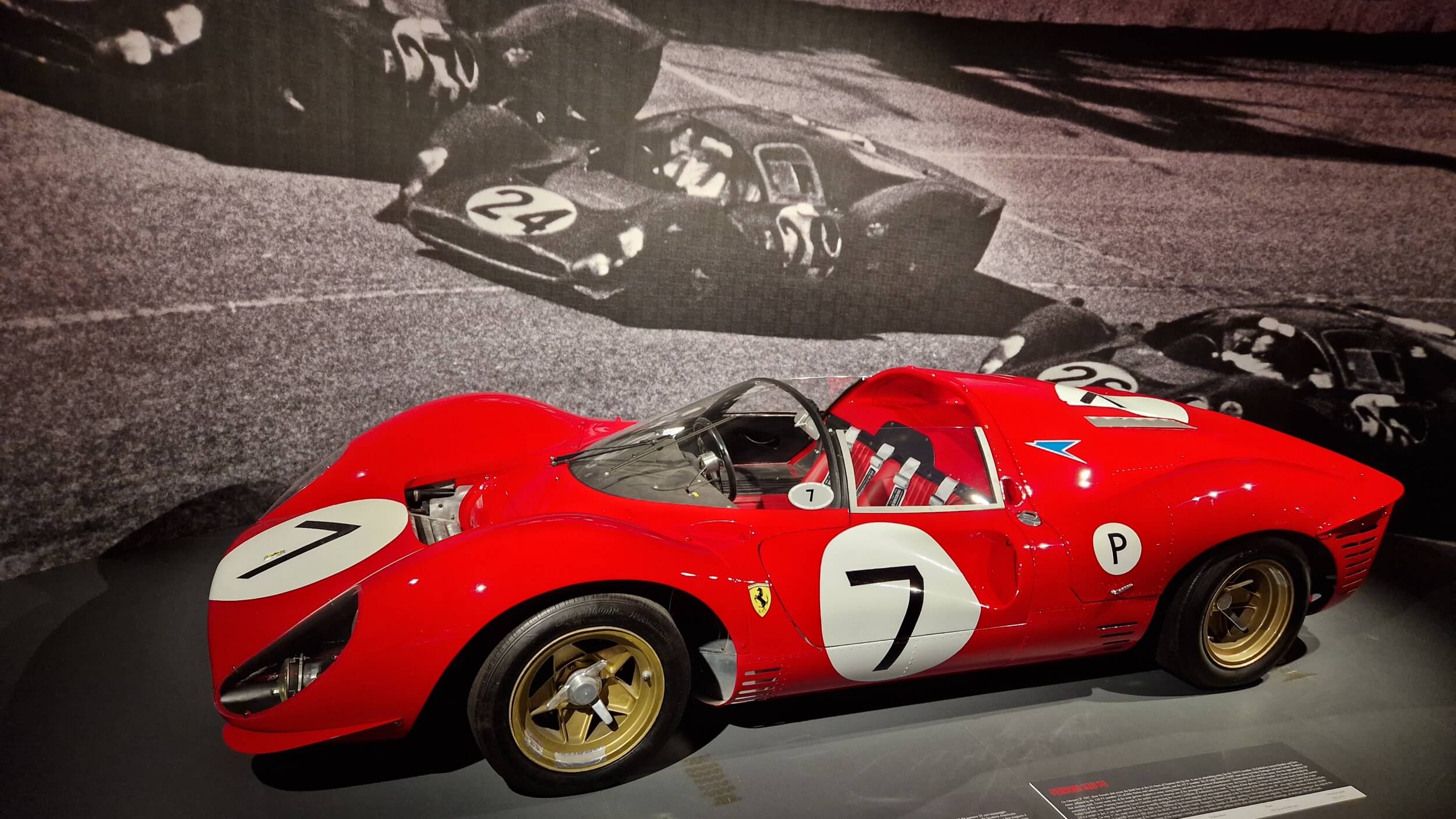
Museo Ferrari, Maranello. Ferrari Tipo 330 P4. Photo RdR.
Next stop was Mantua. At half past 11 I had an appointment at 'Museo Tazio Nuvolari'. I parked my fully packed motorcycle in front of a coffee bar around the corner, trusting that the barista would keep an eye on it. I was received by an official from the Municipality, who is allowed to interrupt his work to open the museum when some crazy person wants to come in and have a look. Again, I was alone in the former church. Tazio Nuvolari is arguably the greatest driver of all time, both in cars and on motorbikes. He drove Alfa Romeo racers for 'Scuderia Ferrari': Enzo owes him a thing or two! This Museo was the other highlight of my trip.
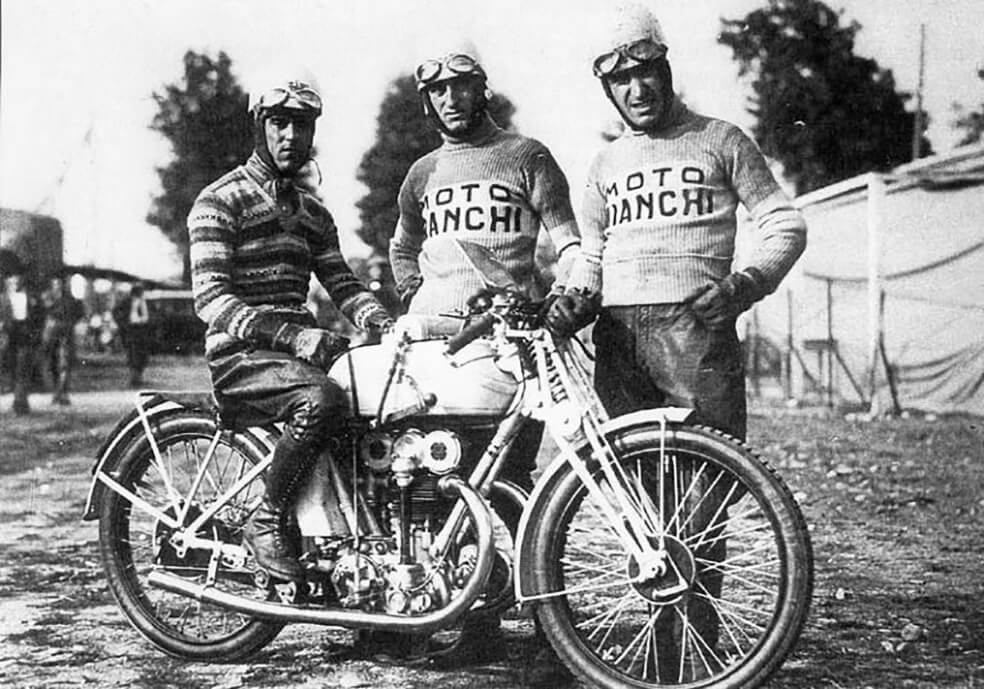
Tazio Nuvolari on his Moto Bianchi.
From Mantua my journey continued to Austria. The SS12 is a pleasant, swinging road and it also made good progress. The plan to drive to Sölden across the Timmelsjoch pass falls through. The pass was still full of snow. The goal was the 'TOP Mountain Motorcycle Museum'. I would just have to ride around it: More km's, but that's no punishment. I now had to ride further north, via SS38 and SS40 to finally arrive, in a southerly direction through the Oetztal, in Sölden. Nice ride, seen some snow! Because I wasn’t sure how cold it was going to be, I had made a reservation beforehand at a guesthouse: Good plan! There I met a German solo rider. At breakfast we discussed each other's plans for the day. From Sölden it is a short distance to the museum. However, I first arrived at a road closure: Some boulders and a tree appeared to have come down, road workers were busy clearing the road while their colleagues checked the rock face for loose rocks. In the meantime, a Dutch motorcyclist had parked next to me. He’s from Zwolle, had been on the road for just 3 days and, like me, didn't know the Timmelsjoch pass was still closed: He is on his way to Kazakhstan! He had never heard of the museum. We decided to go and have a look together: Beautiful collection of hundreds of motorcycles (including at least 11 Guzzi's) that have been made available by collectors from all over the world after the museum, including all motorcycles, burned to the ground about three years ago. I said goodbye to my 'Kazakhstani' friend, and he leaves for the same kind of detour that I had to make, only in the other direction.
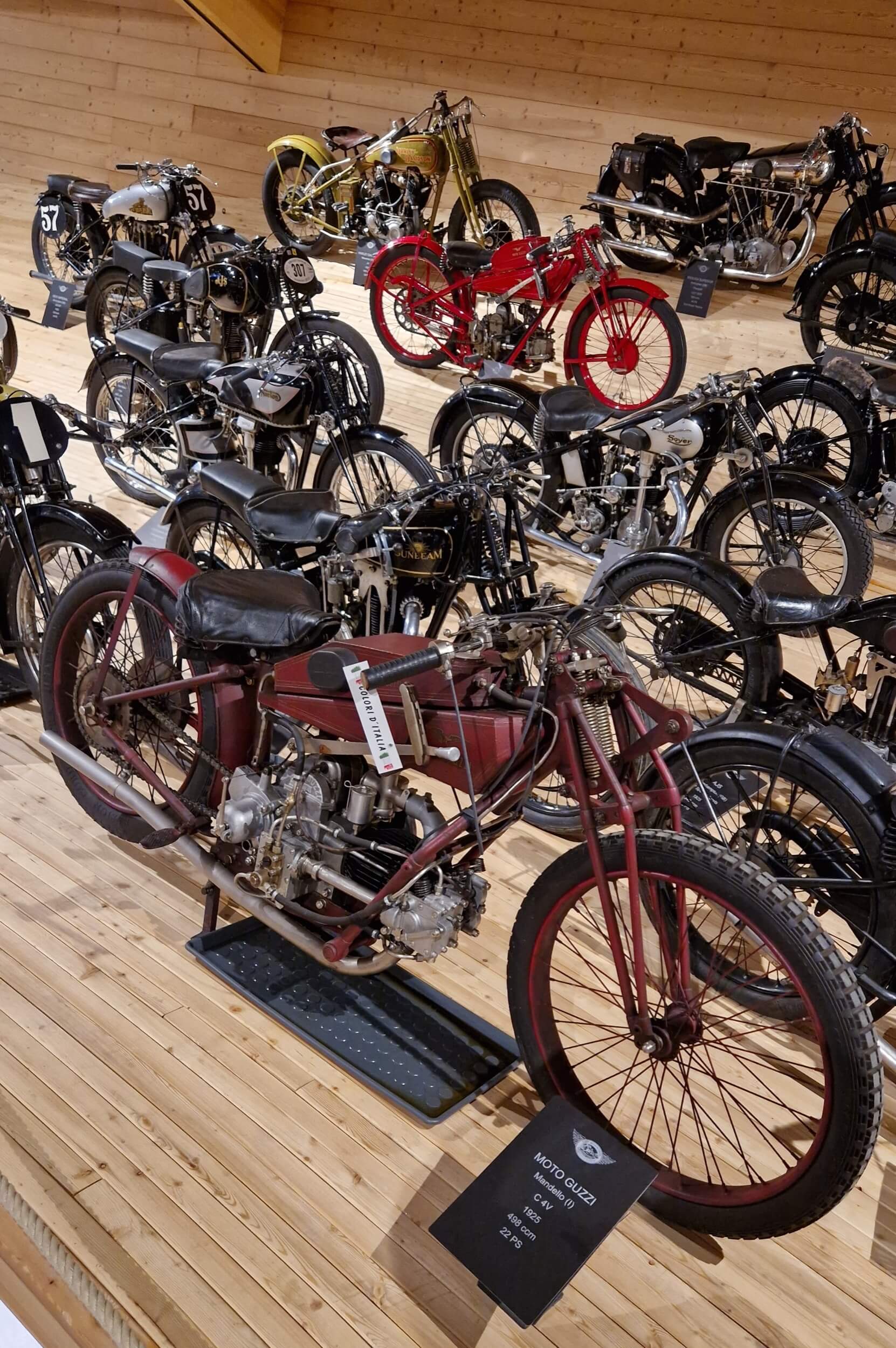
TOP Mountain Motorcycle Museum, Hochgurgl. Photo RdR.
By now it was clear that southern Germany had become a disaster area due to severe floodings. At breakfast, my German motorcycle friend advised me on how to navigate through the misery. I skipped 3 visits that I had planned in southern Germany from my plan. Because I didn't feel like ‘disaster tourism’, I decided to drive home in two stages: To Heidelberg on B-roads and the next day home by 'Autobahn 61'. I was on the road for 3 weeks and I really enjoyed solo riding experience! Of course, it helped me that I had a plan and a goal. Either way, it surely tastes like more.
Back home I continued looking for information, bought 2 books written by Giovanni Lurani and came into contact with his grandson, who is now the caretaker of 'NIBBIO', the first of the record cars. This descendant lives in London, while the car still resides at the family estate in Italy. I hope it will be possible to view NIBBIO at some point.
In the following chapters, more about the specifications of the cars.
2 – La Necessità di Velocità: NIBBIO.
In the early years of the last century, when the car had yet to grow up, many speed records were set: This was considered proof of the degree of technical progress. In 1904, a huge Gobron-Brillié, with a 13.5-litre engine, drove faster than 100mph ('the century') for the first time. Later, that limit was broken by cars with 1.5-liter and 1.1-liter capacity. When a 750cc car with compressor broke the 100mph barrier, it was thought that the limit had been reached. However...
1934: On September 30 of this year, Lurani and Ulisse Guzzi (son of Carlo, 1911-1980) both took part in the hill climb 'Lecco-Maggio' (560 meters of elevation over 12 km). During the festivities afterwards (Lurani won his class) they talk for the first time about developing a speed record car. Lurani already walked around with this idea during his studies in 1926.
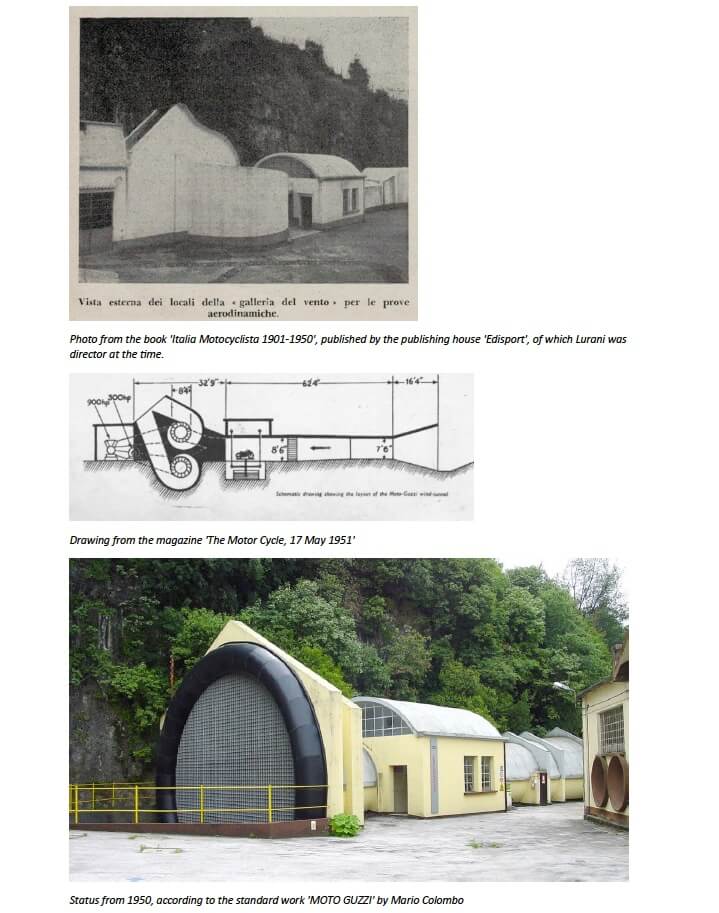
1935: Giovanni Lurani and Ulisse Guzzi set the development of the record car in motion. It will be the first(!) car with a steel space frame (of 'Colombo' aircraft quality), welded together by 'Quadrio Works' in Milan. The front axle is taken from a FIAT 508 Balilla, for the rear axle they initially thought off that of a Moto Guzzi Trialce, but for safety reasons, the wheels would have to be sprung. The chain drive remained, as did the ‘band brake’ as the only means to slow the car down! The body is hammered from aluminum sheet by 'Carrozzeria RIVA' in Merate and is tested in the Guzzi wind tunnel (according to Lurani in his book 'Racing around the World' (1954): "The first thing that was done at Mandello was to carry (literally) "Nibbio" into the wind tunnel of the Guzzi works, where with a wind of 170 km/h it was soon evident that the streamlined shape was good, but that the air intake to the engine had to be considerably modified and fitted with appropriate deflectors").
This raises some questions, Moto Guzzi/Piaggio speak, as far as the wind tunnel is concerned, only about the period 1950-1954, whether the wind tunnel would have already been there in 1935 remains uncertain. Immediately after World War II, it was decided in a Moto Guzzi board meeting to suspend all investments in buildings and machinery for the time being, with only one exception: On the intercession of Carlo Guzzi, investments in the wind tunnel are spared. That wind tunnel may have looked like the attached ‘black and white’ photo at the time. The 'wind' is generated with two ‘paddle-blades’ (see drawing), powered by a 900 hp, 12-cylinder FIAT aircraft engine (which was already available since 1927!). In 1950 the version of the color photo would have been officially put into use, only the building with the rounded roof survived the renovation, a 310 hp electric motor now drives a propeller.
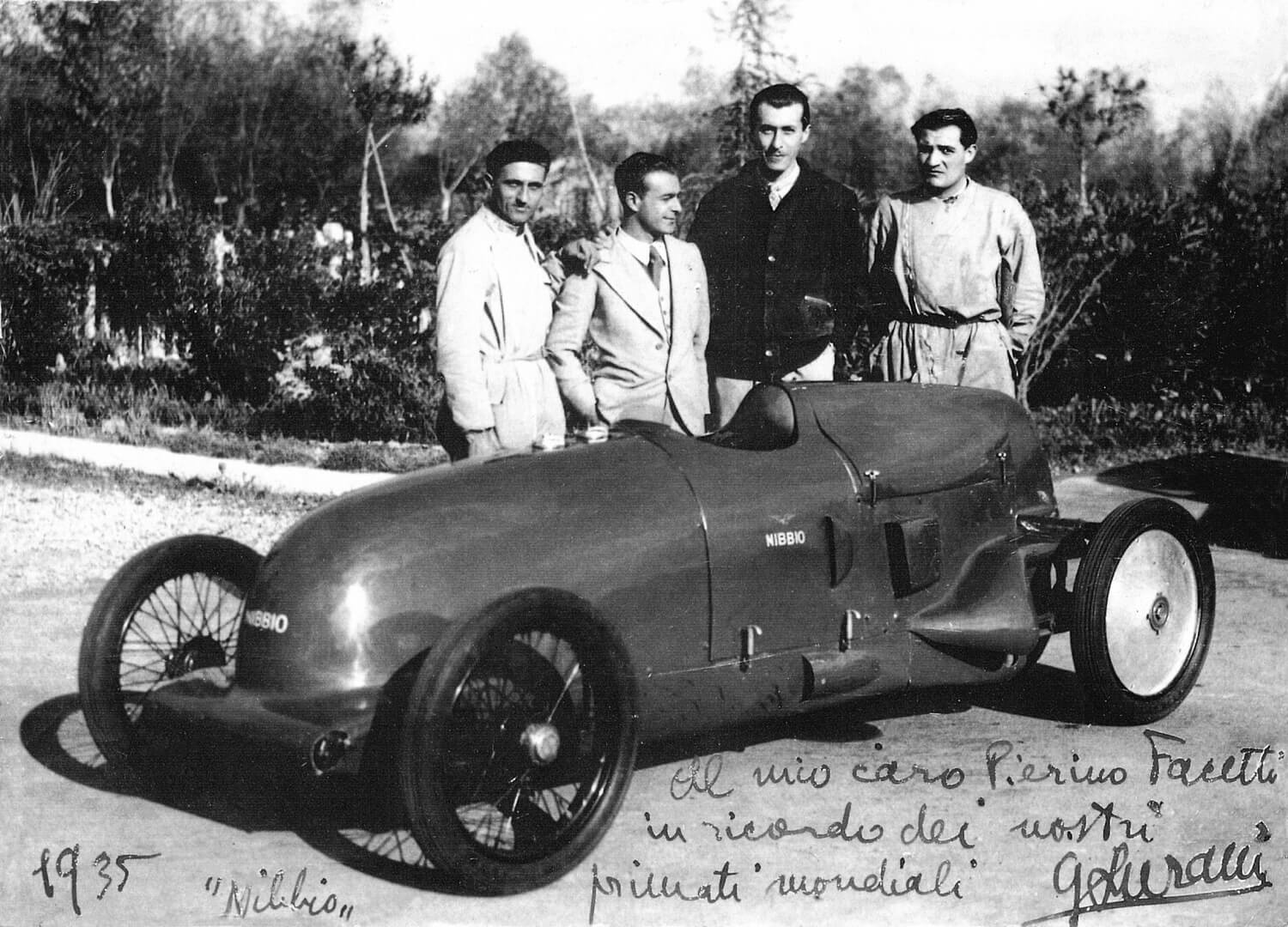
The first Nibbio. The photo caption – 1935,"Nibbio" – reads: 'To my dear Pierino Facetti in memory of our world records', signed: G. Lurani (editor’s note).
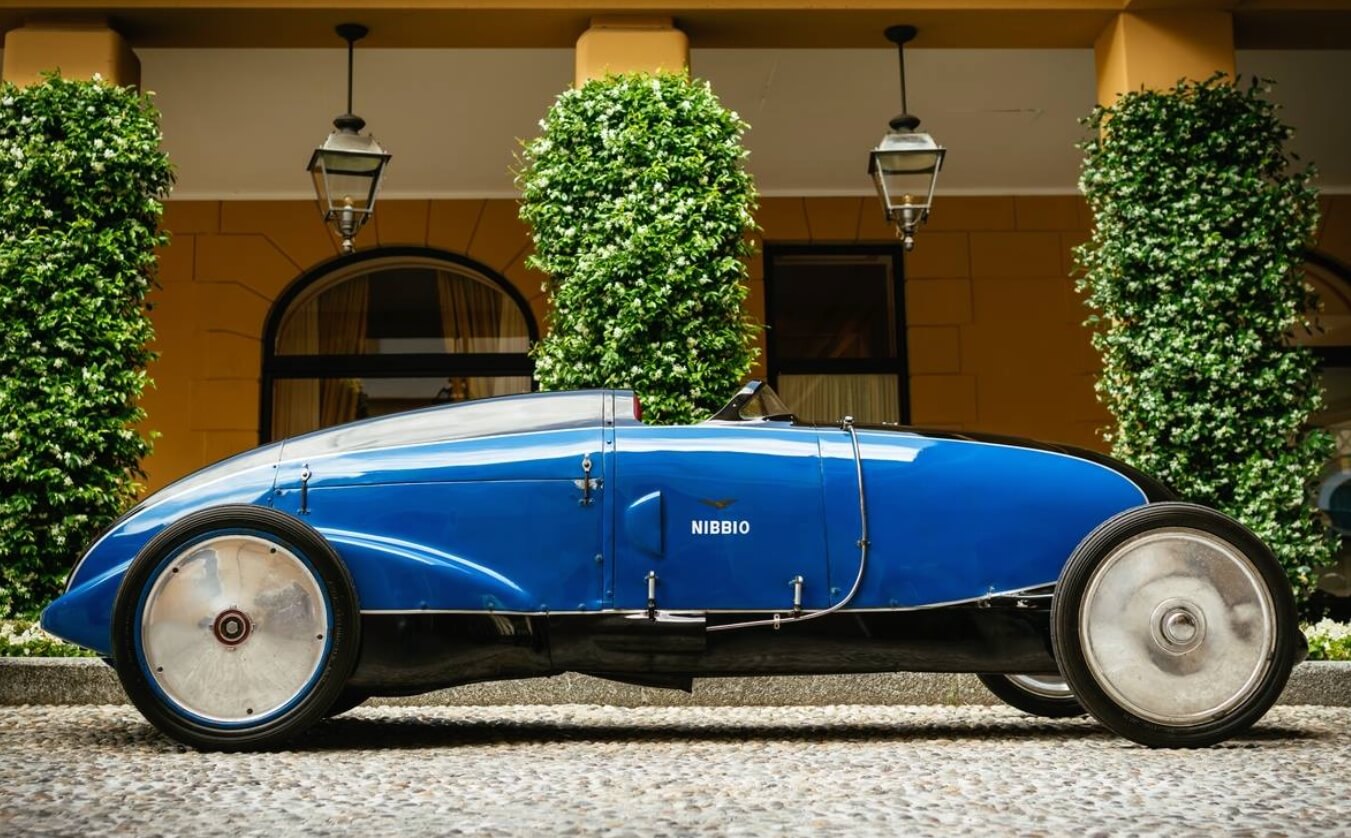
The engine of NIBBIO ('red kite', named after a bird of prey, that is common in the region) will be the 493.6 cc Moto Guzzi 120 degrees V2 that delivers 47 hp. Ulisse Guzzi makes the first test drive from Mandello to Varenna and already reaches speeds of over 100 km/h. During tests at the Monza circuit, motorcycle racer Amilcar Moretti drives a lap at an average of 148 km/h. In a later test on the same circuit, Ulisse Guzzi achieves an average of 157 km/h. On October 16, 1935, NIBBIO is ready to break records. On the highway (now A76) between Altopascio and Lucca, 4 records are broken in International Class I: Standing and flying km and mile. NIBBIO is the very first 500cc car to break the 100 mph (162 km/h) barrier! Driver: Giovanni Lurani.
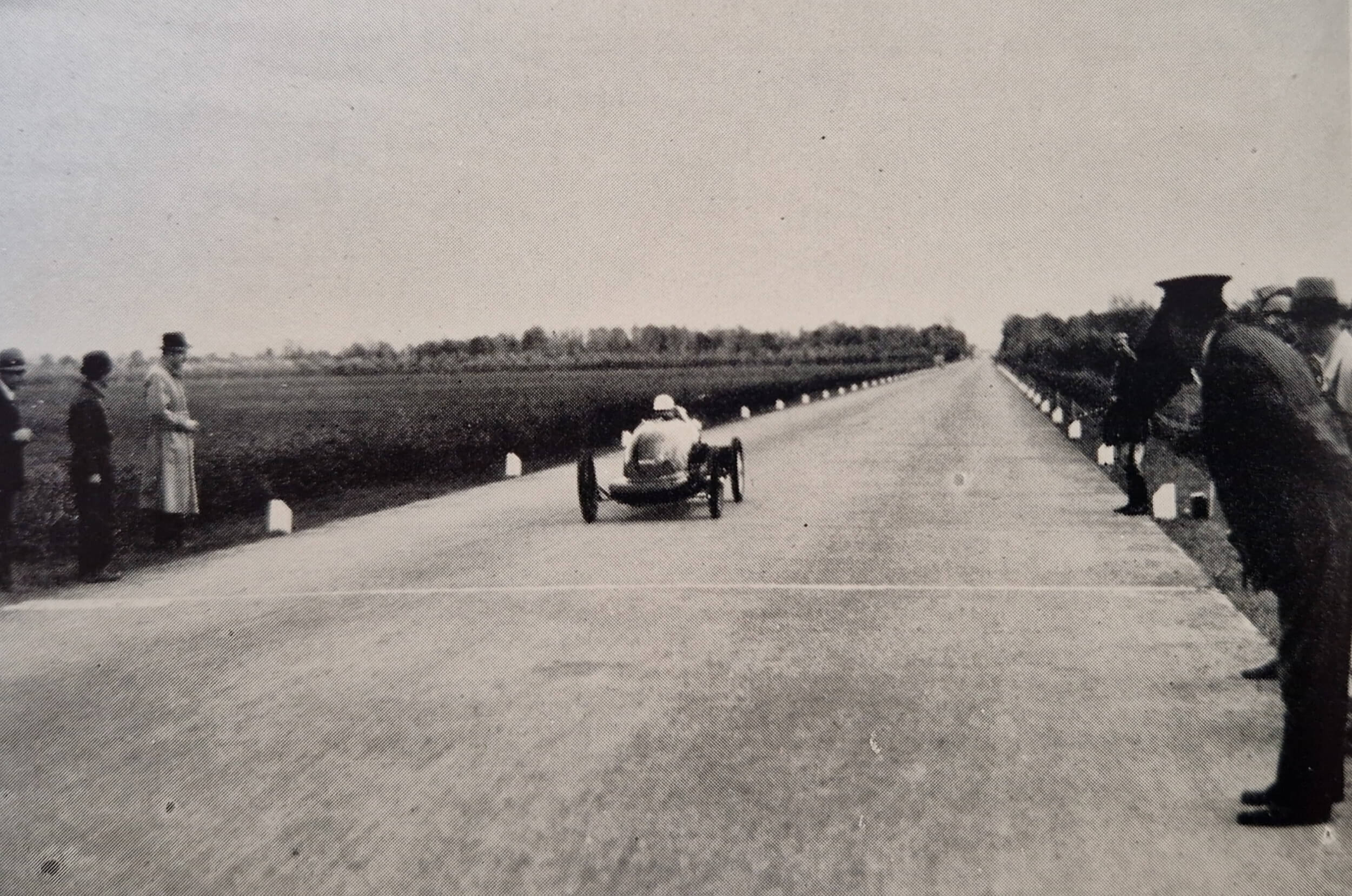
NIBBIO breaking records on the Autostrada Firenze - Mare (Photo from Lurani’s book - Racing around the World).
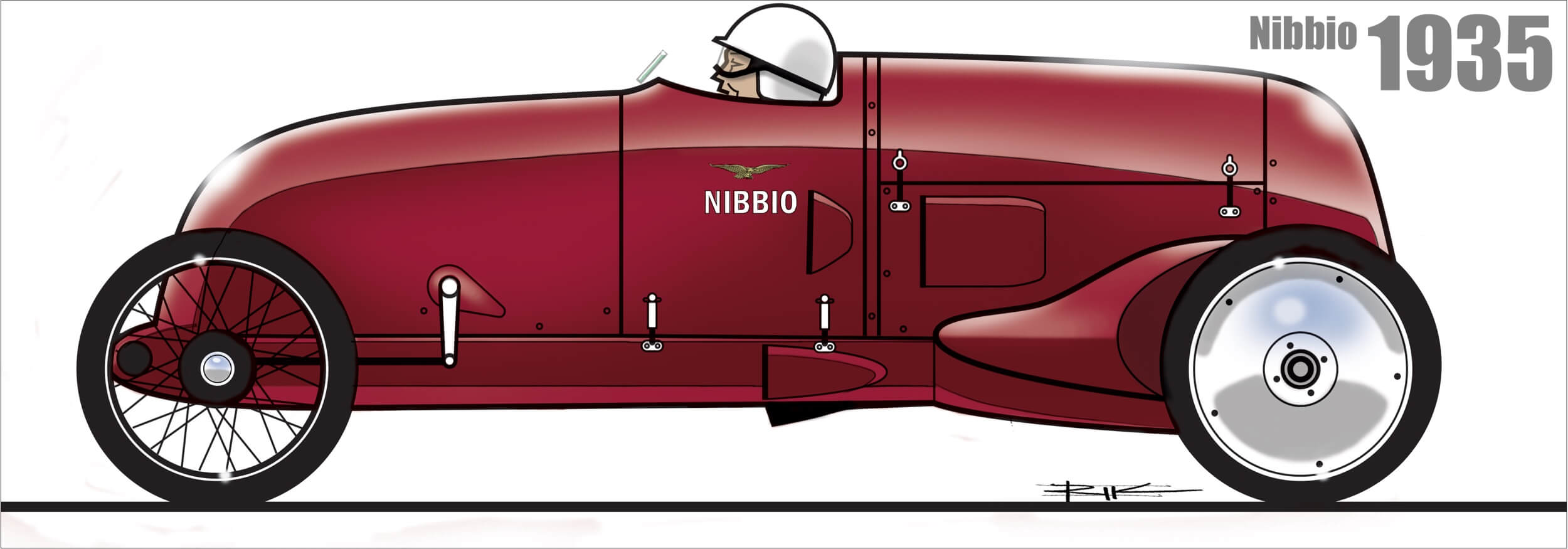
Drawing: Rik de Reuver.
1939: During the record runs of '35, the drivers experienced that the rear of the car became quite restless at high speed. Work is being done on the aerodynamics of the rear end. There will also be a more streamlined windscreen for the driver, made by 'Touring Superleggera' in Milan, the only company that could do this at the time. The front wheels are now also fitted with aluminum discs. On the A9 Dessau-Bitterfeld (Germany), between exits 183 and 184, 8 new records are broken, the maximum speed rises to 172 km/h. Driver: Giovanni Lurani.
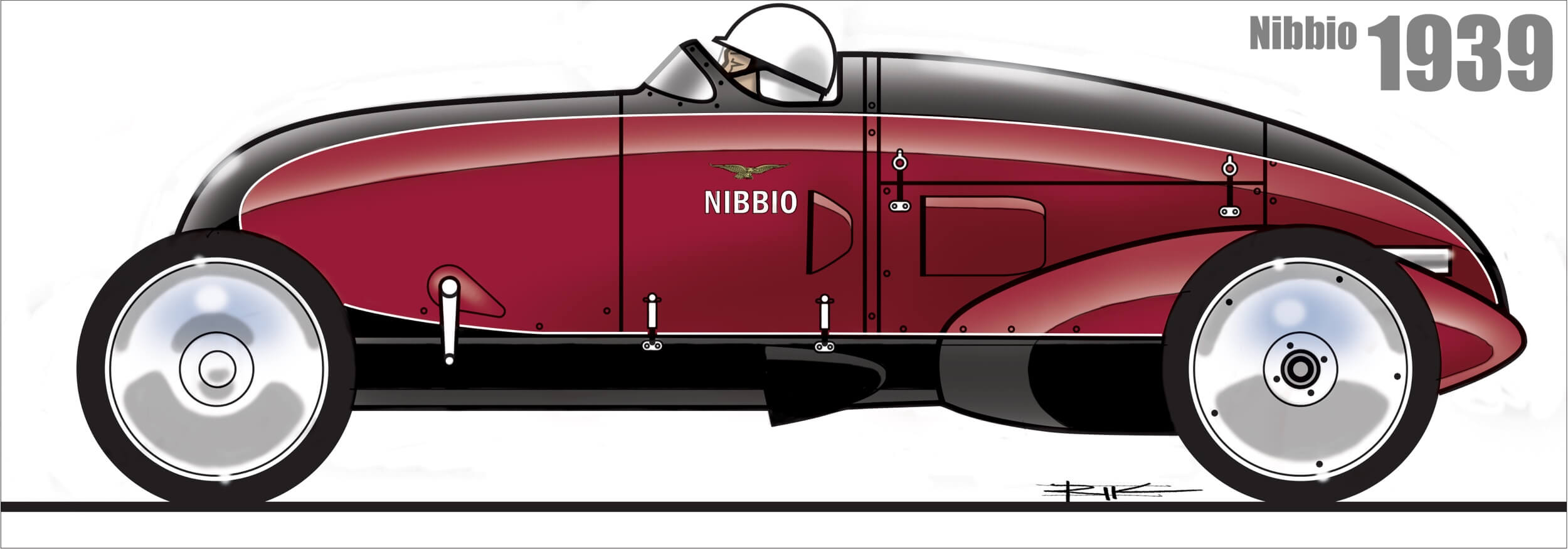
Drawing: Rik de Reuver.
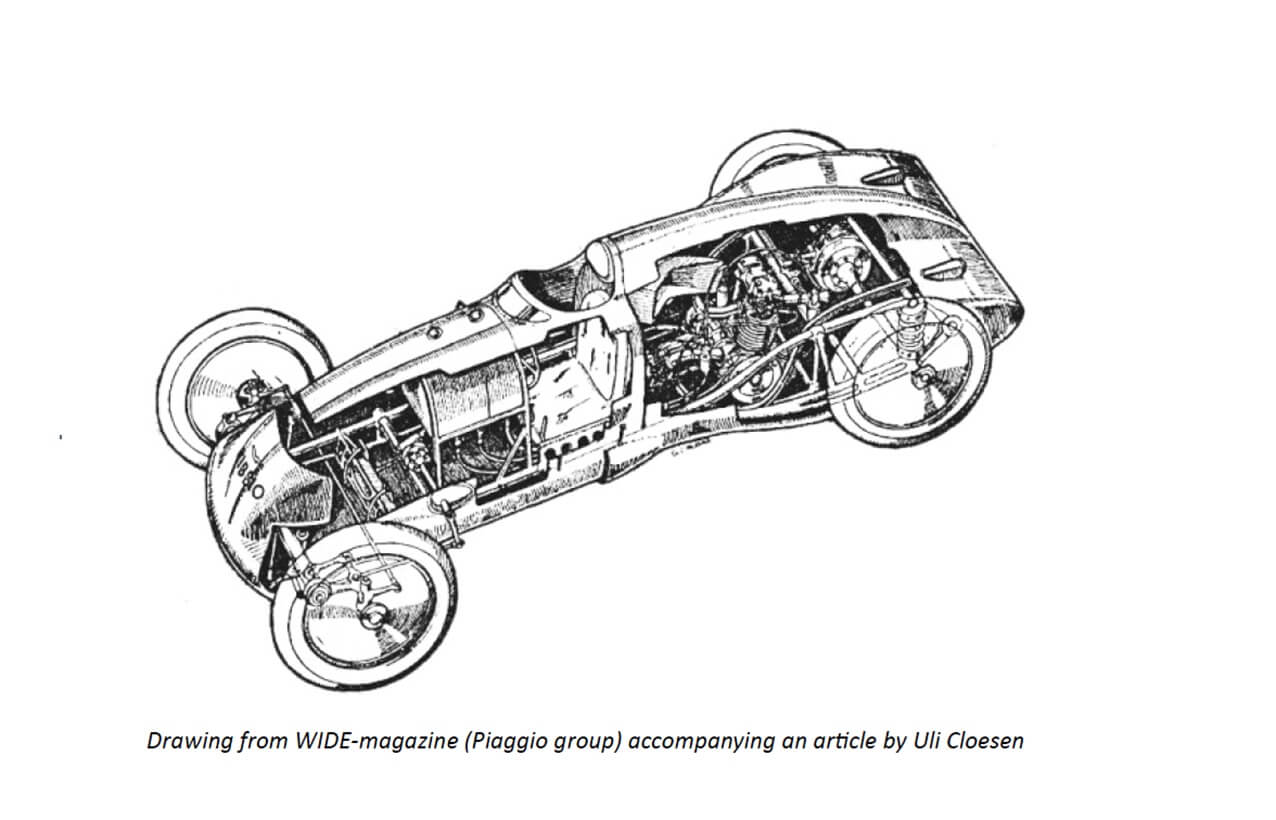
https://wide.piaggiogroup.com/en/articles/garage/moto-guzzi-with-a-difference/index.html
1947: After the war, NIBBIO comes into action again. Once again, further aerodynamic adjustments take place, this time at the front: To prevent 'lift' of the front axle, the car is fitted with a pronounced front spoiler. There is also a change in the drivetrain. Guzzi's famous horizontal 1-cylinder 'Gerolamo' engine finds its destination in NIBBIO. That means: 246.8 cc capacity and a 'Cozette' compressor. The result is 43 hp (48 hp on Methanol). Records in class J (up to 350 cc) are now attacked. 6 new records are broken on the new highway (the current N377) near Jabbeke (Belgium). Once again, the 100mph was broken with an even smaller engine. Driver: Giovanni Lurani.
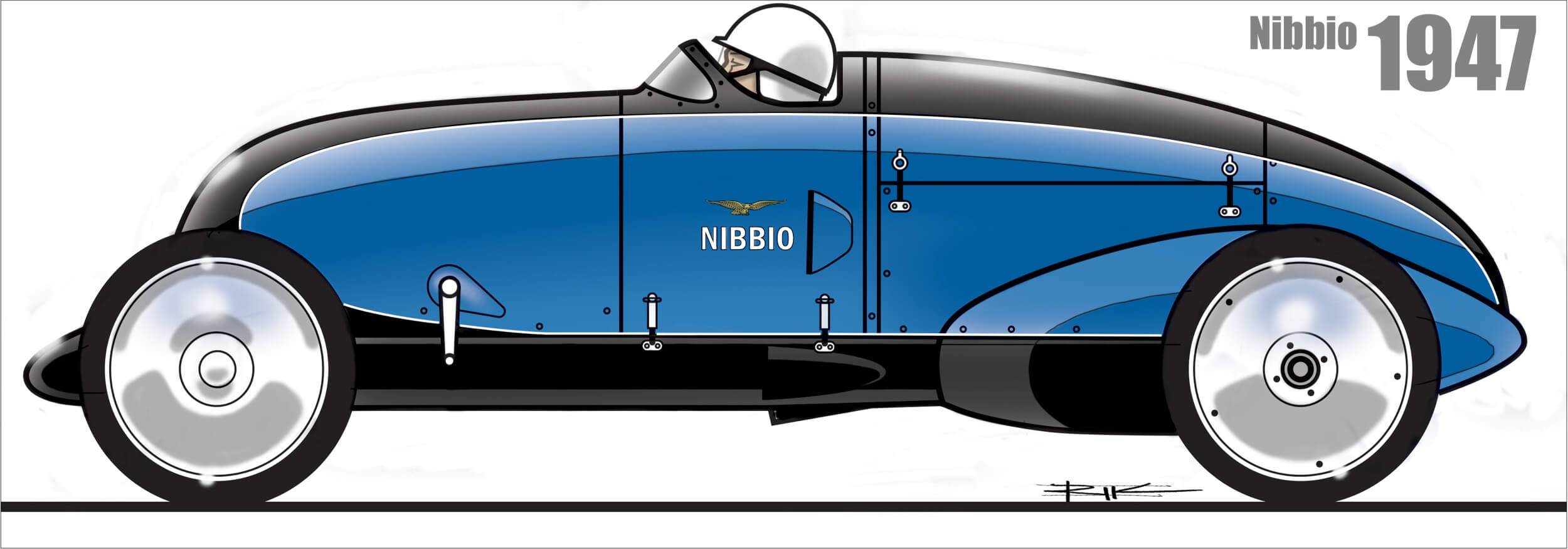
Drawing: Rik de Reuver.
2017: NIBBIO is still owned by the Lurani family to this day. Now, grandson Federico Göttsche Bebert takes care of the car. Externally, nothing has changed since 1947. However, the 'Gerolamo' engine was requisitioned by Moto Guzzi, in exchange Lurani got a 246.8 cc racing engine, made of magnesium, without numbers and without a compressor, with a power of about 27 hp. This engine is still in the car today.
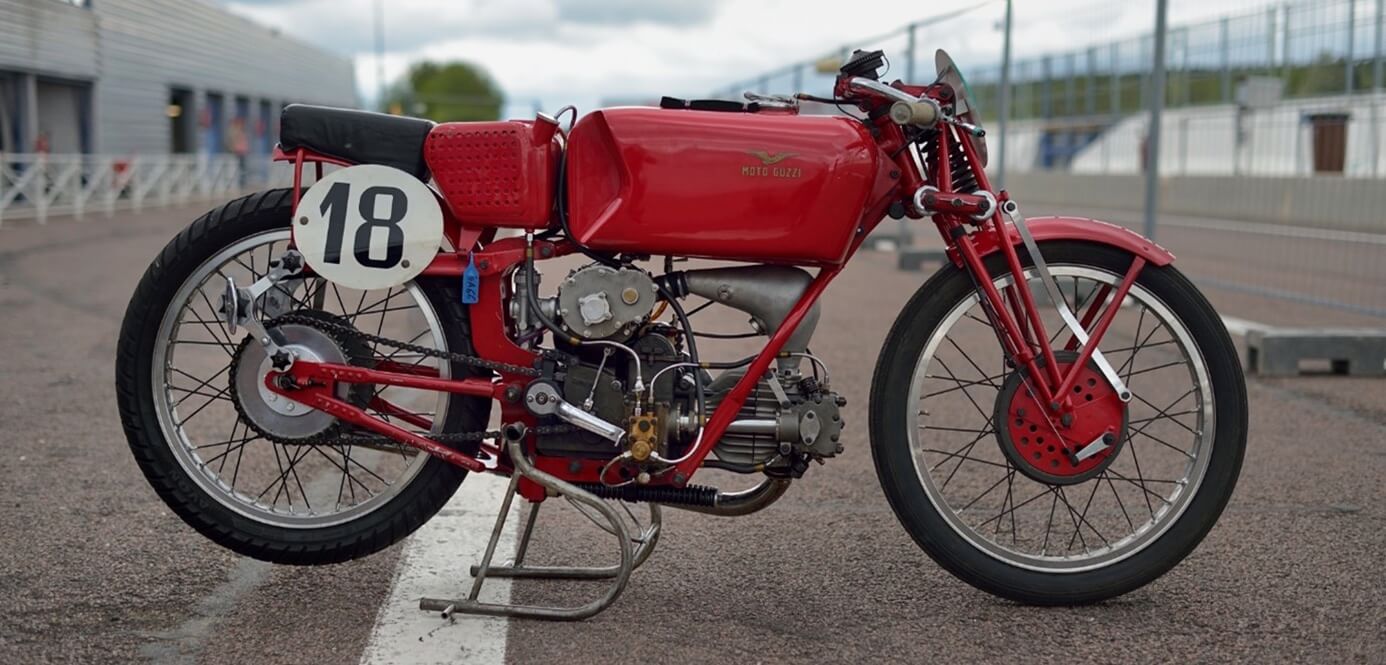
Moto Guzzi Compressore Gerolamo 1939, 250cc. Photo Christophe Bogula.
The latest surprising feat of NIBBIO is that, totally unexpected, it received the '2017 Coppa d'Oro' of the prestigious 'Concorso d'Eleganza Villa d'Este’, instead of one of the grand classic cars of the major car brands.
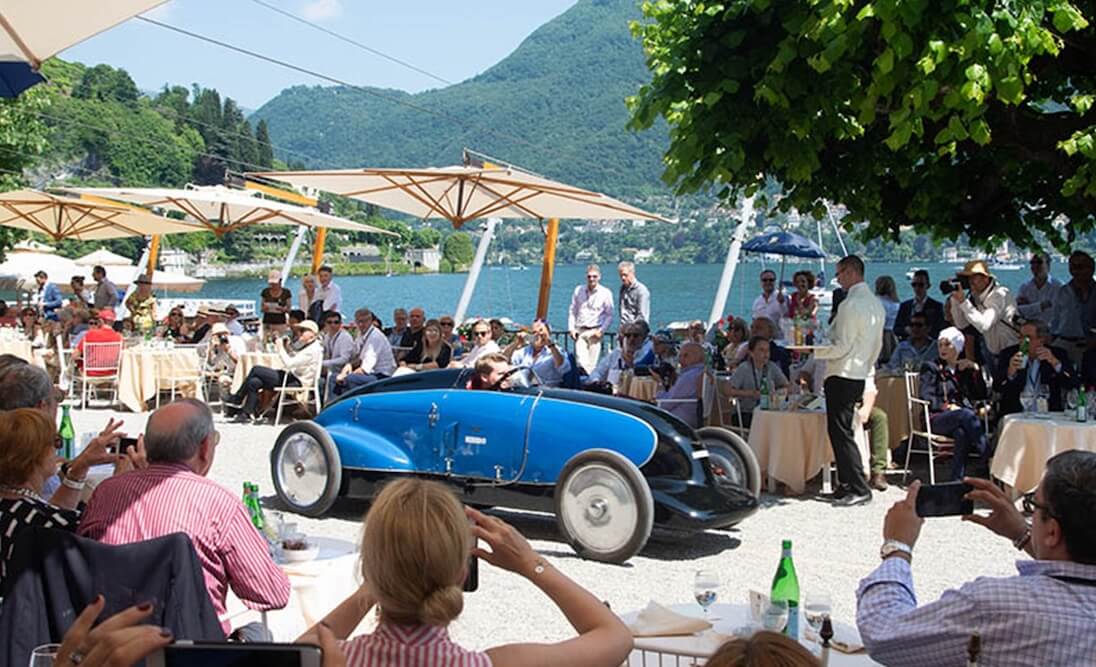
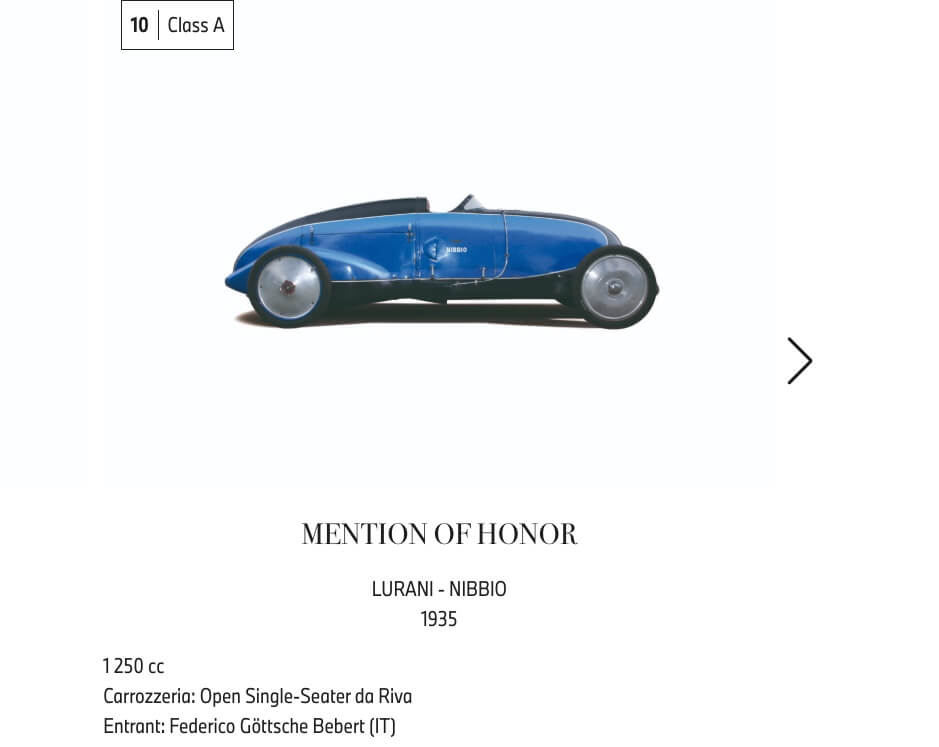
Left, NIBBIO awarded at 2017 Concorso d’Eleganza Villa d’Este. The Nibbio was presented in the competition by Lurani's grandson, Federico Göttsche Bebert (editor’s note).
Right, image source and info: https://concorsodeleganzavilladeste.com/blocks/home

Drawings: Rik de Reuver.
3 – La Necessità di Velocità: NIBBIO II.
1955: From 1954, Lurani worked on NIBBIO 2. This time the starting point was a 'Volpini' Formula 3 chassis. Carrozzeria 'GHIA' was commissioned to develop the body, and they put designer Giovanni Savonuzzi to work: Known for designs for i.e. Alfa Romeo and Ferrari. This resulted in a first, non-driving, mock-up that is now also shaped over the wheels and is equipped with 'American' wings. The driver is shielded from the elements. It was reportedly tested in the wind tunnel at the University of Applied Sciences in Turin.
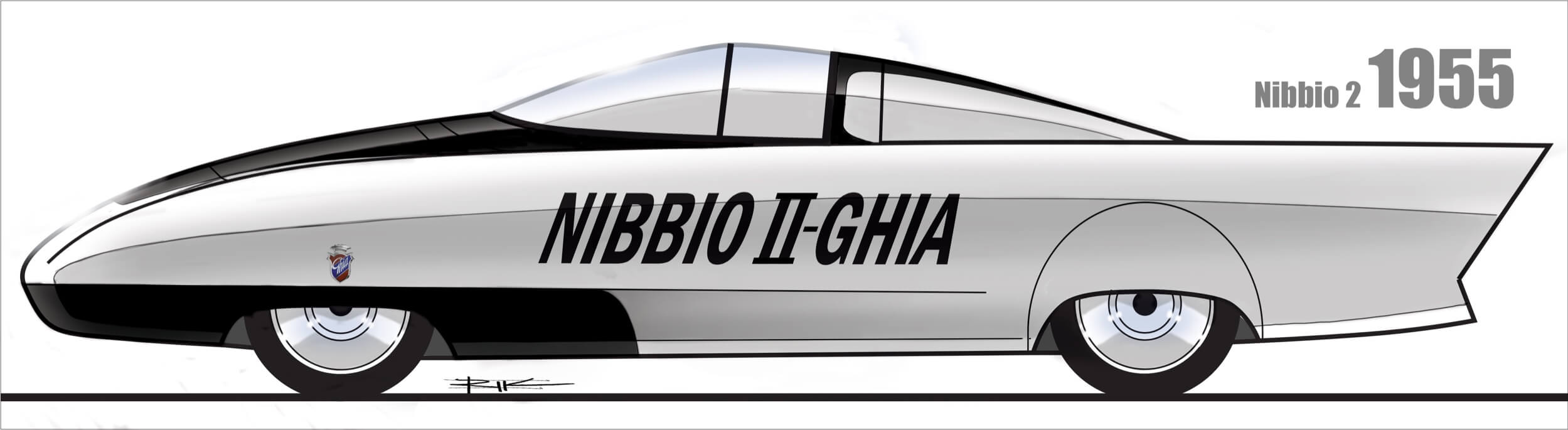
Drawing: Rik de Reuver.
1956: The first driving version of NIBBIO 2 is equipped with Guzzi's 349 cc, horizontal 1-cylinder with 2 overhead camshafts which delivers 37 hp. The gearbox features 5 gears. As with NIBBIO, the drive is done by means of a chain to the rear axle, there is no differential. The car weighs approx. 350 kg and reaches a maximum speed of more than 185 km/h. Guzzi also used the engine in the 350GP motorcycle with which world championships were won in '55 and '56. NIBBIO 2 set several new records in Class D (up to 350cc) in multiple sessions at Monza.
Drivers '56-'57: Giovanni Lurani, Piero Campanella, Angelo Poggio, Gianpaolo Volpini.
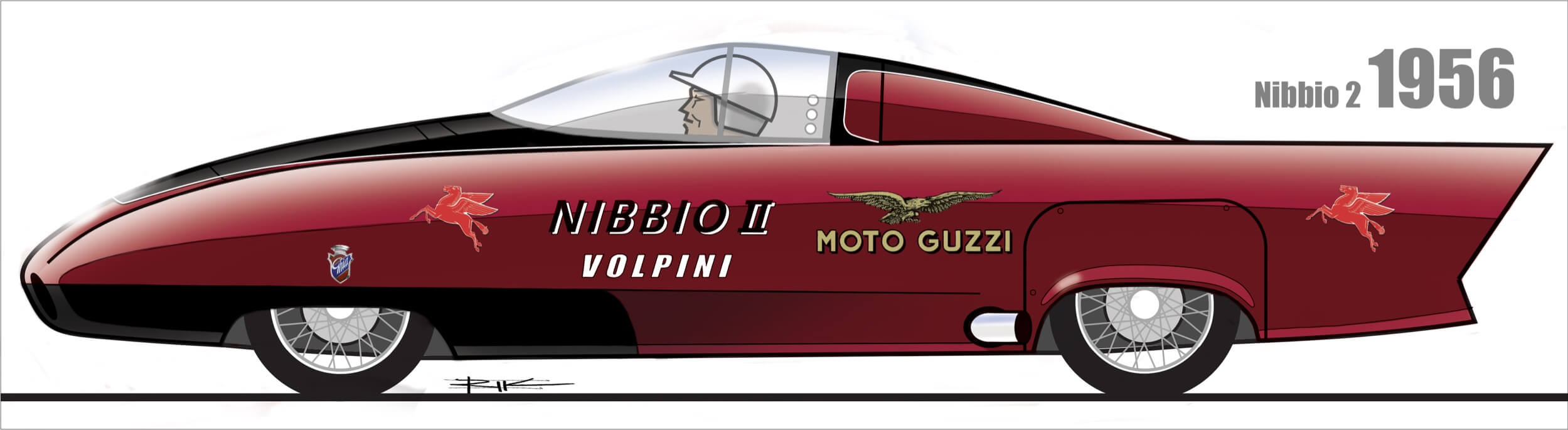
Drawing: Rik de Reuver.
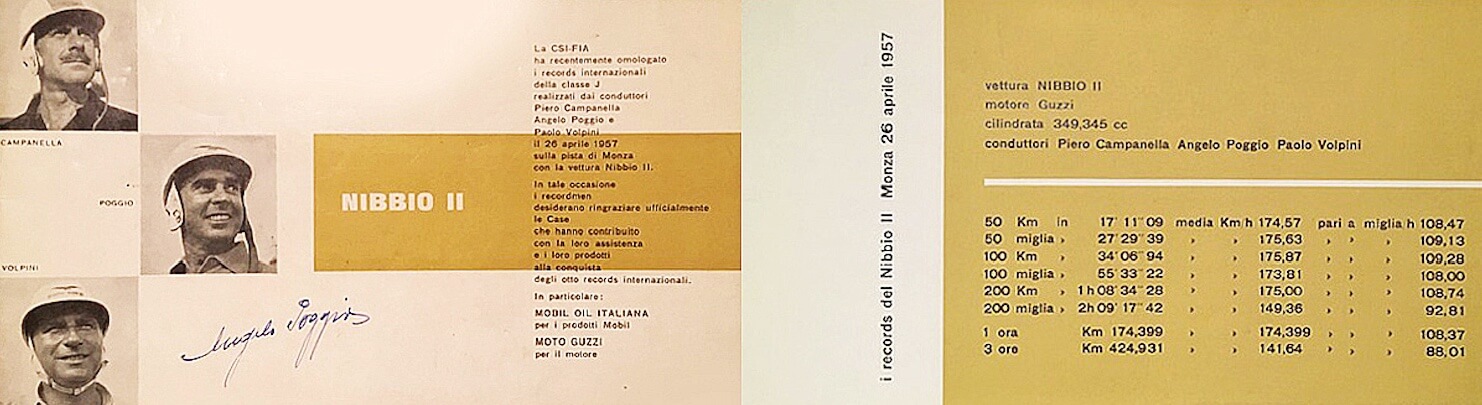
Scorecard.
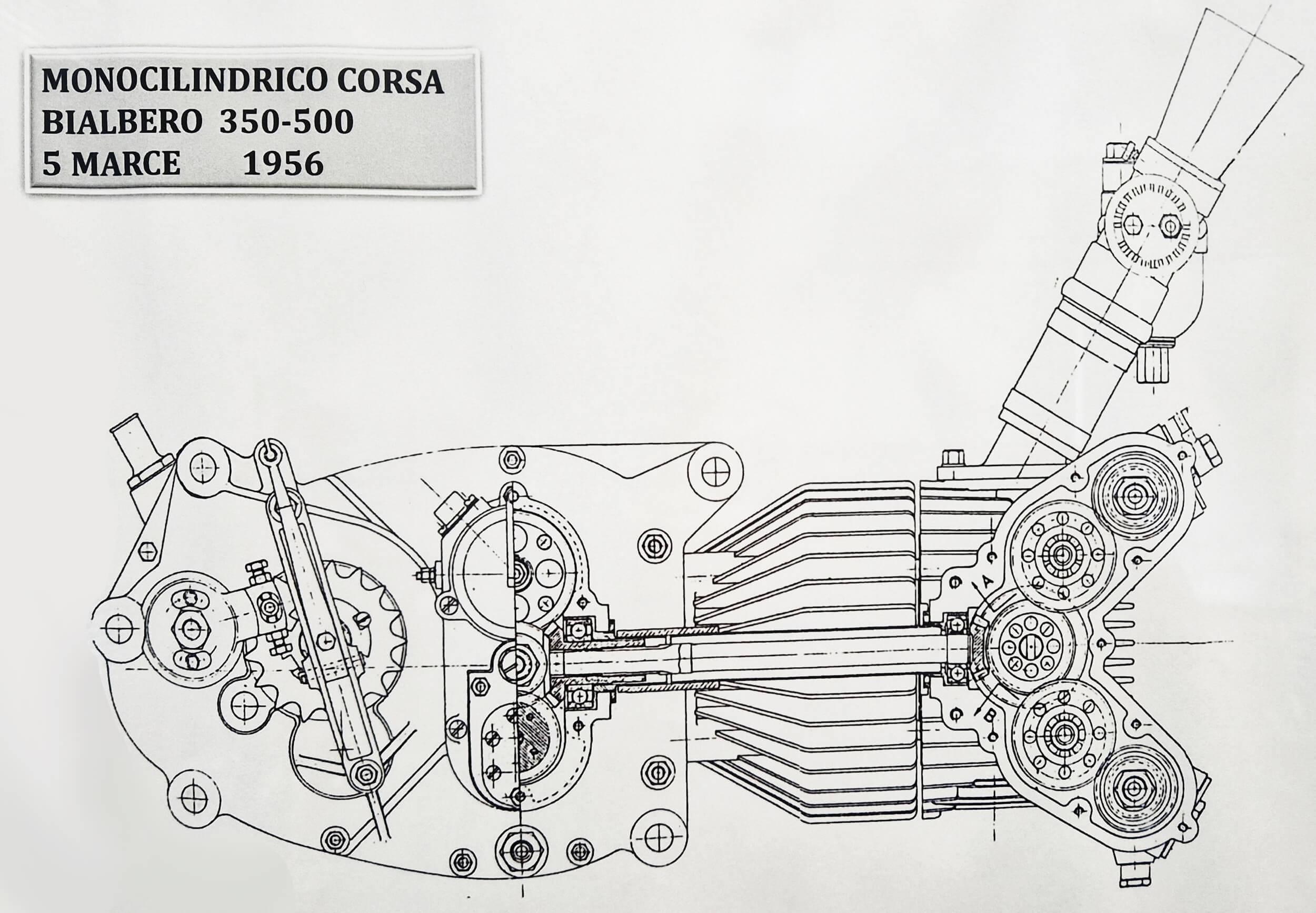
350cc Engine Block. Photo RdR.
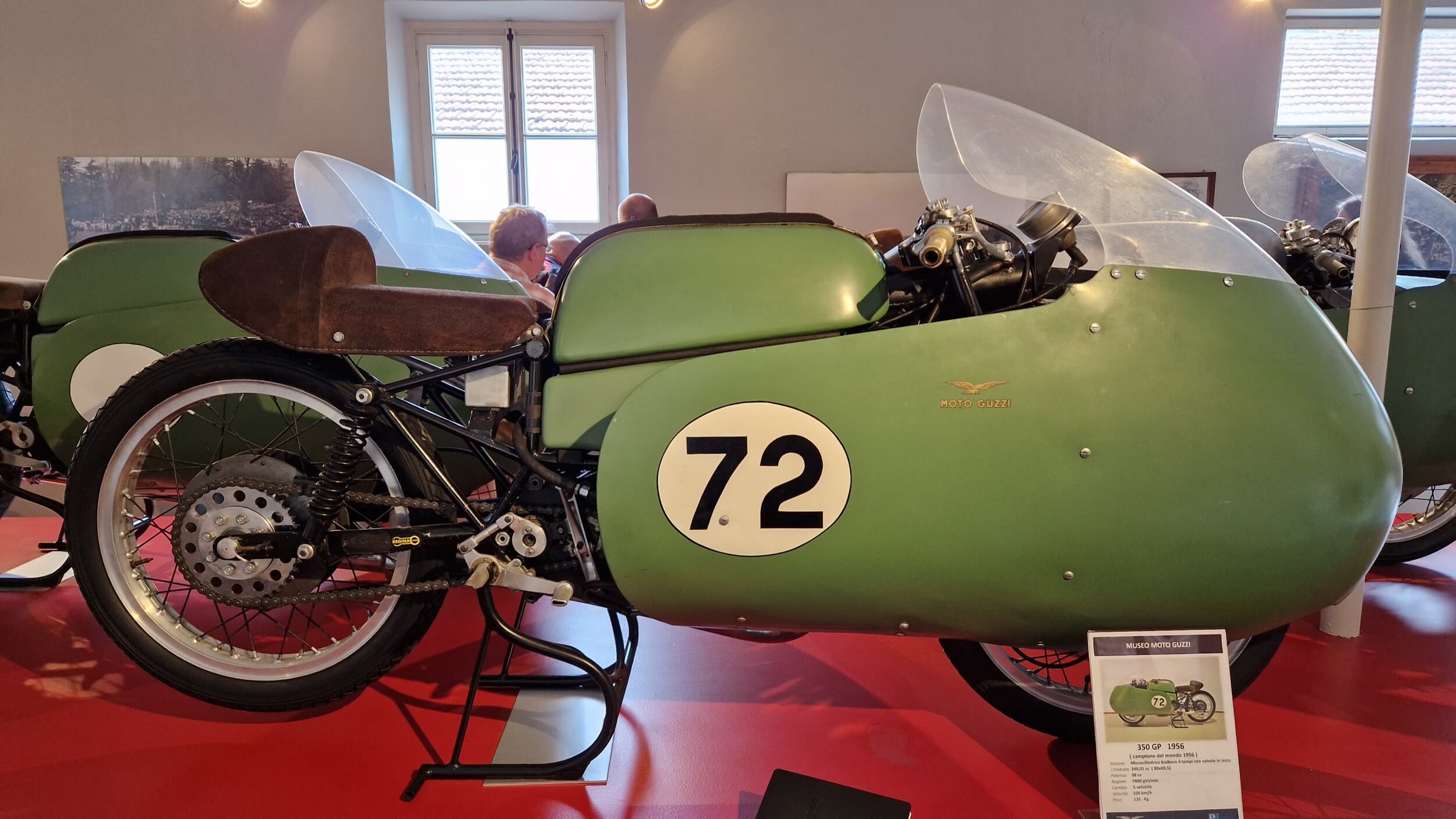
1956 World Championship bike shares engine with NIBBIO 2. Photo RdR.
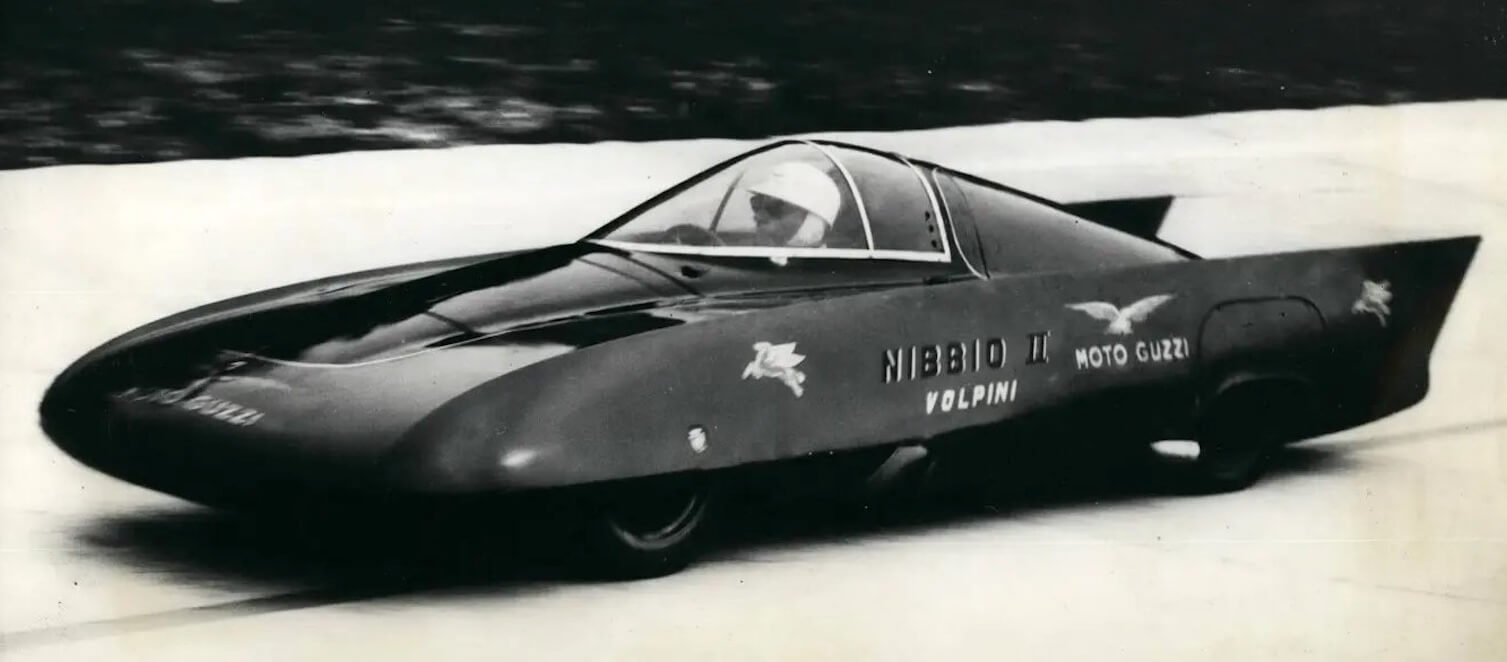
NIBBIO II, 1956. Driver Paolo Volpini.
1958: In this year, NIBBIO 2 also sets several records at Monza, thanks in part to the aerodynamic improvements to the body: The wings have been cut back considerably. The power of the engine now reaches 40 hp. The car is equipped with disc brakes at the front and rear.
Drivers: '58: Giovanni Lurani, Piero Campanella, Angelo Poggio, Gianpaolo Volpini.
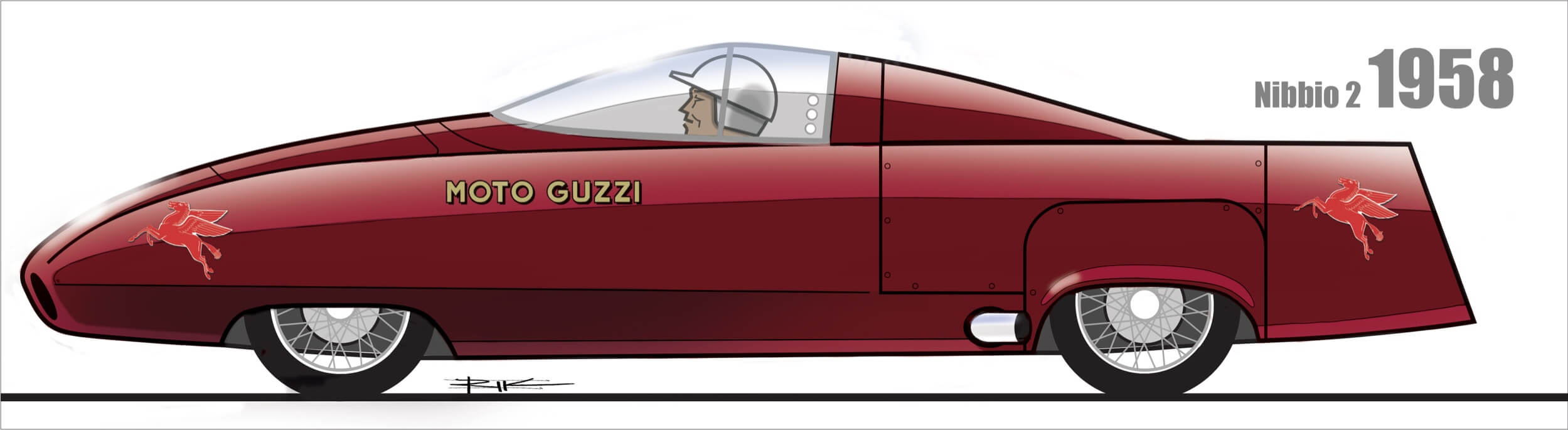
Drawing: Rik de Reuver.
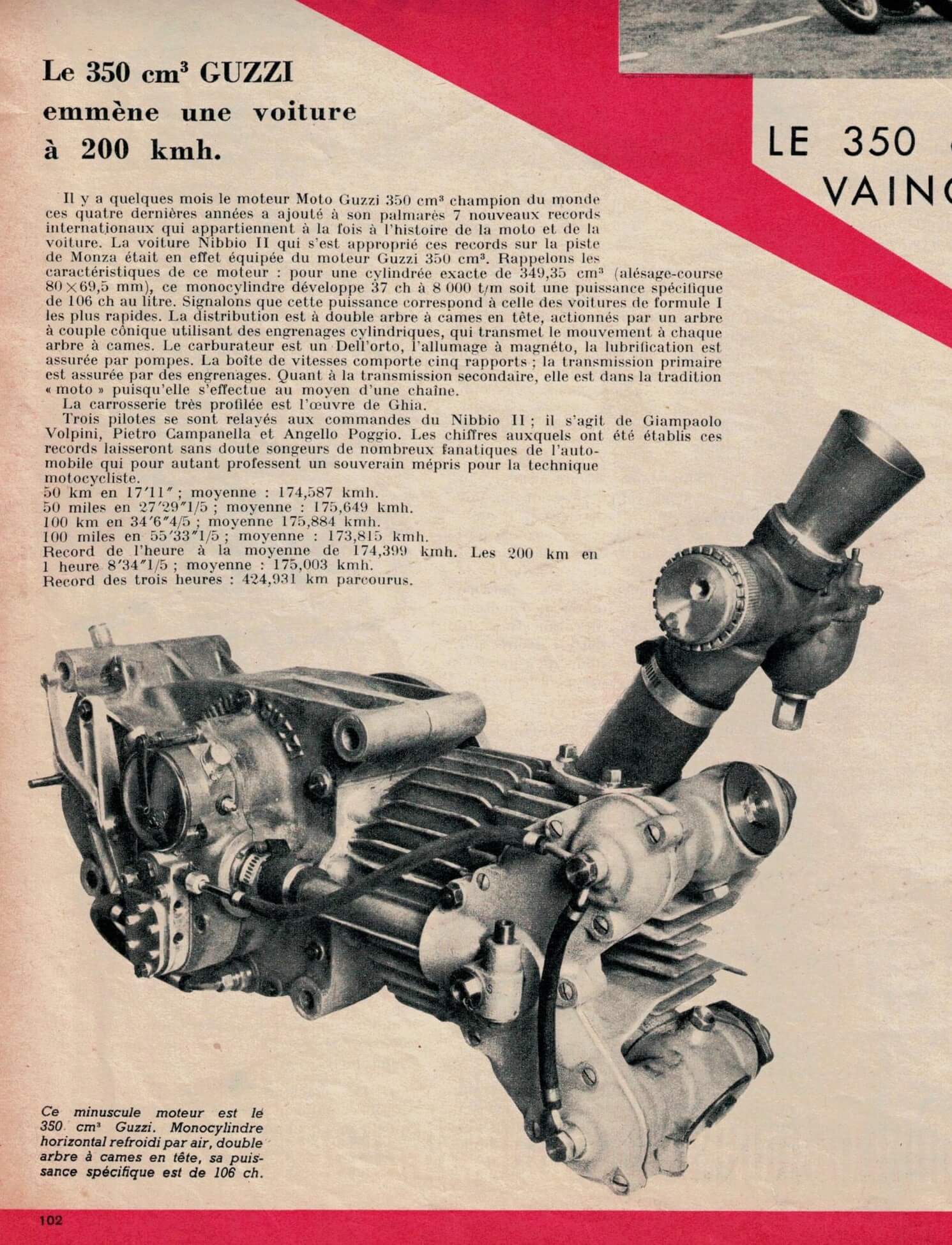
Advert for Dell'Orto carburettors, mentioning NIBBIO 2.
NIBBIO 2, 1958.
1959: Further technical and aerodynamic improvements should lead to even more records. The nose of the car has been made flatter and the cockpit has been given a much smoother and lower shape. At the rear, the wings are pushed down further and the underside is raised considerably. These changes were not carried out by 'GHIA' but by 'Stanguellini' and therefore probably form the prelude to further cooperation towards COLIBRI. In addition, this version of NIBBIO 2 is equipped with a different engine and Guzzi chooses the 246.8 cc, horizontal 1-cylinder (26 hp) to also set records in class K (up to 250 cc). This vehicle can be viewed in MAUTO, Turin.
Drivers: '59-'60: Giovanni Lurani, Piero Campanella, Angelo Poggio.
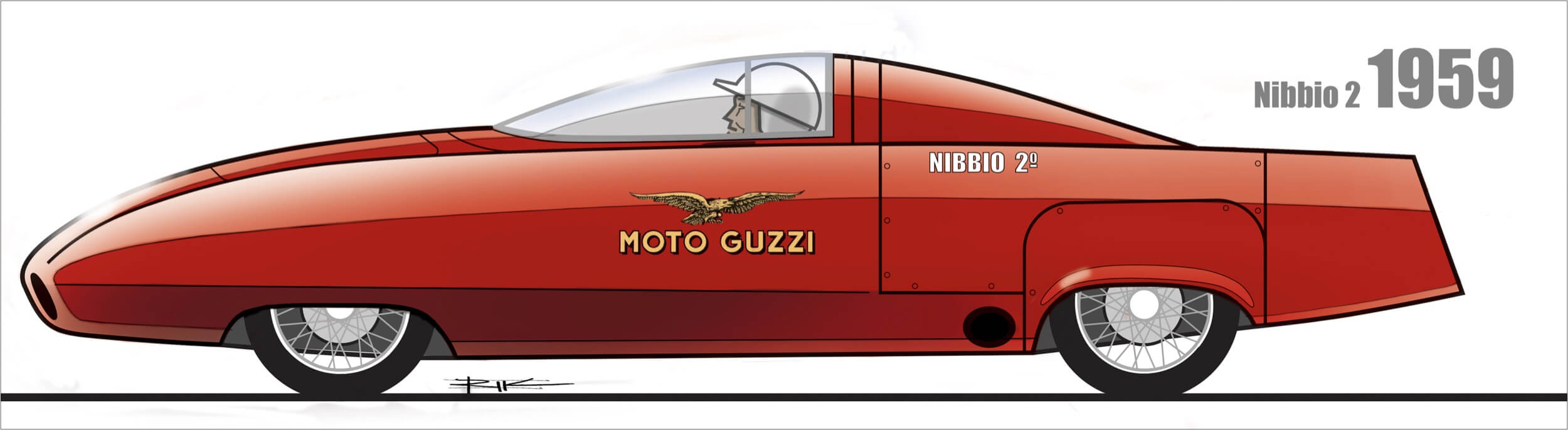
Drawing: Rik de Reuver.
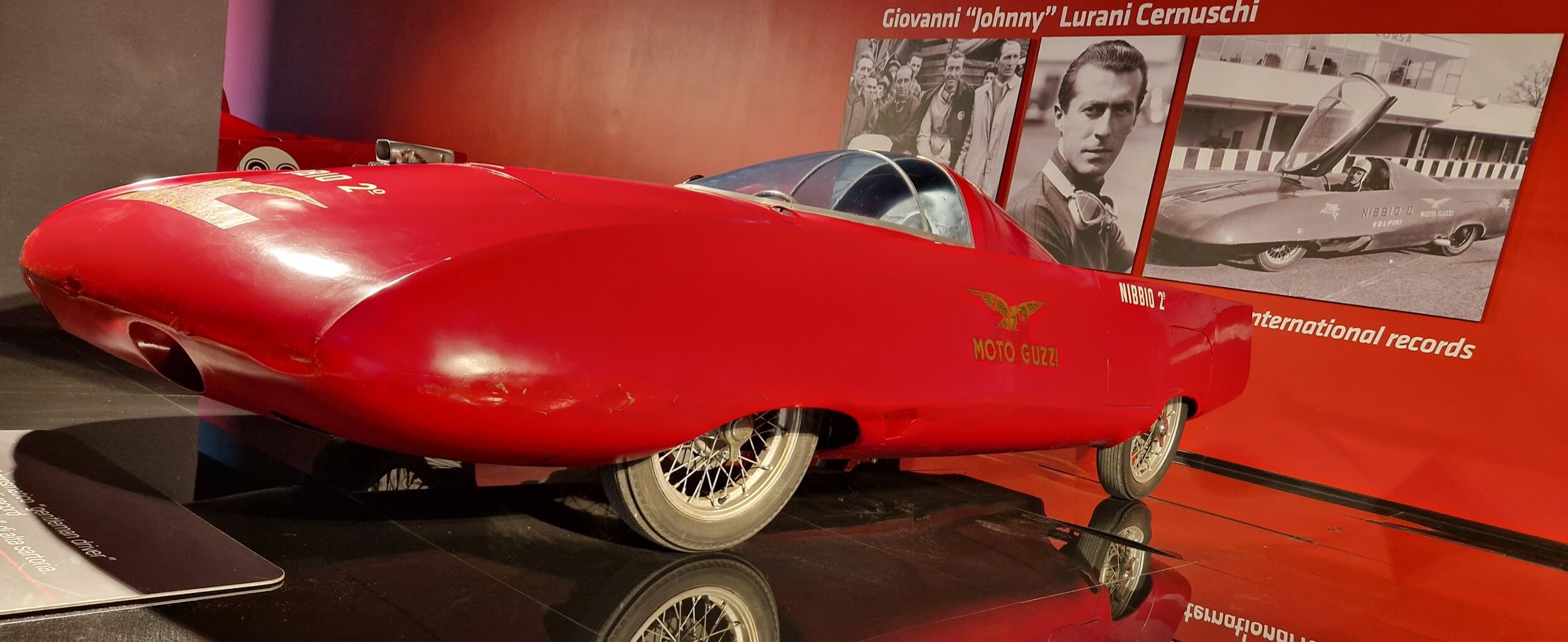
NIBBIO 2 in MAUTO. Photo RdR.
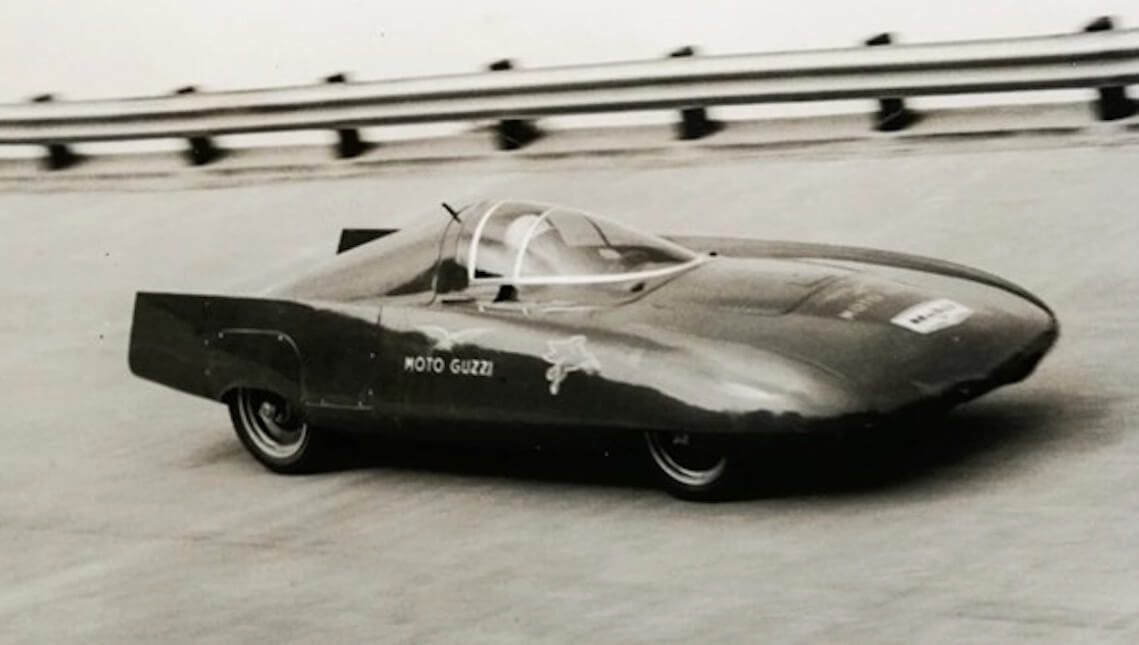
NIBBIO 2 in motion.

Drawings: Rik de Reuver.
4 – La Necessità di Velocità: COLIBRI’.
1963: The last generation of record cars is known as COLIBRI’. 'Stanguellini' is responsible for the tubular chassis, the aluminium body is manufactured by 'Vaccari-Baccrini-Carrozzeria Gransport' from Modena. The great Franco Scaglione ('father' of the '67 Alfa Romeo 33 Stradale!) is responsible for the design. Rumour has it that the intention was to put Guzzi's 500cc V8 in the car, but that doesn't seem likely. The records are taken with the 246.8 cc engine from the 1959 NIBBIO 2, which now delivers 29 hp to push a dry weight of 310 kg forward to a maximum speed of 180+ km/h. 5 new speed records are set at Monza. COLIBRI’ can be admired in 'Museo Stanguellini' in Modena.
Riders: Piero Campanella, Angelo Poggio.
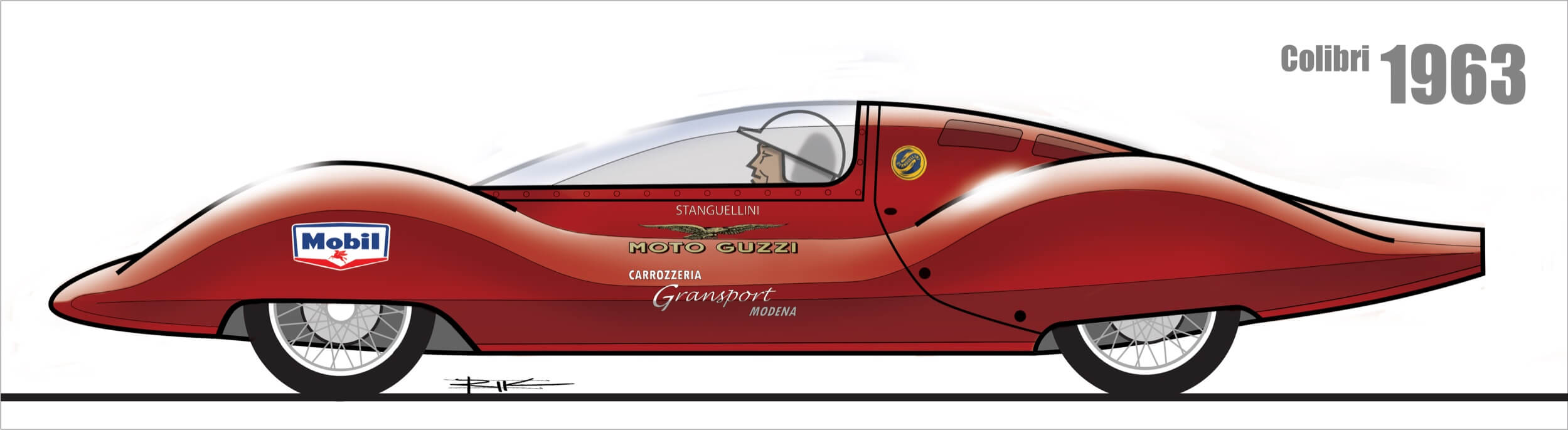
Drawing: Rik de Reuver.
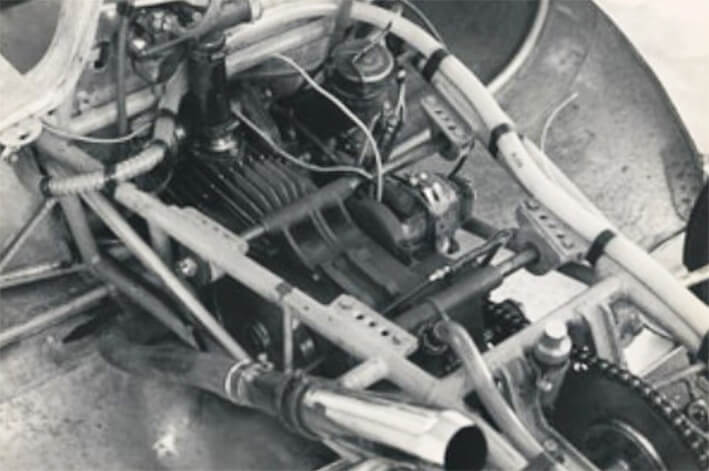
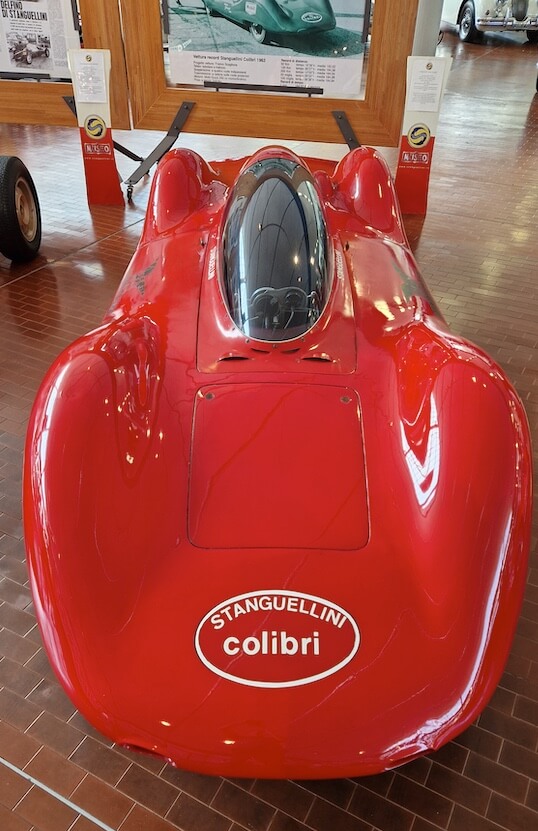
COLIBRI’ engine block. Right, Colibrì in Stanguellini Museum. Photo RdR.
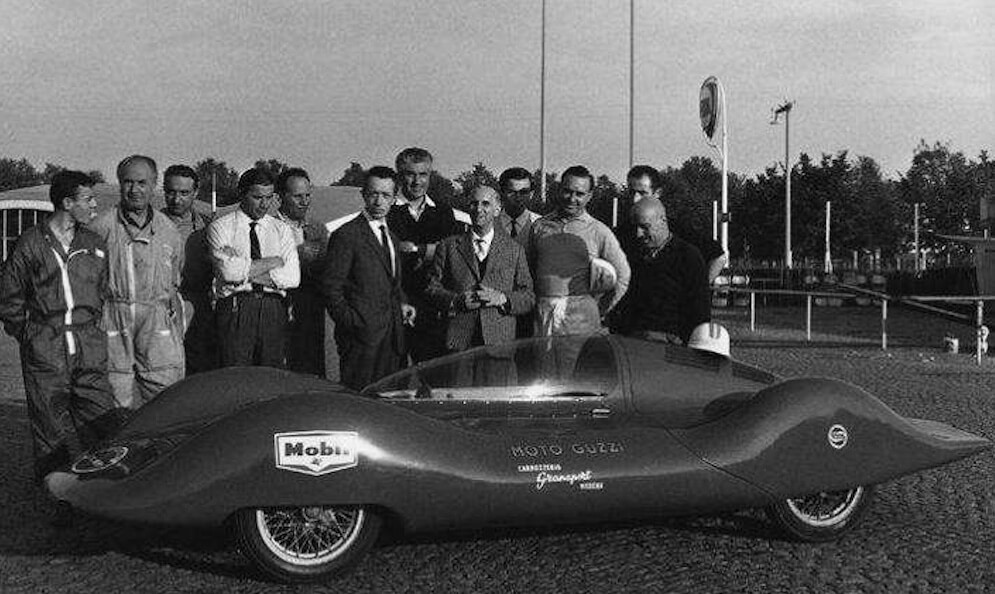
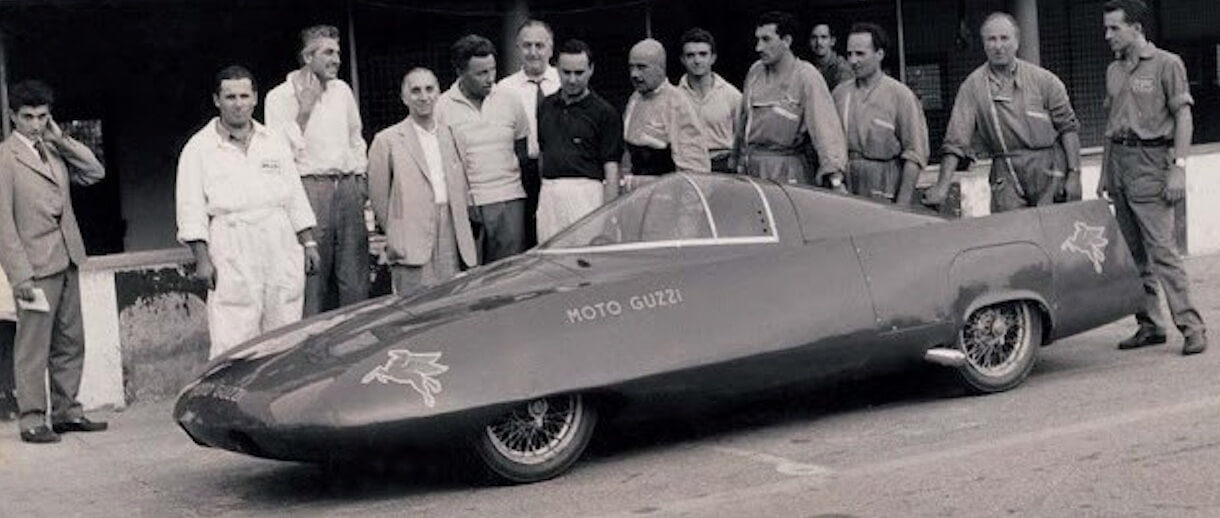
COLIBRI’ met Franco Scaglione (man in suit and tie, sixth from left) and Vittorio Stanguellini (man next on the right to him).
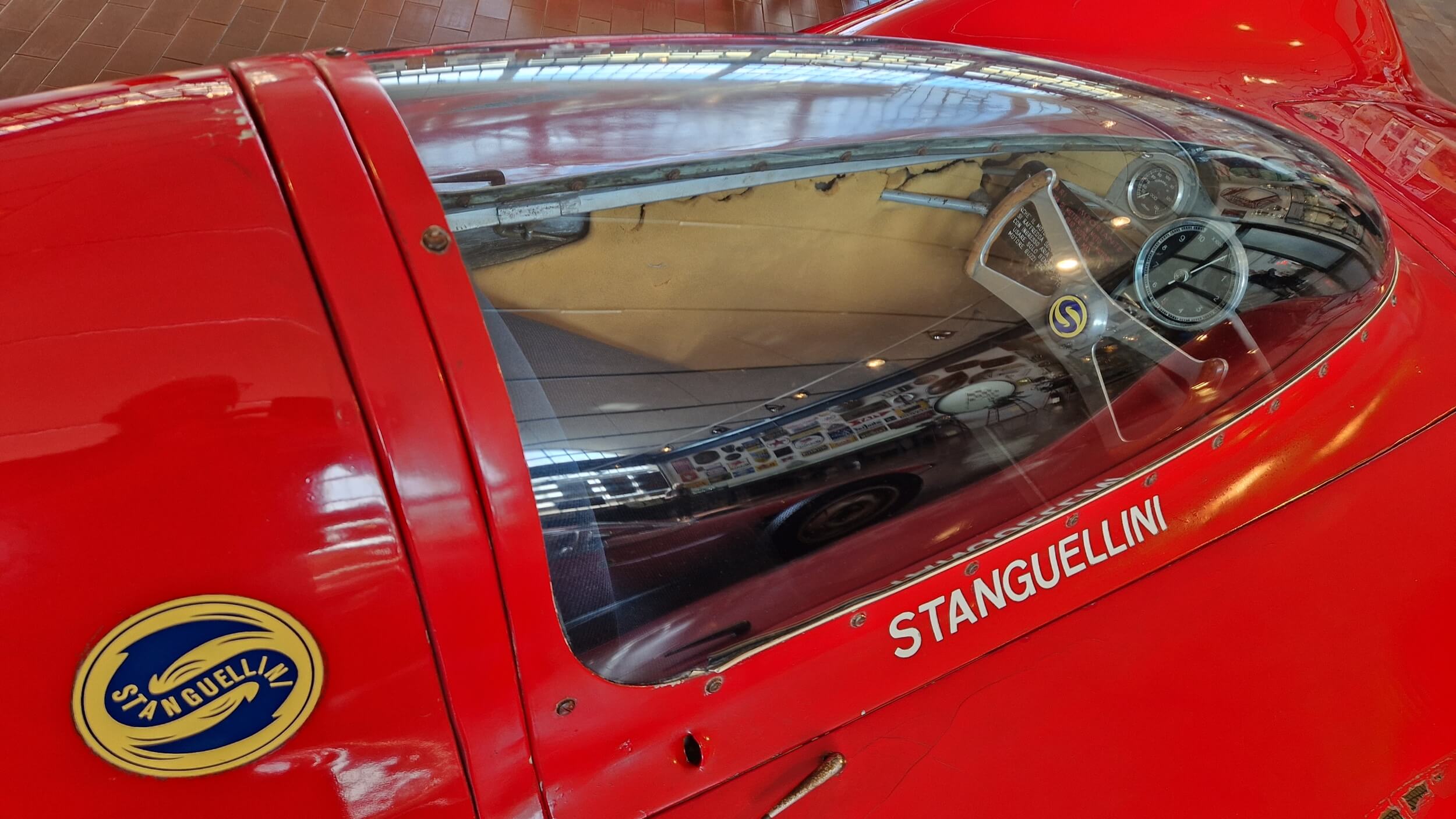
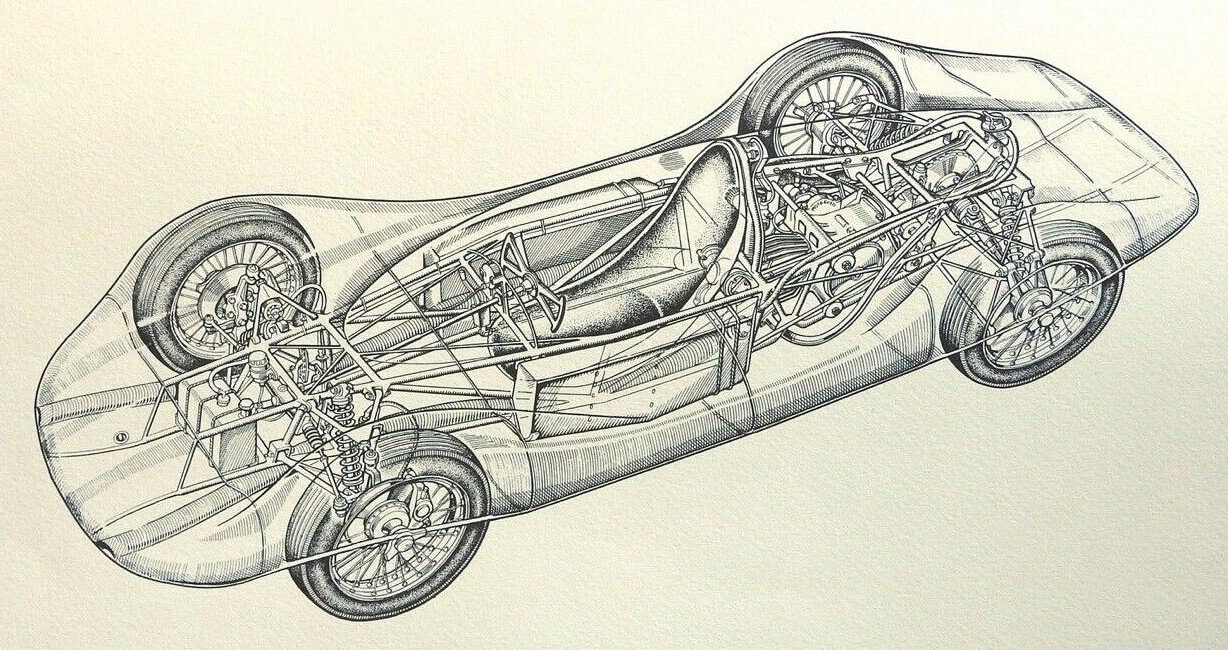
Left, COLIBRI’ ‘canopy’; right, COLIBRI’ 1963, interior through a project drawing.
5 – La Necessità di Velocità: NIBBIO – NIBBIO 2 – COLIBRI’.
To be able to compare the mutual size ratios properly, I add the images below. It clearly shows how the vehicles have become lower over the years and thus more streamlined: Frontal surface determines a lot! The development of NIBBIO, NIBBIO 2 & COLIBRI brilliantly illustrates the progress and importance of aerodynamics.
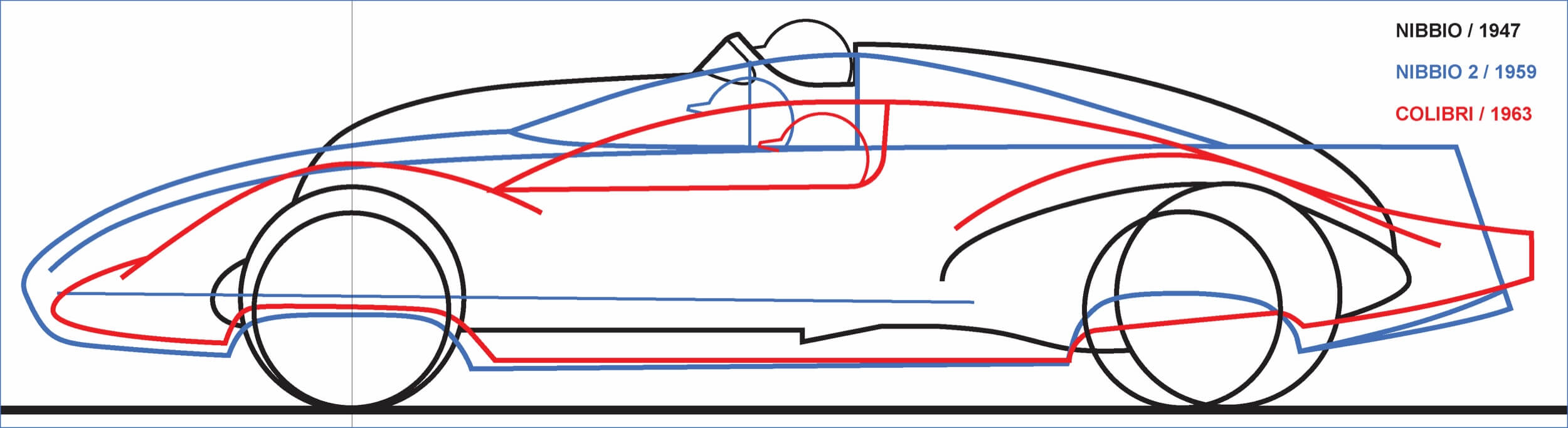
Drawing: Rik de Reuver.

Drawing: Rik de Reuver.
5 – La Necessità di Velocità: BISILURO TARF 1 & COBRA.
1948: Because of my fascination for the adventures of Giovanni Lurani and the beautiful, evolutionary path he took, I almost overlooked two other record cars powered by Moto Guzzi engines. One of them was built by another famous driver/constructor: Piero Taruffi. He conceived and built the 'BISILURO TARF'. Where BISILURO stands for '2 torpedoes', exactly as the car was built. The vehicle was driven with 2 handles on either side of the driver. In the first version of this car, the Guzzi 493.6 cc 120 degrees V2 was used. In 1948, 6 speed records were set with it. A later version of the TARF 1 was powered by a 350cc engine from Gilera. The later TARF 2 got a 4-cylinder 1720cc Maserati engine. It eventually reached speeds of more than 300 km/h! The car ended up in Australia where a Ferrari Dino V6 engine was installed, but by then there is no longer any question of originality. The version with Gilera engine can be seen in MAUTO, right next to NIBBIO 2.
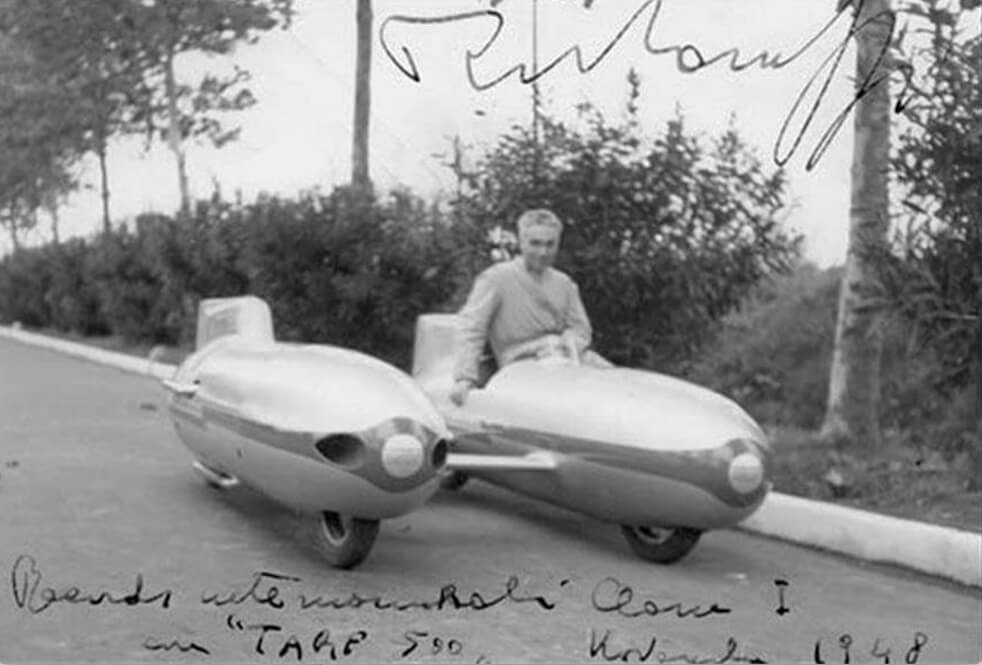
Bisiluro TARF 1 (with Moto Guzzi engine) and Piero Taruff (November 1948).
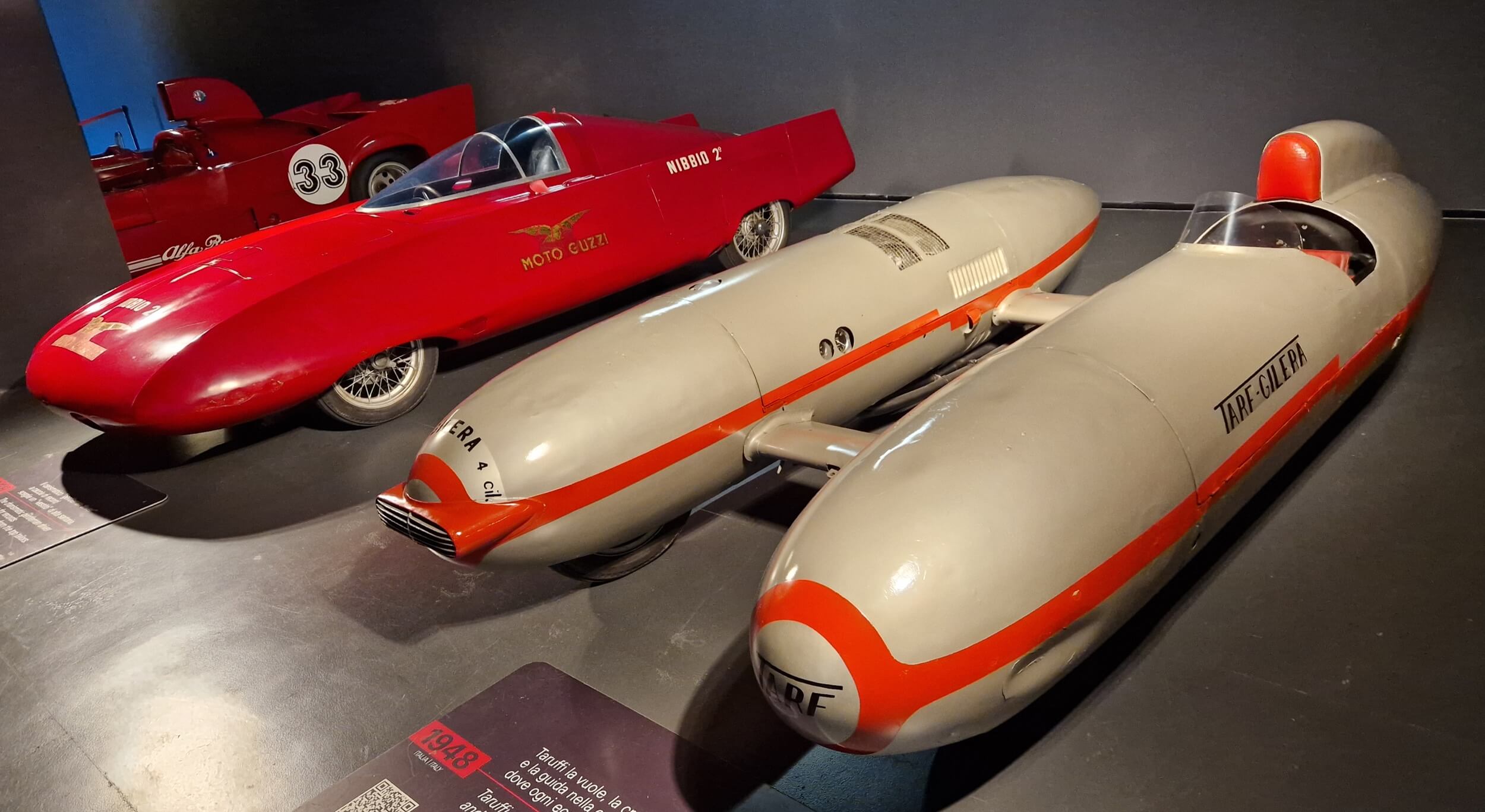
Left, NIBBIO 2 and Bisiluro TARF (Gilera engine).
1959: Another record car was developed within the Moto Guzzi company itself. The 'Moto Guzzi COBRA' proved that, aerodynamically, it was possible to go even 'flatter'. This time, the initiative came from renowned Guzzi engineers Giulio Carcano and Enrico Cantoni. Motorcyclist Gino Cavanna (formerly a speed record holder on Guzzi motorcycles) was lying in the car, headfirst! The well-known 248.6 cc 1-cylinder with compressor drives the very closely spaced rear wheels. 4 records were taken on the highway between Parma and Reggio Emilia, in the same year as NIBBIO 2, which drove in the class up to 250cc. COBRA, because of the compressor, in the class up to 350 cc.
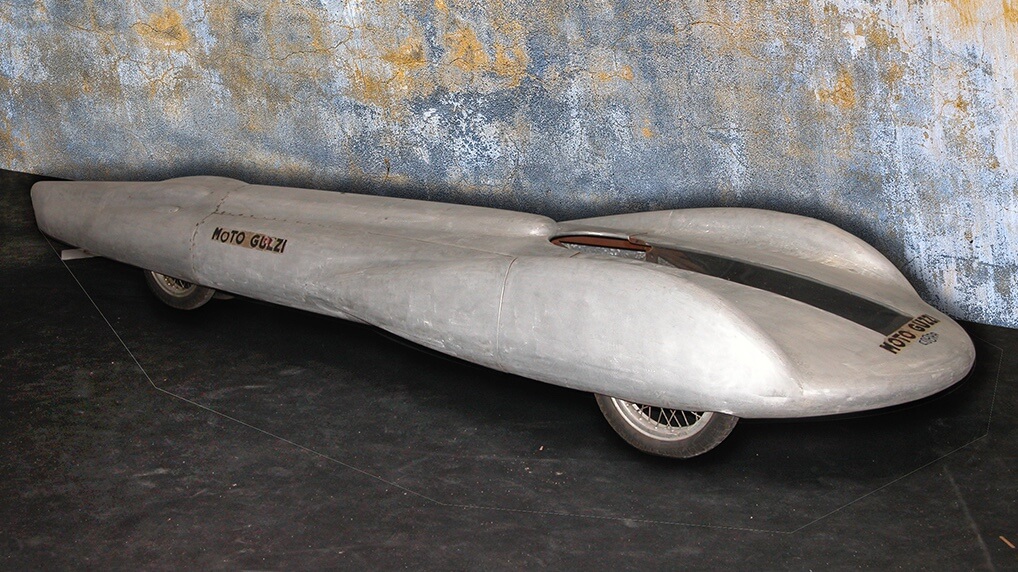
Moto Guzzi COBRA, 1959. Image source and info, ASI-Automotoclub Storico Italiano (Italian Historic Auto Moto Club, editor’s note):
https://www.asifed.it/giornate-mondiali-guzzi-inizia-lo-show-tra-le-aquile-dorate-esposte-da-asi-anche-la-cobra-da-record-del-1959/
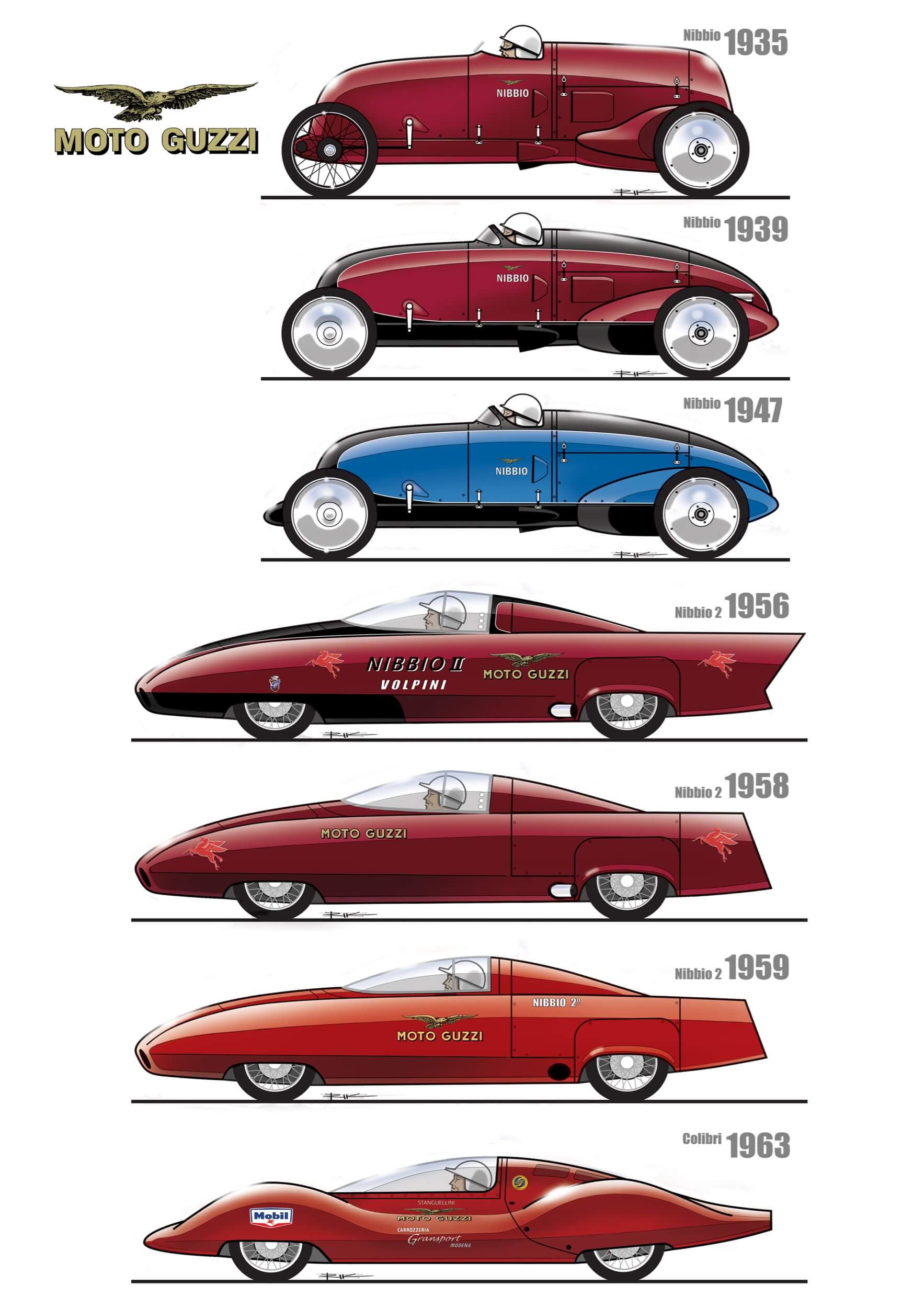
Great poster: Drawings signed of Rik de Reuver.
Thanks to: Co-riders to Mandello del Lario: Henk, Jan, Martien & Peter. Correctors: Sylvia Blaauw & Huib Seegers. Historians: Federico Göttsche Bebert, Erina Fukui, Kees van Stokkum & Uli Cloesen.
Literatuur: ‘A History of Motor Racing’ (Lurani, 1972), ‘Racing around the World’ (Lurani, 1954), ‘Stanguellini: Il Mago dei Motori’ (Candini & Manicardi, 1998), ‘Magic MPH’ (Gardner), ‘Specials’ (Bolster), ‘500cc Motor Racing: Year Book 1952’ (Sneyd), ‘Moto Guzzi’ (Colombo, 1977), Moto Guzzi Motocycles since 1921 (Schiffer, 2013), The Motor Cycle (17 May 1951), https://wide.piaggiogroup.com/en/
NOTE: I've done my best to credit the pictures/photographs to their rightful owners. The rights for the drawings remain with me.
The article has been also 'published' in club magazine "De Koerier' of the Dutch Moto Guzzi Club (MGCN). https://www.mgcnonline.nl/
Text, drawings and captions: Rik de Reuver (The Netherlands).
***
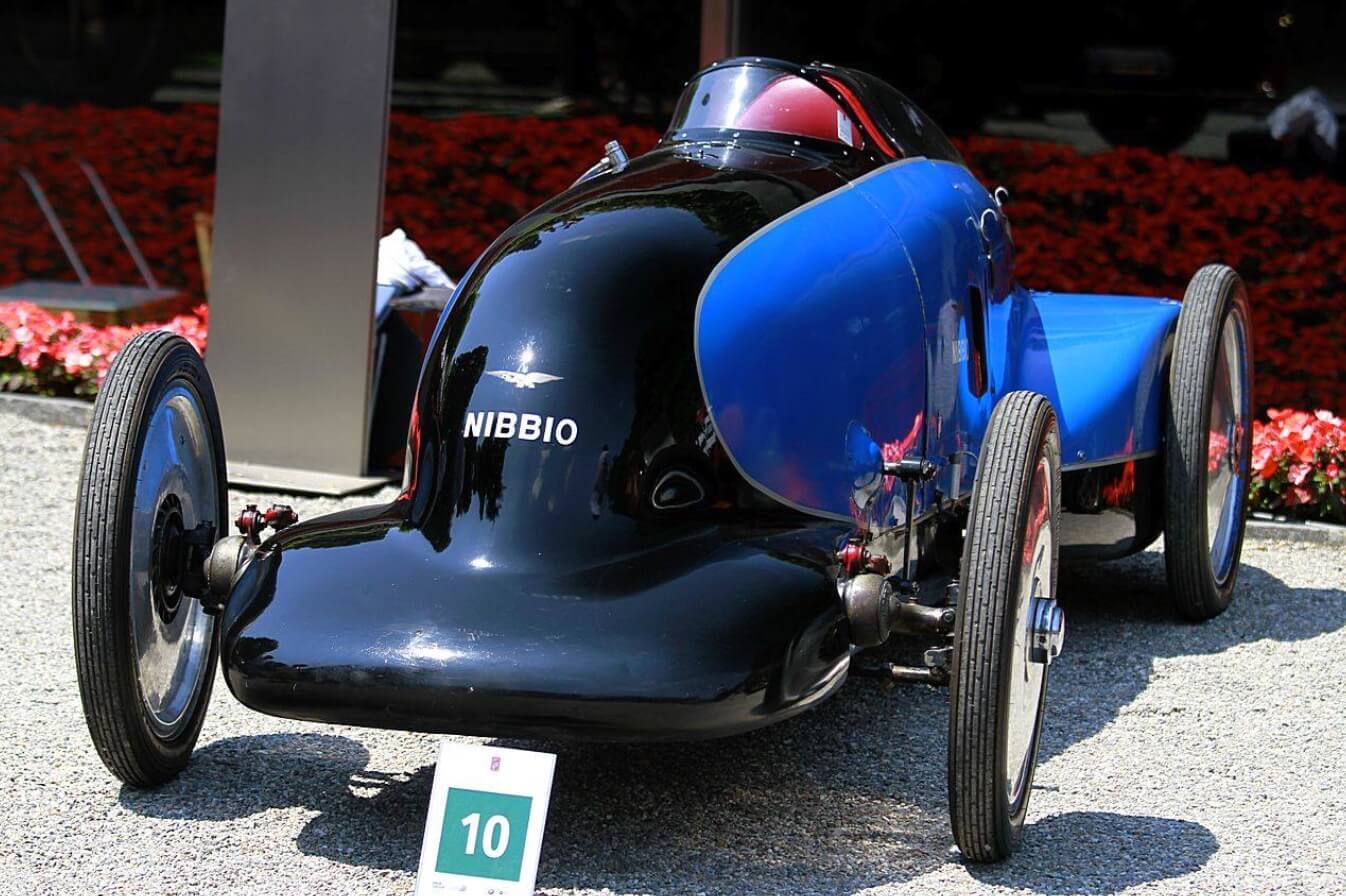
NIBBIO I. Design and built in 1935 by Giovanni Lurani Cernuschi, VIII Count of Calvenzano of Italy. The record-breaking car was based on 500cc V-twin Moto Guzzi (46hp) engine and became the first 500cc engined car to break the 100mph barrier. In 1939 the car was modified and again in 1947, now with a 250cc super-charged MG engine and called “Gerolamo” all to compete in different classes. The NIBBIO II (1956) used a 350cc V-twin Moto Guzzi (39hp) engine. Post of: https://www.facebook.com/classicandrecreationsportscars
IL SOUND DELLA LURANI NIBBIO A VILLA D'ESTE 2017.
(The sound of Lurani Nibbio at Villa D’Este 2017).
AutoDigest TV: