
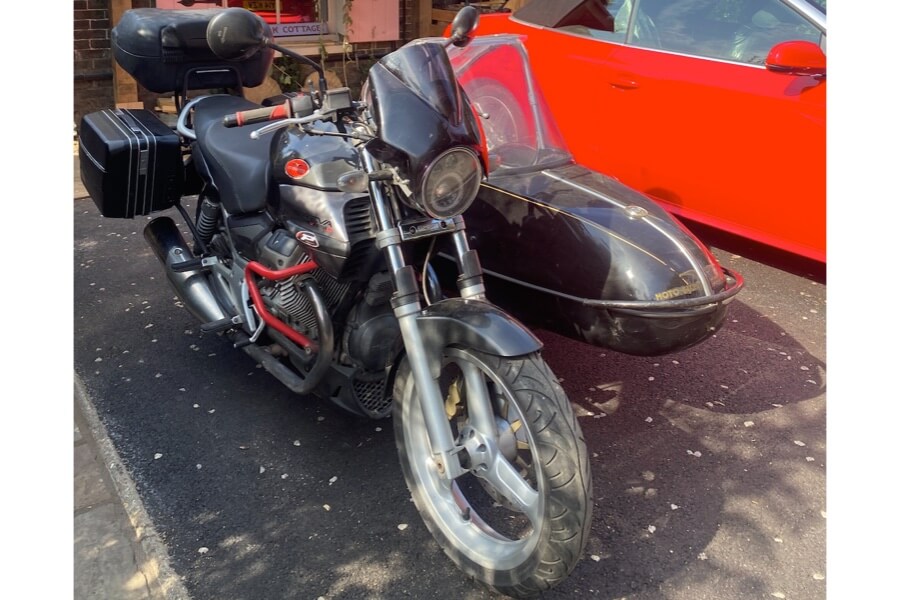
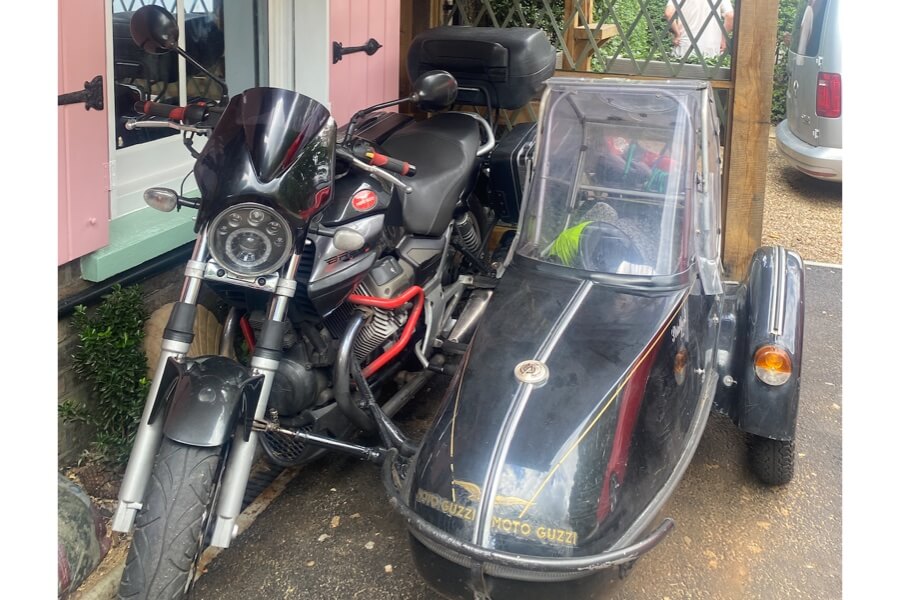
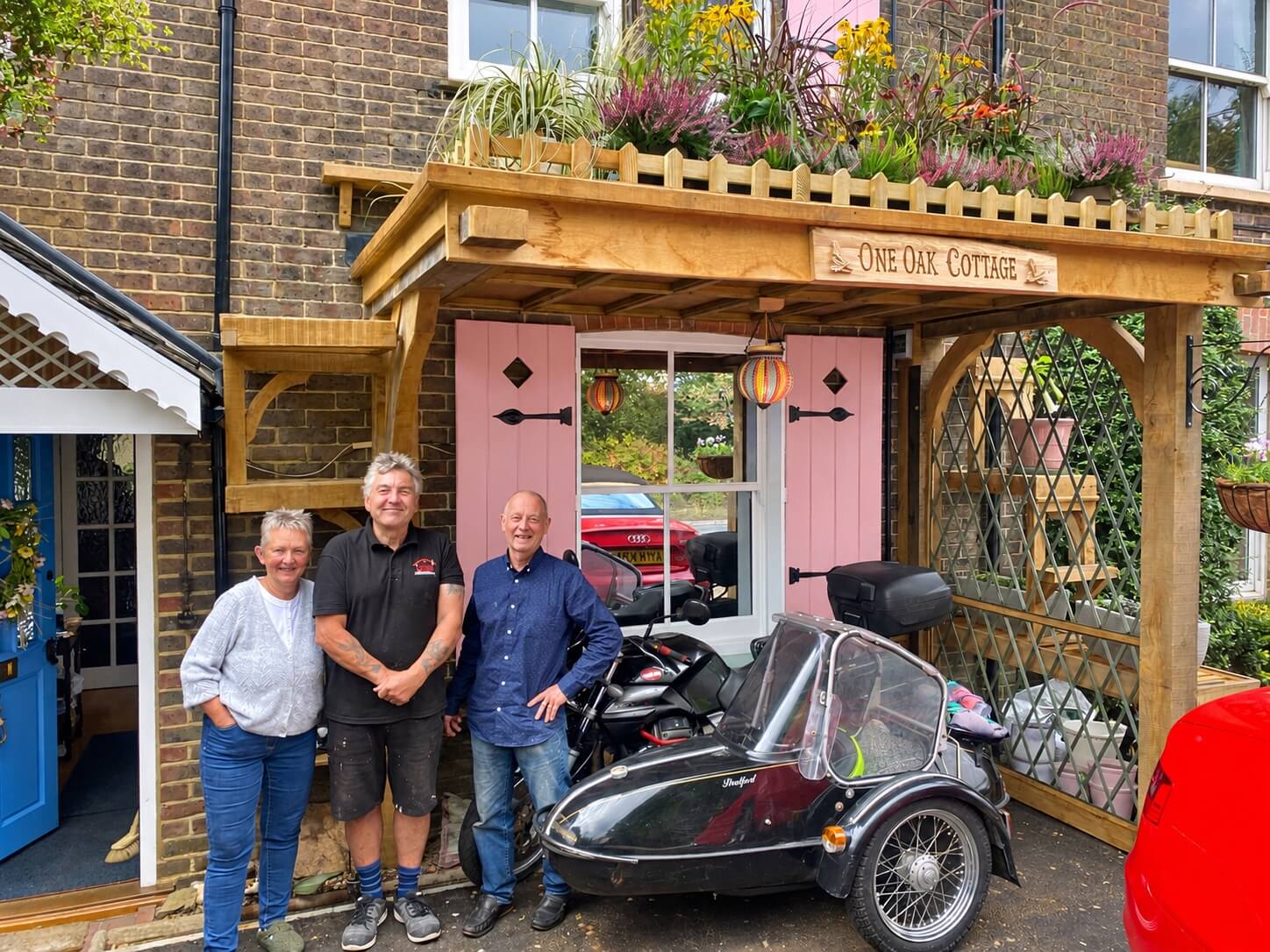
“The finished Glorious Folly with the Moto Guzzi Breva and Watsonian beneath it. What began as somewhere to keep my Moto Guzzi Breva and Watsonian sidecar became something rather more elaborate. There was only one non-negotiable condition from the missus: the plants were staying.”
September 2026 (G.T.) – Story by Ray Wilson. Every folly begins with an idea that sensible people dismiss. Mine began with a motorcycle. Not the motorcycle itself, but the simple desire to give it a proper home. There was, however, one non-negotiable condition: the glorious display of wildflowers, hanging baskets, troughs and every cherished plant had to remain. The common belief was that you could either have a practical parking space or a flourishing garden, but not both.
I refused to believe that.
The challenge became proving that the two, seemingly diametrically opposed, could not only coexist but also complement one another. Perhaps it was inevitable. Motorcycles have never been entirely about practicality. Since the earliest pioneers coaxed fragile machines along rutted roads, they have represented something just beyond common sense: freedom, independence and the irresistible urge to travel simply because the road continues beyond the next bend.
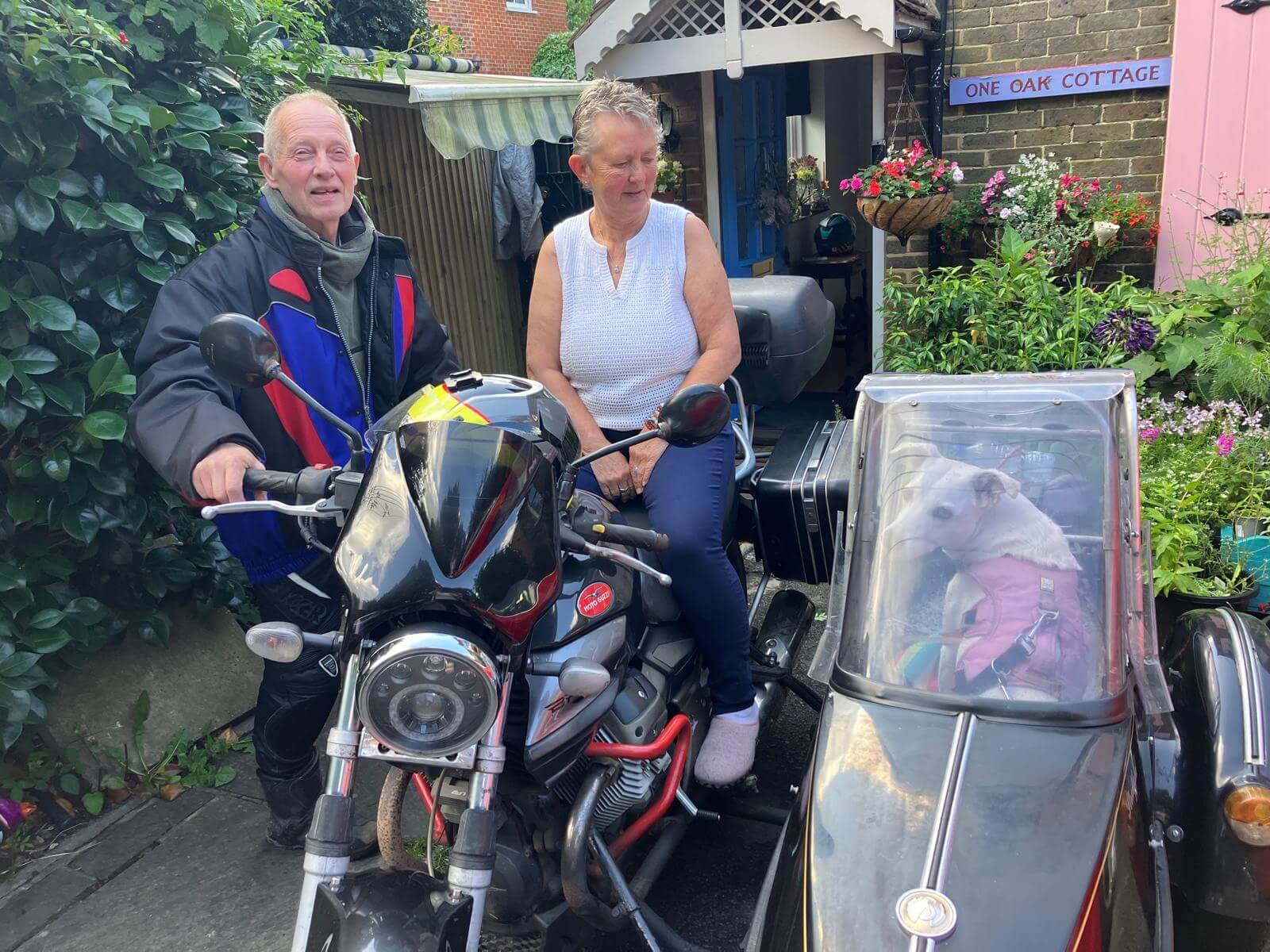
“Ray & Carolyn Wilson with Ania and the Moto Guzzi Breva and Watsonian. The sidecar has accompanied the Guzzi for every one of its miles. I thought I was simply building somewhere to keep a motorcycle. Quite the opposite. It is merely the latest consequence.”
Today, my own machine continues that story. The Moto Guzzi Breva, with its unmistakable transverse V-twin engine, represents another proud chapter in European motorcycling. Beside it sits the Watsonian sidecar. The sidecar was never simply an indulgence. It had a purpose. It allowed our dogs to travel with us.
Our first companion, Lola, covered an astonishing 88,000 miles, becoming something of a celebrity in the Scottish Highlands. In Inverness she attracted the attention of a coachload of Japanese tourists, who surrounded the outfit with cameras as though she were the star of the show — which, of course, she was. Her successor, Ania, is still serving her apprenticeship, with a mere 15,000 miles to her credit. So the Guzzi combination needed a home.
When I first shared the idea with my friend Trev, he looked at me with the expression usually reserved for people who have completely taken leave of their senses. “This is the road to madness,” he declared. He wasn't entirely wrong.
For several weeks we debated, sketched, measured, discarded ideas and started again. Trev remained unconvinced that it was anything more than an elaborate exercise in wishful thinking. Gradually, however, the argument shifted. This wasn't simply about creating somewhere to park a motorcycle.
It was about creating something unique — a practical structure that celebrated the garden rather than destroyed it. There remained one obstacle considerably greater than engineering, planning or construction. The missus.
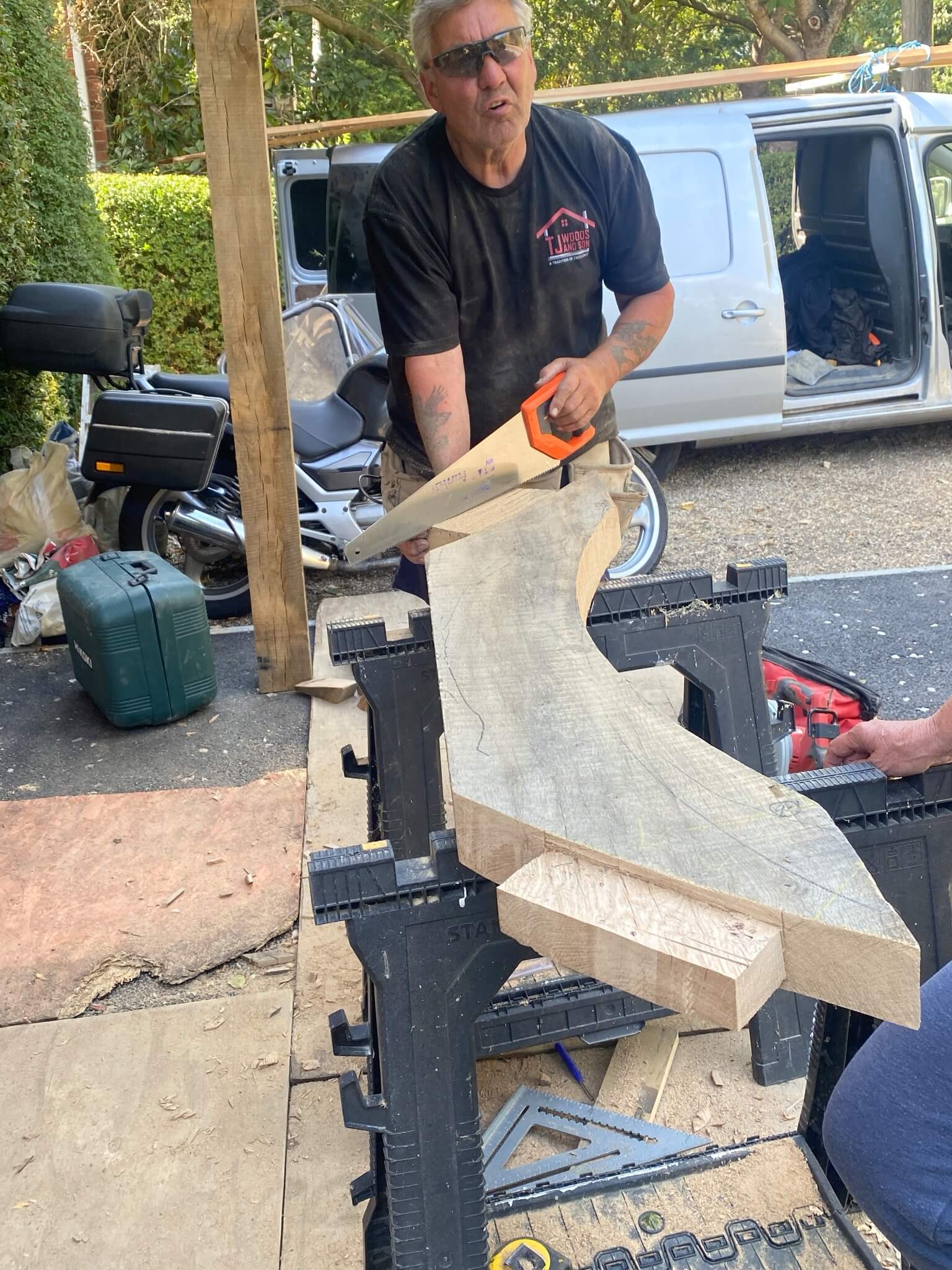
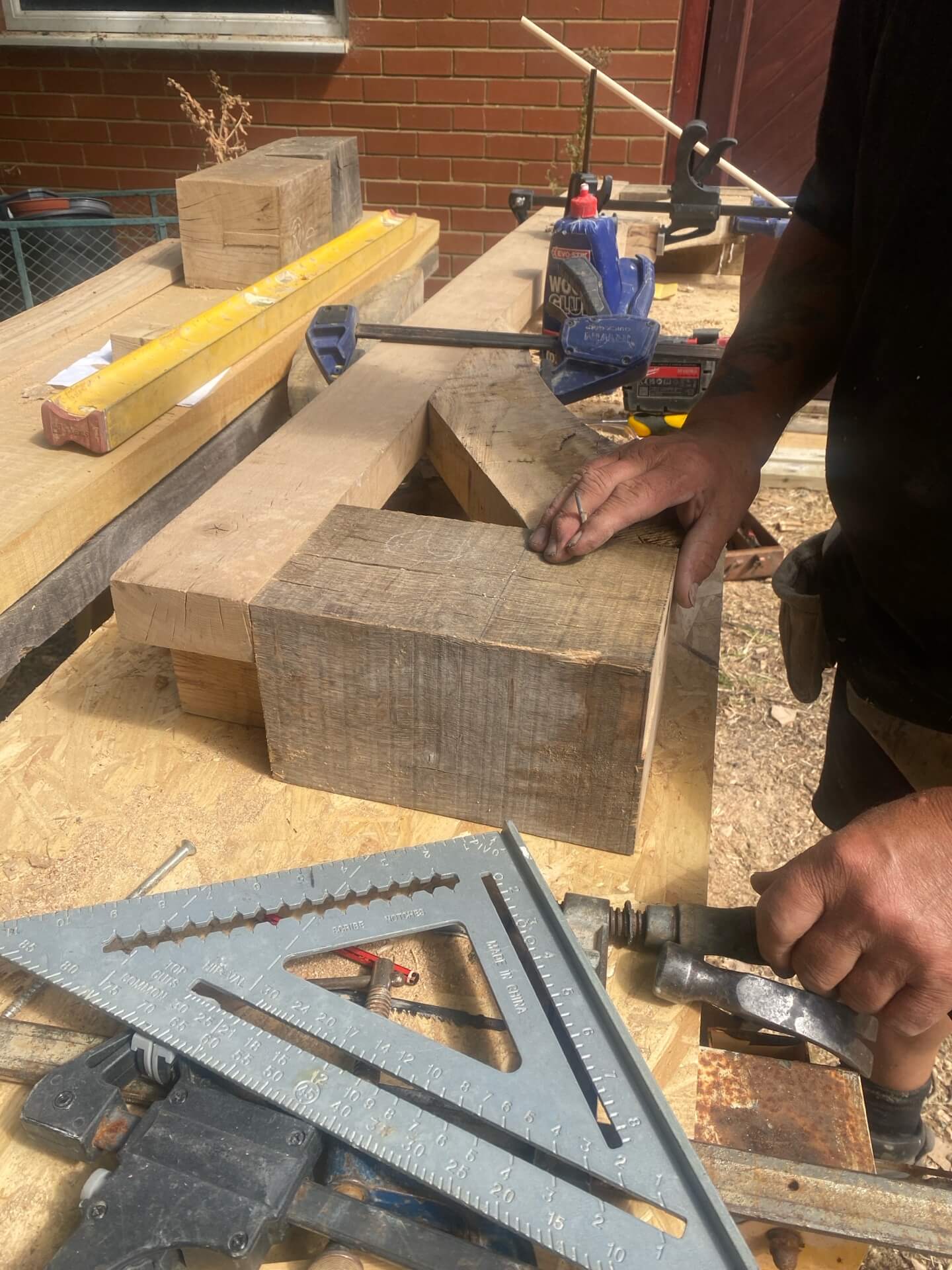
Left photo: “Trev Woods shaping the curved oak support. A conventional fourth post would have solved the structural problem beautifully. Unfortunately, the post and the Guzzi with its Watsonian needed to occupy exactly the same piece of Sussex. The fourth post was out. The motorcycle was staying. Right: Old English oak and traditional joinery. Trev worked the structure using mortise-and-tenon and half-lap joints, gallows brackets and the sort of methods the timber would probably recognise. Some of the oak may be around 300 years old.”
Right photo: “Old English oak and traditional joinery. Trev worked the structure using mortise-and-tenon and half-lap joints, gallows brackets and the sort of methods the timber would probably recognise. Some of the oak may be around 300 years old.
Her plants were not to be disturbed, moved or interfered with in any way. Every pot, every trough and every treasured specimen had earned its place over many years and was to be treated accordingly. Eventually, after weeks of careful planning and no small amount of diplomacy, every plant was lifted, transported with military precision and settled beneath our 180-year-old oak tree at the back of the garden. For the first time in over a quarter of a century, the site stood completely clear. The design was complete. The oak frame had been meticulously planned.
Even more remarkable, the timbers themselves came from mighty English oaks that first put down roots some three hundred years ago. When these trees were saplings, there were no motorcycles. There were no railways, no steam engines, no internal combustion engines and certainly no sidecars. The roads they overlooked echoed only to horses' hooves and wooden cart wheels.
Three hundred years is a respectable age for any living thing. Yet these oaks had not reached the end of their story. Instead, they were being granted a remarkable second life — not as the ribs of a man-of-war or the beams of a mediaeval hall, but as the framework for something altogether more eccentric: a structure conceived to shelter a motorcycle without sacrificing a single flower.
Trev still called it the road to madness. Madness? Perhaps it was.
The Folly during construction showing the open corner, flitch beam and curved support.
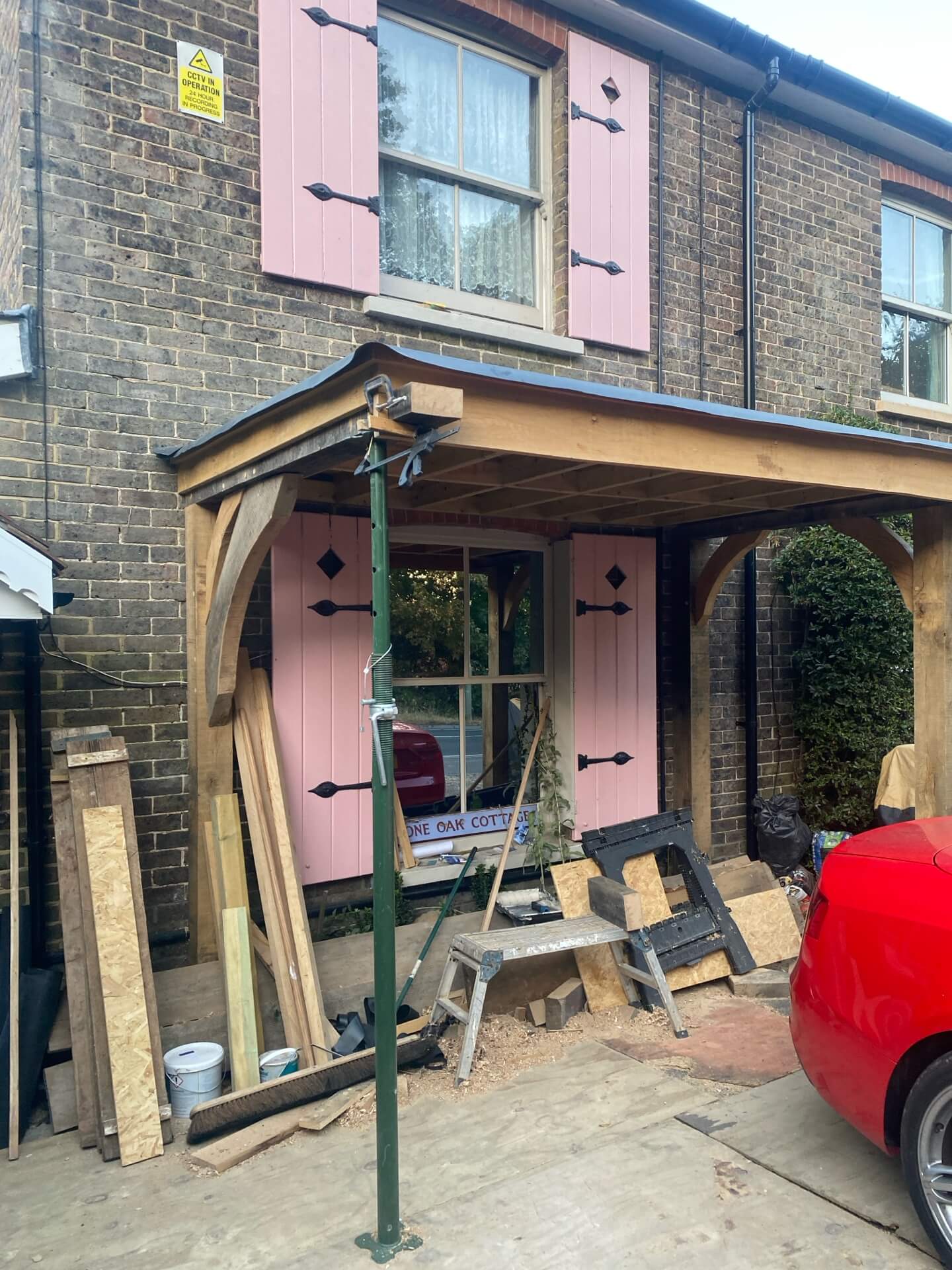
“The missing fourth post. The Guzzi began dictating the architecture. A flitch beam provided part of the answer, followed by the curved oak support that allowed the front corner to remain open for the motorcycle and sidecar.”
THE OLD ENGLISH OAK. We went to see Mike Astridge at Clemsfold Sawmill in Slinfold. “People don't normally like the old grey oak; they all want it freshly cut,” Mike told us. “No, we want the old weathered look. What's the provenance of this old timber, Mike? Where does it come from?” I asked. “Most of it is local — within a 20-mile radius.” “What would you say — 300 years old?”. “Some of these were saplings, all right, at least that long. That one there is from Newdigate. If you want, you can count the rings.” “I'll tell you what, Mike. I'll take a photo and maybe count them later.”
Trev spent days cutting mortise-and-tenon joints, laying them out with a knife and square, scribing shoulder lines, working with a chisel and mallet and gradually persuading these substantial pieces of seasoned oak to fit together.
He showed me one of his favourite tools, a handcrafted wooden gauge whose dimensions enabled him to produce the perfect full tenon rather than a half tenon. Then came his beautifully balanced mortise chisel. “The perfect accessory for more joints,” he said with a wink. By late afternoon the beams and gallows brackets were becoming a sturdy timber frame. “Well, Ray, the big boys are all done!” Trev announced. “We are ready for tomorrow.”
We weren't.
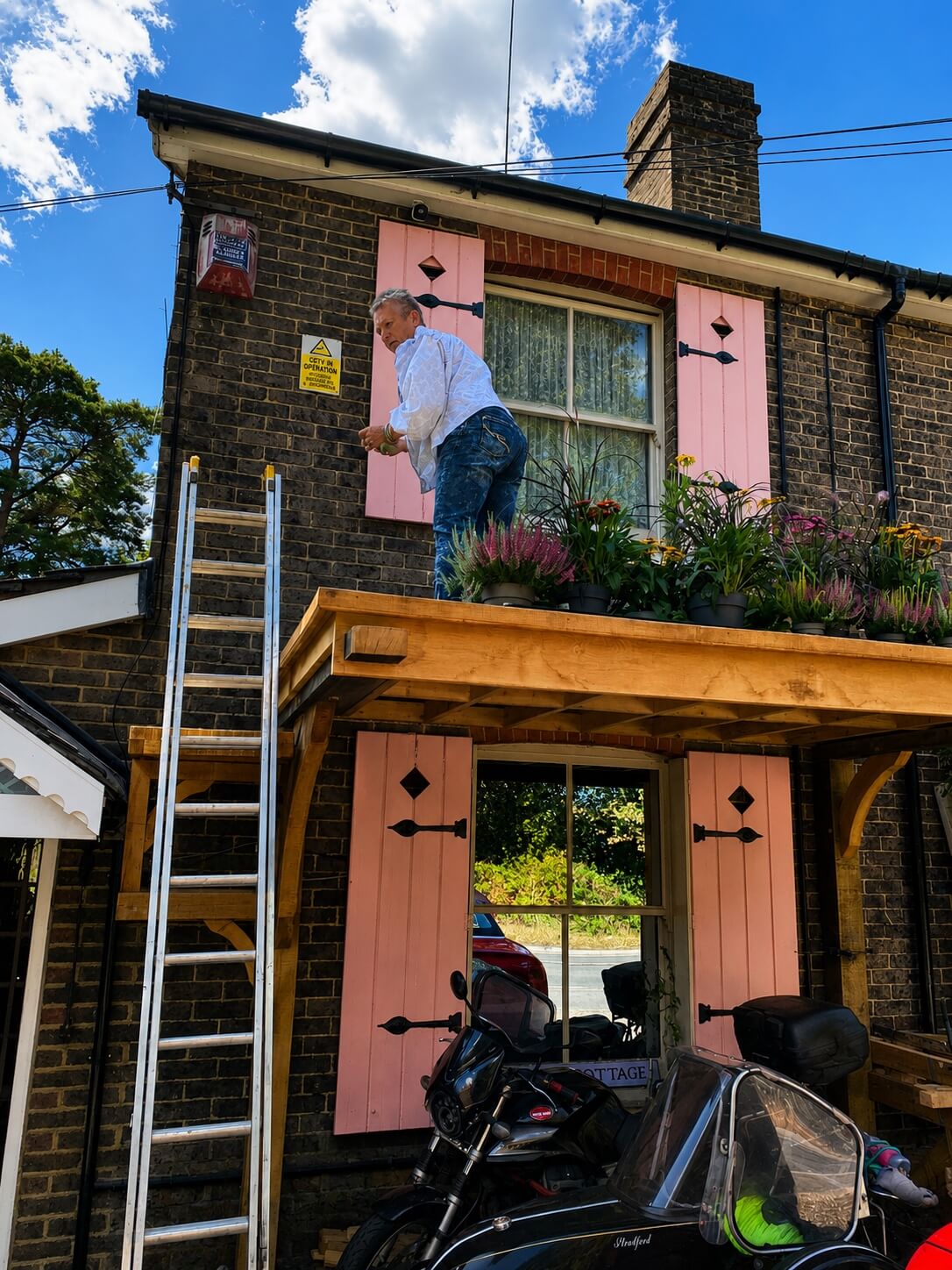
The Missus on the Glorius Folly.
THE FOURTH POST. The real problem was the Moto Guzzi. A conventional fourth post would have made the construction considerably easier. Unfortunately, the fourth post, the Moto Guzzi and its Watsonian sidecar, all wanted to occupy exactly the same space.
“We're going to have to get some steel and make a flitch beam,” Trev explained. “The alternative, I suppose, is to put in a fourth post,” I said, “but that's going to create access problems.”
My older son Khristian supplied the steel, and, by the end of the day, the flitch beam was in place. Then came the test. The car was positioned, and the great motorcycle-juggling exercise began. I called Trev. “Good news and bad news.” A pause. “The car and Breva live in harmony. Our measuring spot is spot-on.” Another pause. “But…”
I let that hang for a moment. “I had to remove the Acrow prop. I tried all sorts of positions — no go. So, absolutely no chance of getting a fourth post in?” “Ahhh…” Trev began. “But what about an oak beam installed at an angle to support the roof structure above it? I can still get the motorcycle in, as long as the beam is above the height of the handlebars.” There was a brief silence. Then, at least, we had something. The fourth post was out. The motorcycle was staying. And the roof still had somewhere to stand.
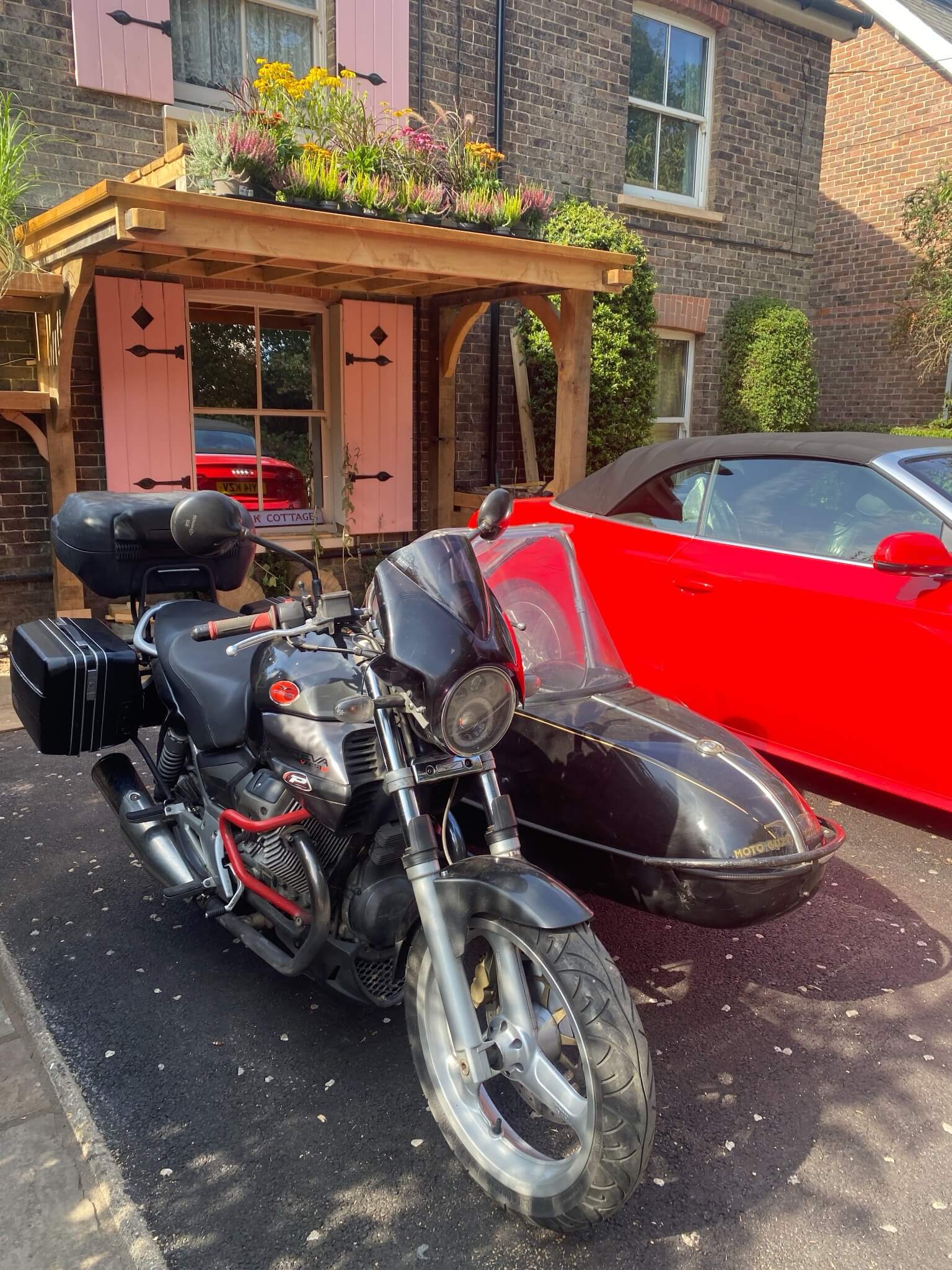
Moto Guzzi Breva and Watsonian Stratford sidecar by the nearly completed Folly.
THE GOLDEN-ISH RATIO. That meant more oak from Slinfold Mike. But the real problem became describing the arc. It doesn't sound difficult. Draw an arc. Put it where you want it. Job done. Except it doesn't work like that. The additional oak bracket was to become the replacement support, allowing us to dispense with the fourth post. The oak had to carry the load, but it also had to look as though it belonged there. Trev eventually found himself wrestling with a three-metre length of black plastic tubing.
After much fiddling, clamping and standing back to admire it — up a bit, down a bit, left a bit, right a bit, rather like The Golden Shot — we finally arrived at something that looked right. In the end, we achieved the golden ratio. Or at least the golden-ish ratio.
I left Trev to fashion the lump of seasoned oak into a load-bearing visual demigod of both aesthetic wonder and physical prowess. The following morning the slightly tricky insertion began. “It has to fit, one way or the other,” Trev declared. It did. The Moto Guzzi could get underneath.
THE RETURN OF THE TRIFFIDS. Of course, there were still the plants. Trev constructed a solid oak plinth above the canopy, skilfully fashioning yet more mortise-and-tenon joints. The day of the return of the Triffids was fast approaching. Then came side tiers, more oak gallows brackets, trellis work, rubber roofing, lead flashing and the problem of rainwater.
“We need the rain to test out our rubber roofing and decide on the various diverters to water the plants,” Trev explained. After weeks of near-drought, when the rain finally arrived, we began creating the water diverters. Trev made a raised wooden matrix to support the plants, with 21 pointed castellations across the front and 13 along each side.
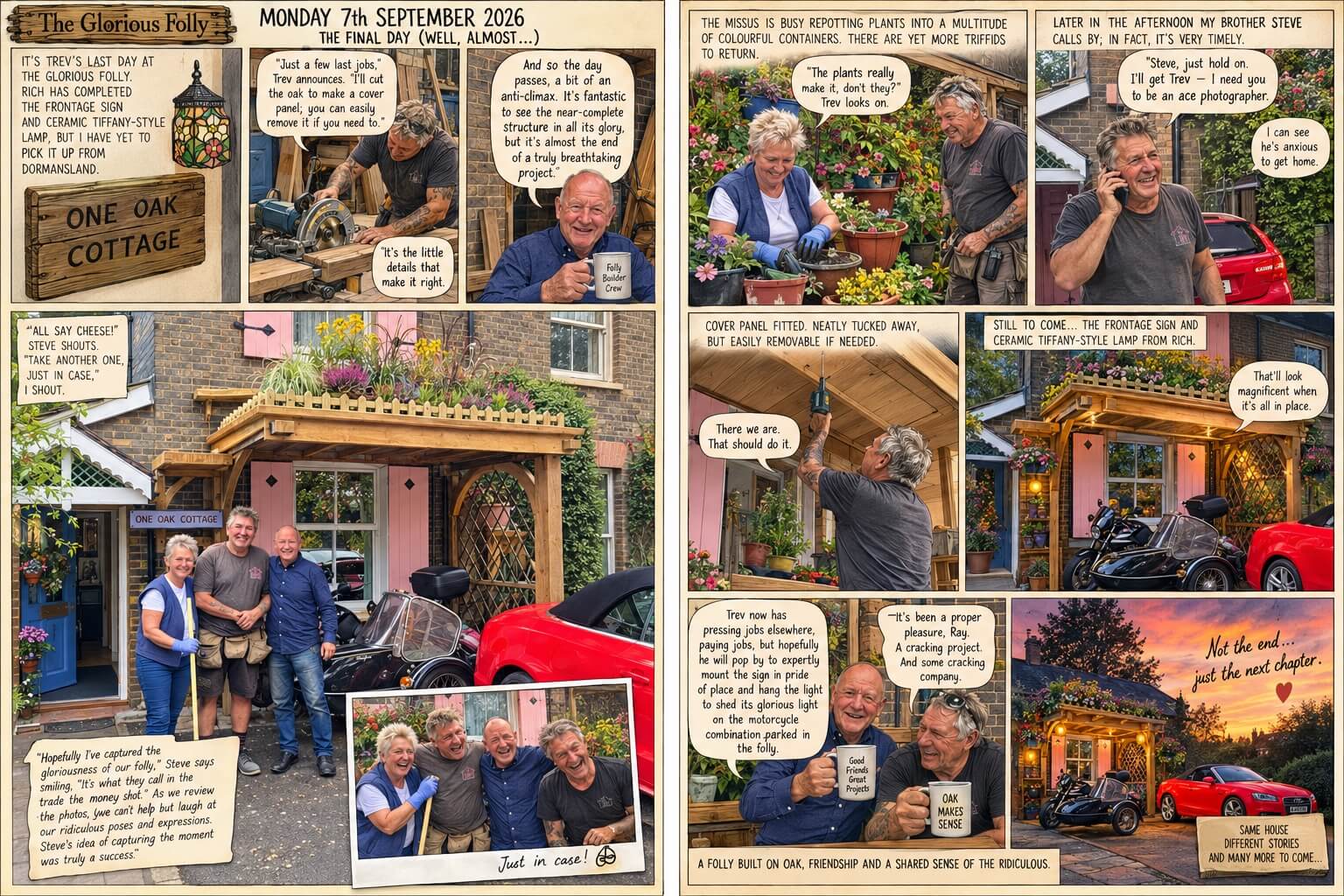
The Glorious Folly,7th September 2026 – The final day (well, almost…).
“I'm going to place diagonal beads of silicon strategically on the rubber roof to create a drip feeder for the tiers of plants on either side,” he explained. The underside of the canopy was infilled with wooden panels. “It's like what they have at Hampton Court,” Trev said with a wink.
By now neighbours and passers-by were stopping to look. One neighbour from Lanes End stood admiring it. “Oh, it's simply marvellous — all of that work, the oak, it's magnificent — that man is a real craftsman.” “We are calling it the Glorious Folly,” I replied. “Who designed it?” “That be me—or more correctly, dreamt it up. Trev is the one who turned it into a reality; he came up with the practical ideas.” The missus appeared. “Well, you know, I am just admiring the Folly,” our neighbour continued. “All those lovely plants, a wildlife sanctuary. Once the others are on the tiers, well, it's simply breathtaking, wonderful — that man is a genius.” She pointed at Trev, still busy and surprisingly subdued. The perfect end to the day.
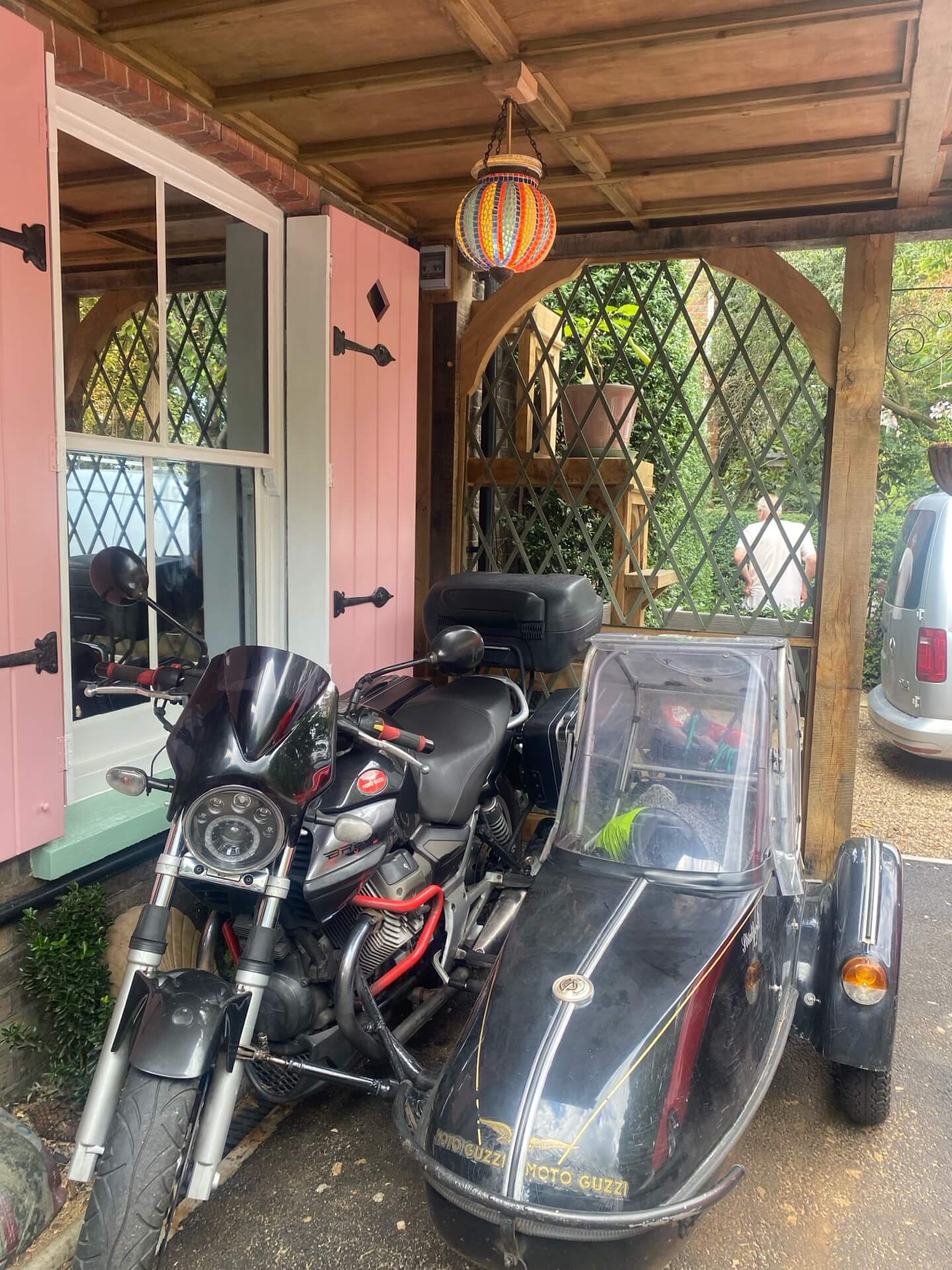
BUT WHERE DID IT REALLY BEGIN?
While all this was going on, something else had happened. I began looking through the family photographs. The more I dug into the story of the Glorious Folly, the more I realised that building somewhere for the Guzzi combination wasn't really where this story began at all. It had been coming down the road towards me for generations.
Bertie Wilson with his 1929 Ariel motorcycle and sidecar.
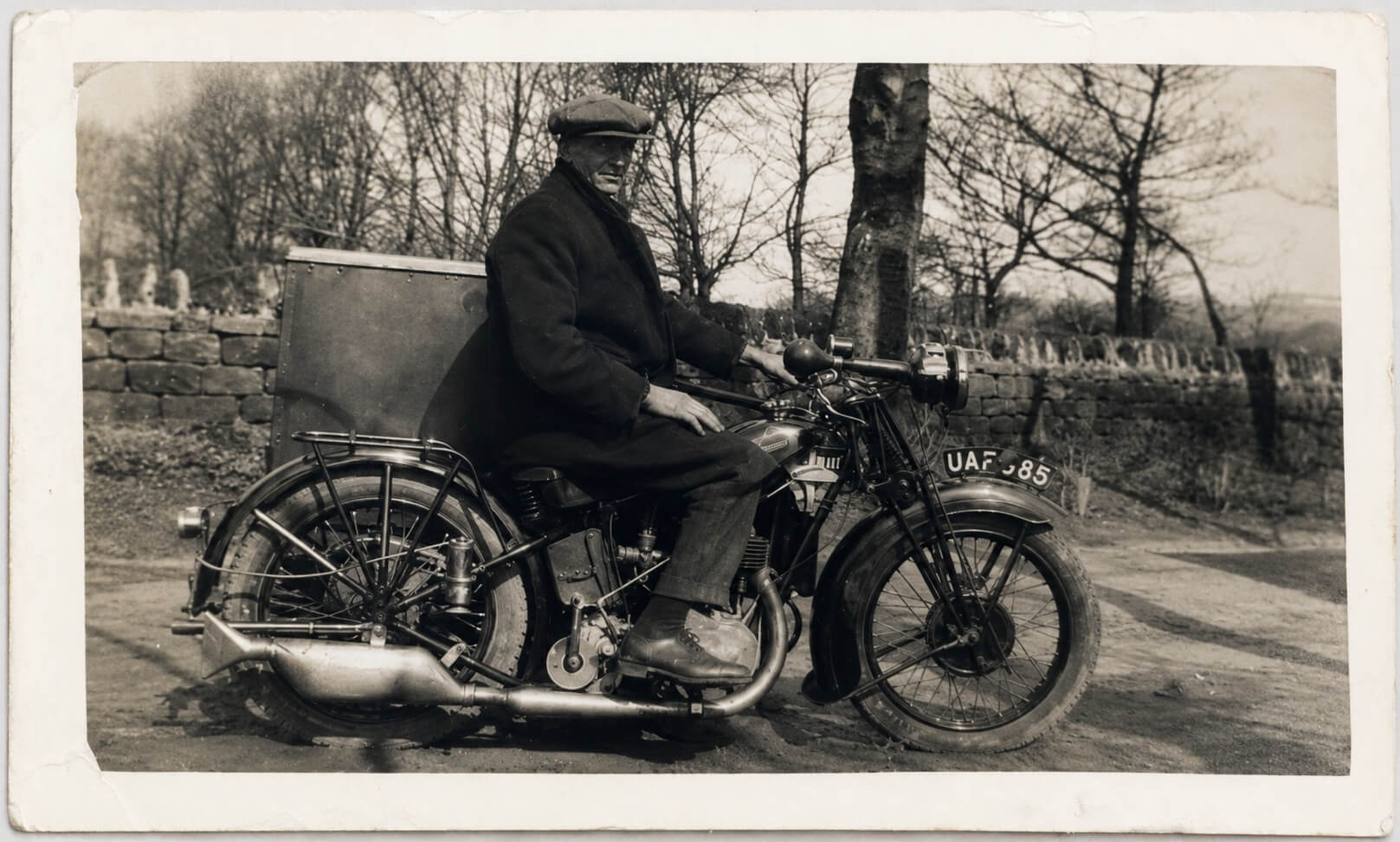
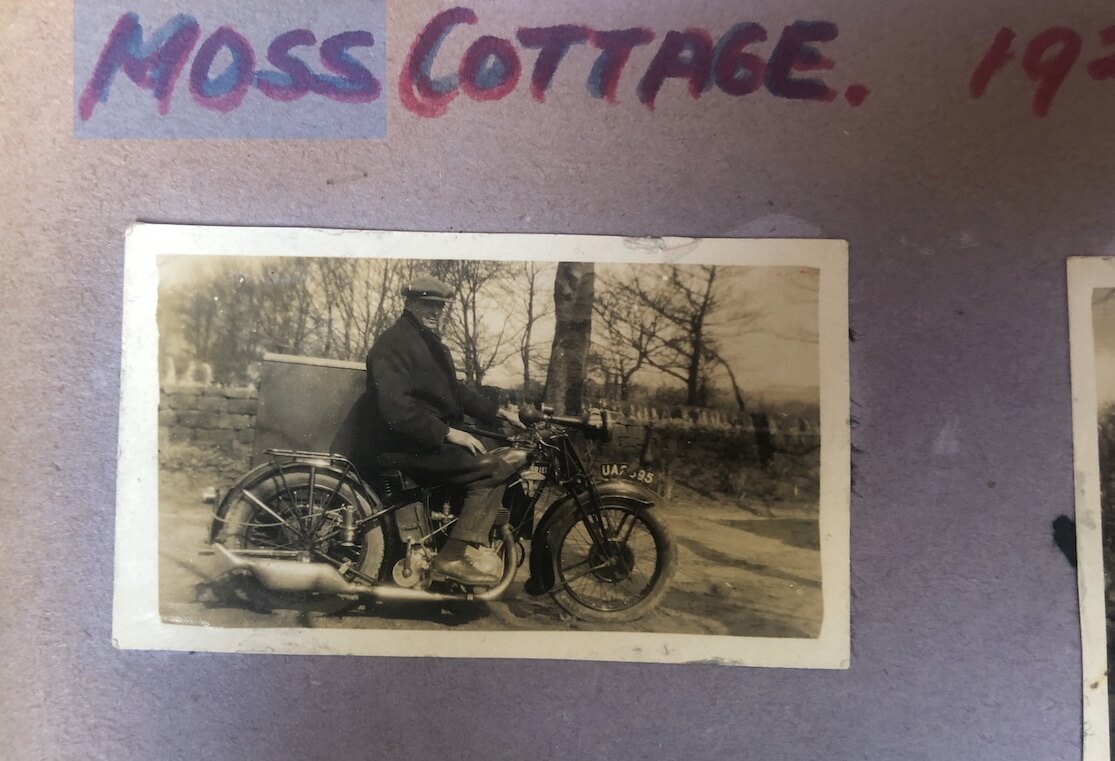
“My grandfather Bertie Wilson with his Ariel motorcycle and sidecar, 1929. Bertie was a decorator and carried his decorating materials in the chair, with his pasteboard fitted between motorcycle and sidecar. I only discovered while writing the Glorious Folly that the motorcycle-and-sidecar thread went back this far.”
In an old photograph from 1929 there is my grandfather, Bertie Wilson, proud as punch with his Ariel motorcycle and sidecar. Bertie was a decorator, and the combination wasn't a toy or weekend indulgence. It was transport. It was business. It was a working vehicle. His decorating materials went into the sidecar, and, wonderfully, his pasteboard apparently slipped neatly between the motorcycle and chair.
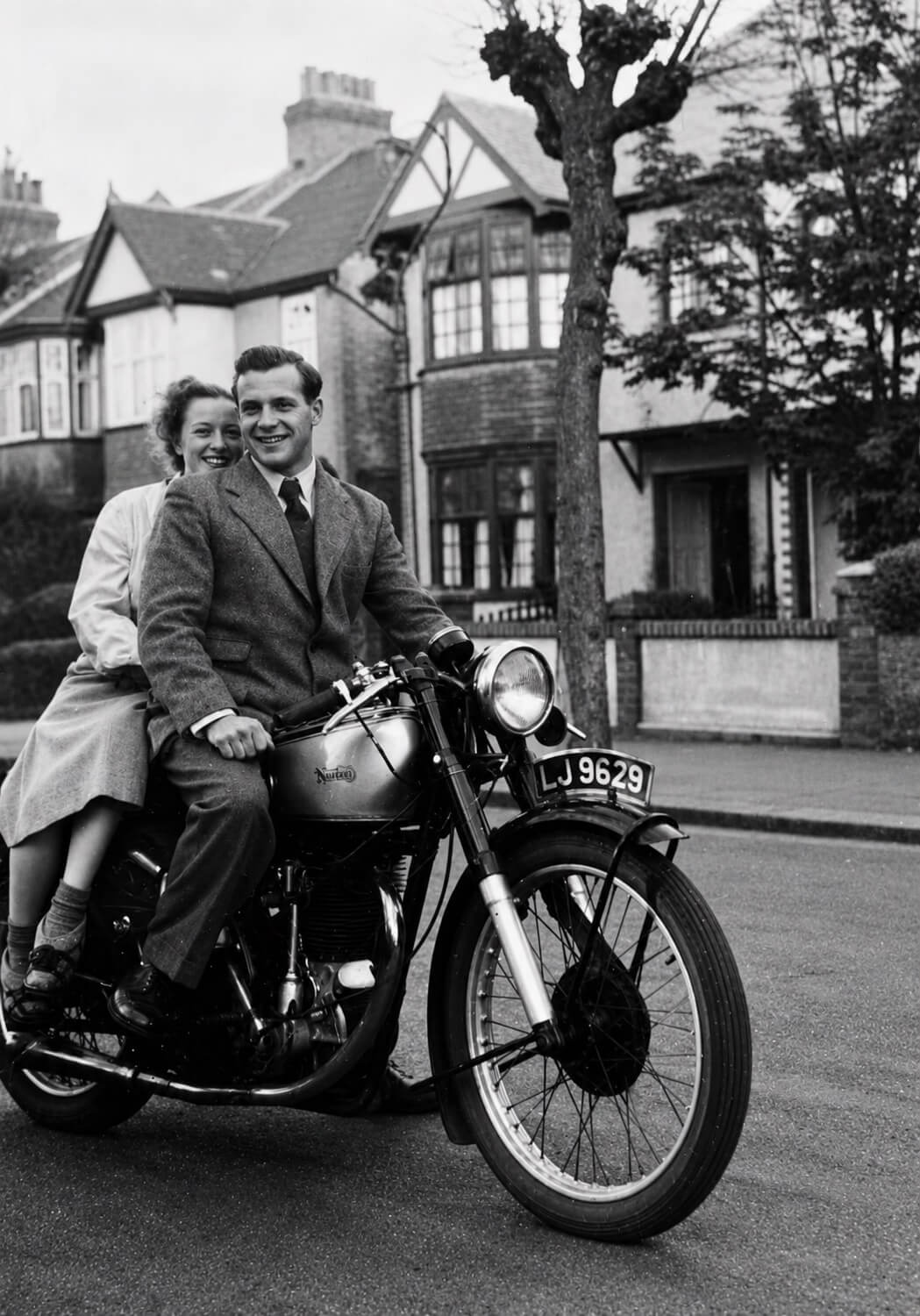
“Manx Norton, Mum and Dad.”
Long before anyone had thought of vans full of racking and power tools, Grandad had an Ariel combination. My father Barry followed. There are photographs of Dad and Mum with the Manx Norton, another from 13th November 1948 showing his BSA 500 with sidecar, and later Dad's beloved Panther combination.
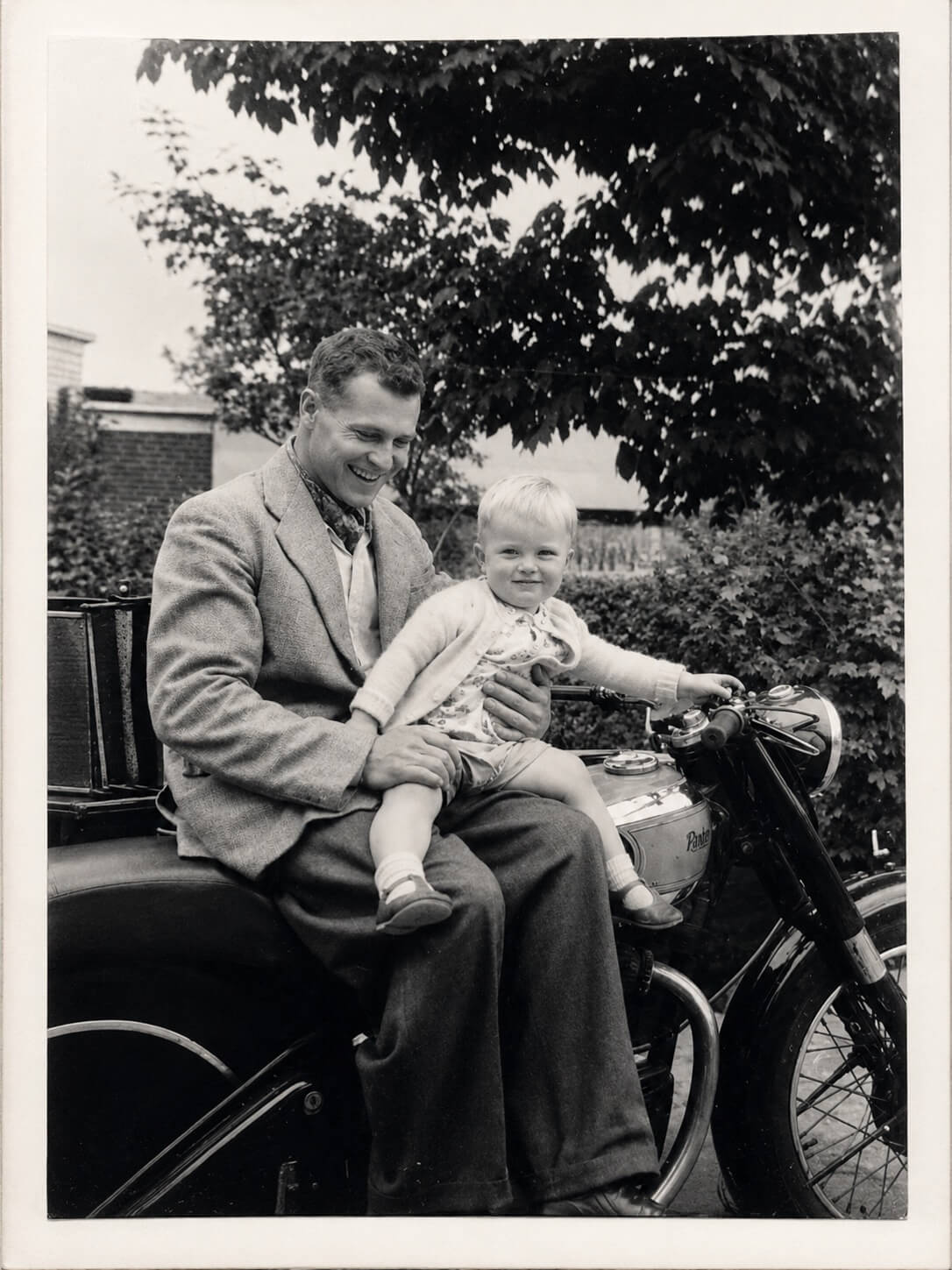
“Dad and the Panther and me.”
My brothers Steve and Rich carried it on. Steve toured the South of France in 1978 on his Suzuki 500 and later built a Suzuki racing special. Rich became a motorcycle mechanic at Monty and Ward in Edenbridge, finishing, testing and tuning motorcycles. Carolyn — the missus — had her own Suzuki Marauder. Our sons rode. And now our grandson Cameron has a Puch restoration project.
Without really intending to, I had become another link in a chain that began long before I was born. Grandad's Ariel carried decorating equipment. Dad's motorcycles carried Mum, children and sidecars. Steve's Suzuki carried him across France. Rich turned motorcycles into a profession. Carolyn rode her Marauder.
And eventually I acquired the Moto Guzzi Breva and attached a sidecar to it, whereupon motorcycles began carrying dogs. Which, when written down like that, sounds less like a progression and more like a family condition. Then, almost as an aside, Trev told me: “My dad had a motorbike and sidecar. I used to love that thing as a child.” Another connection. Motorcycles again. They seem to keep creeping into this story whether I invite them or not. And there was one more.
My younger son Steffan had broken his back in a motorcycle accident. After his back healed and he no longer needed the rigid frame supporting it, he went out on the razzle to celebrate. At that event he met Laura, his now-partner. Laura is a Woods. Wilson and Woods. And Laura's dad? Trev. Of course he is. Perhaps the Glorious Folly isn't really the end of anything. Just another piece of the jigsaw.
The actual Moto Guzzi odometer showing 99999 of the Breva V 750 i.e.
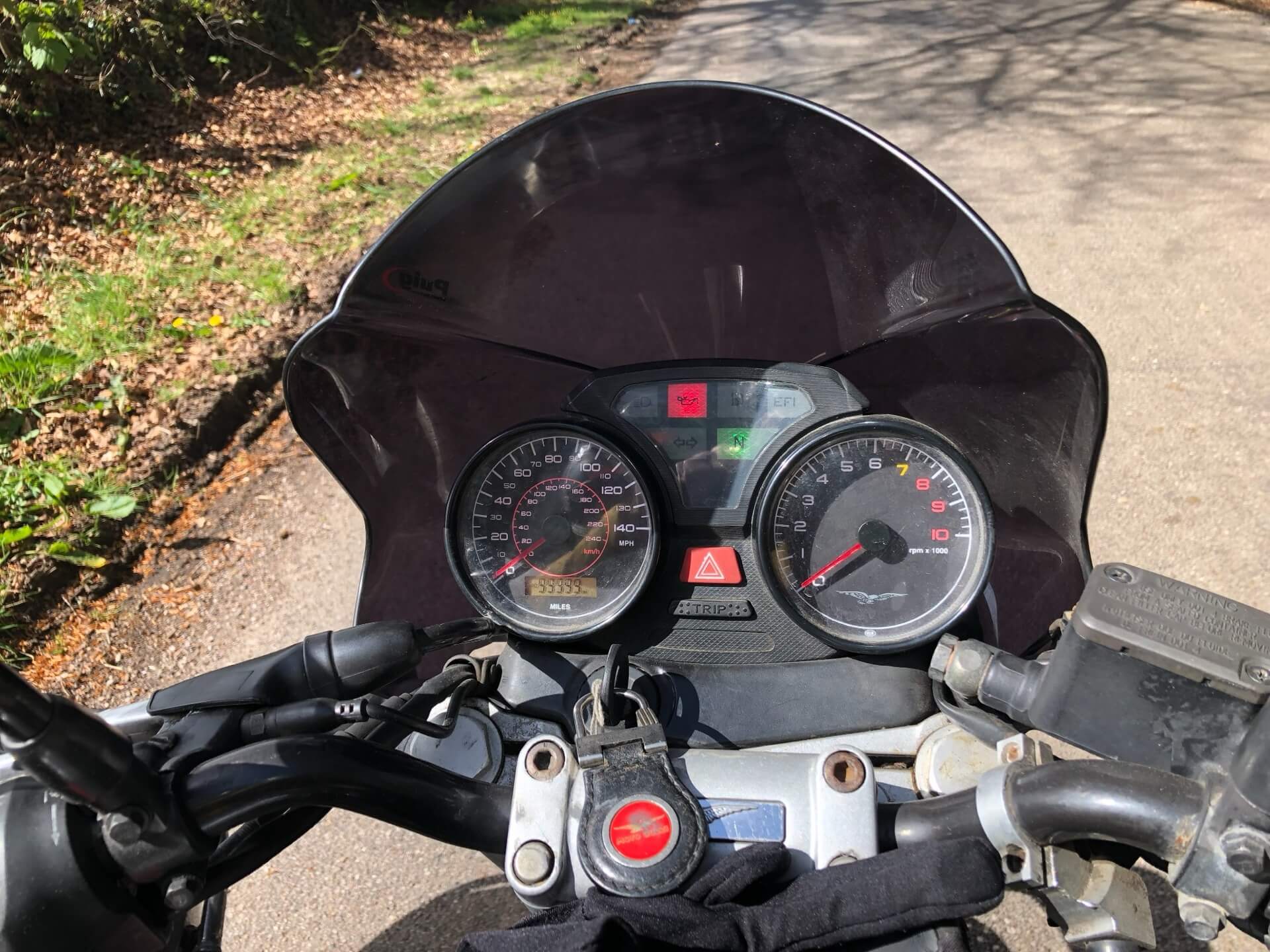
“99999 — and then it stopped. Dorset, April 2026. The missus and I were touring when the Breva reached 99,999 miles. “Better photograph that,” she said. So I did. We expected the odometer to click over to zero and start again. It never did. The Breva, however, did.”
99999: THE ANGEL NUMBER… There is one final chapter which seems particularly appropriate for a Moto Guzzi story. In early April 2026, the missus and I were touring Dorset. The Moto Guzzi Breva's odometer reached: 99999. It's a significant mileage; to some, it is known as the Angel Number. I stopped and pointed it out to my missus, who was riding pillion. “Better photograph that,” she responded. So I did. We were heading back to our shepherd's hut in Kittwhistle, expecting the odometer to click over to zero and start again. It never did. It is immovably fixed at 99999. Did Moto Guzzi ever anticipate that their remarkable motorcycle would surpass 100,000 miles and continue to operate at an exceptional level? Ours has done so.
And it has been accompanied by a Watsonian Squire sidecar for each mile of that. Now, outside our old English cottage, beneath three-hundred-year-old English oak that Trev has cut and carved into something rather wonderful, sits the Moto Guzzi combination that started this whole ridiculous business.
Lola travelling in the Watsonian sidecar.
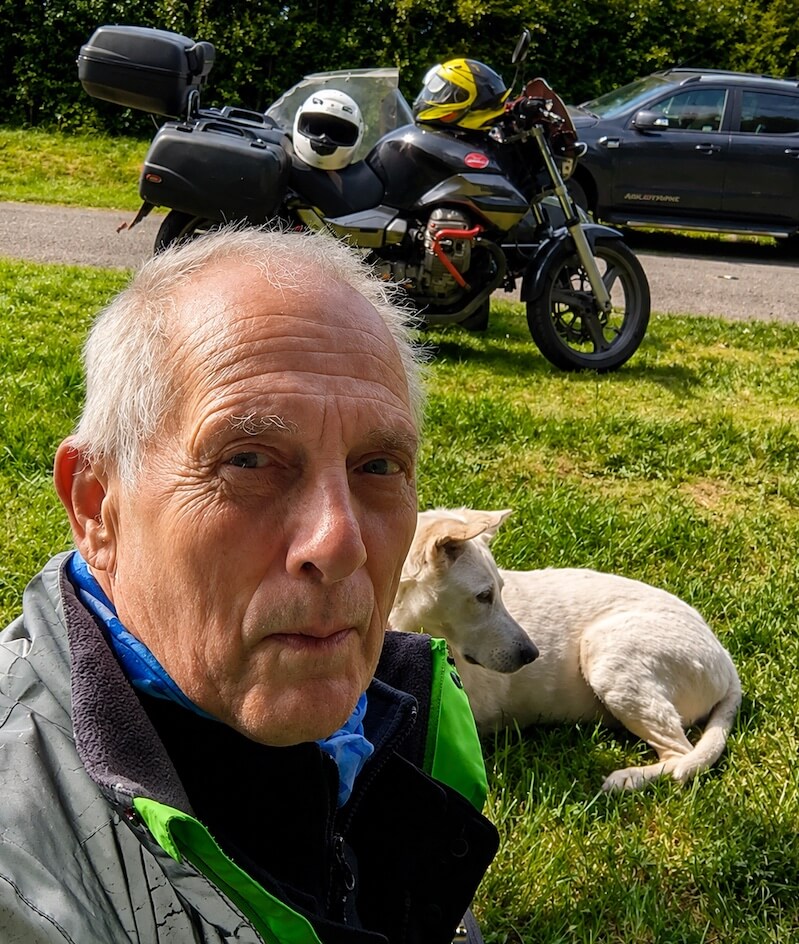
“The Watsonian was never simply decoration. Lola travelled around 88,000 miles in the sidecar, including the Scottish Highlands. Her successor Ania has continued the tradition. The sidecar exists largely because the dogs come with us.”
Addendum — The People Behind the Glorious Folly. Although the Glorious Folly began as one of my ideas, it certainly wasn't built by me alone. Like most things that start out reasonably simple and then head off down the road to madness, it eventually involved a collection of people with rather different skills.
Trev Woods — T.J. Woods & Son. The oak work belongs very firmly to Trev. He and his son Matt run T.J. Wood & Son in Dorset, and are Goldaming Trust Award winners no less! Trev is a traditional craftsman, which became increasingly important as the Folly developed. This wasn't a collection of modern timber screwed together with metal brackets. Much of the old English oak was worked using traditional mortise-and-tenon joints, half-lap joints and gallows brackets. Some of that oak may be around 300 years old, so Trev was effectively working with timber that had already lived several lives before arriving at One Oak Cottage. He also had to deal with the consequences of my design decisions. The most obvious was the missing fourth post. Structurally it would have made perfect sense. Unfortunately, it occupied precisely the bit of Sussex required by the Moto Guzzi and Watsonian. So the fourth post was out. The motorcycle was staying. The eventual solution included the flitch beam and the substantial curved oak support. Trev and I established the curve with a three-metre length of black plastic tubing — up a bit, down a bit, left a bit, right a bit, rather like The Golden Shot.
Eventually we found the golden ratio. Or at least the golden-ish ratio.
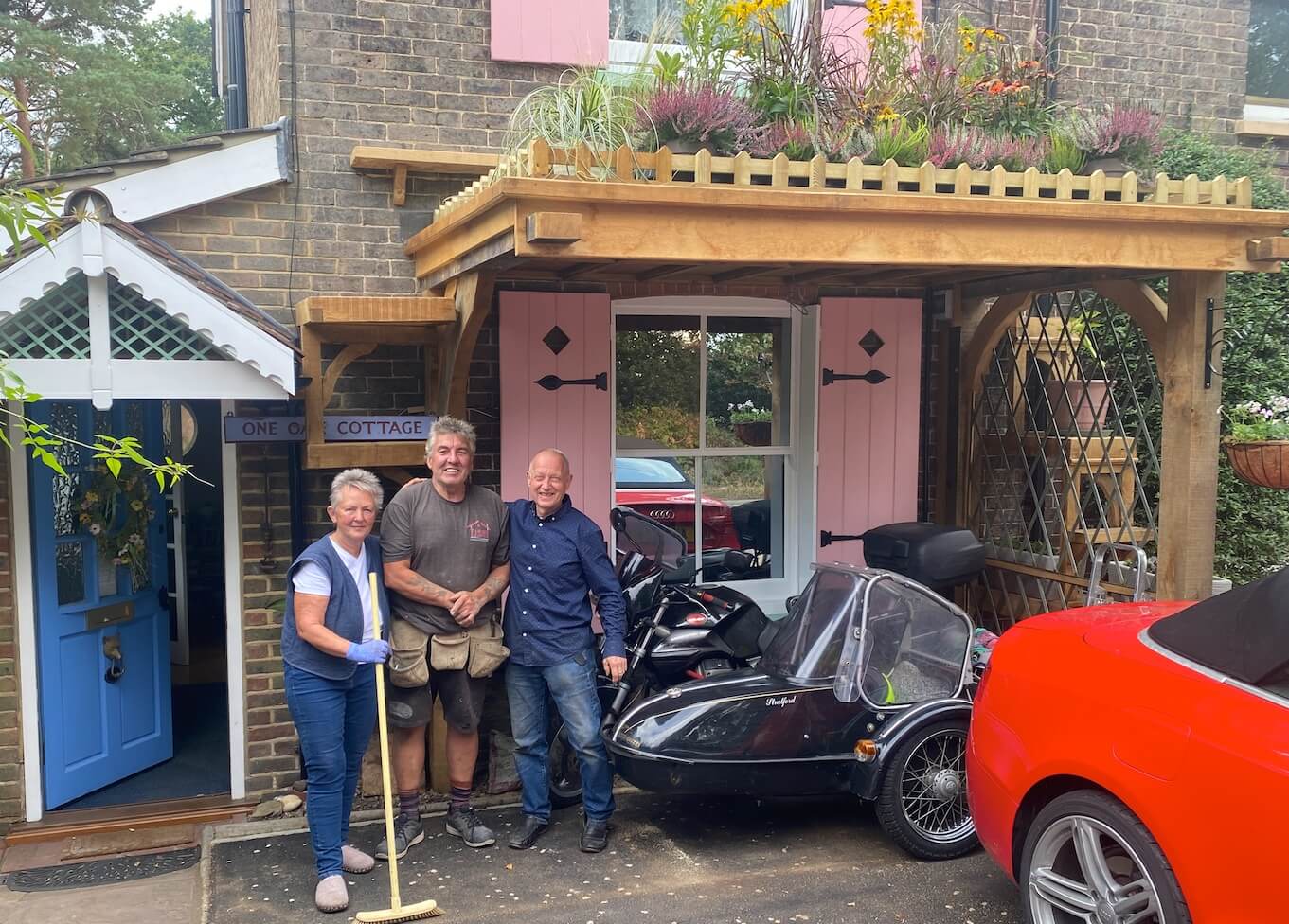
Mike Astridge — Clemsfold Sawmill. Then there is Mike Astridge at Clemsfold Sawmill, better known throughout the diary as Slinfold Mike. Mike was responsible for supplying much of the wonderful old local English oak that gave the Folly its character. This wasn't timber selected from a catalogue because it happened to be the right dimensions. Trev and I went looking through Mike's stock, finding pieces that could become posts, beams, braces and eventually the upper plant tiers. The age, grain, twists and imperfections of the timber were part of the project rather than something to be machined out of it.
Dean Milan — Atrium Building and Landscaping Limited. Before Trev could start turning old oak into the Folly, there had to be something underneath it. That brought in Dean Milan of Atrium Building and Landscaping Limited, our wiz with tarmac and sprinkles. The groundwork had become particularly important after the flooding problems at One Oak Cottage. Dean's part of the project included preparing the area and dealing with the driveway and tarmac work on which everything else depended. Even that wasn't entirely straightforward. At one point the tarmac lorry managed to wedge itself in our neighbour's driveway, leaving the hot tarmac to be barrowed in by hand. Another perfectly ordinary day at One Oak Cottage.
Khristian — Avensys Ltd. My eldest son Khristian of Avensys Ltd brought another sort of experience to the project. When it became obvious that the conventional fourth oak post wasn't going to work, the structure needed another answer. Khristian became involved with the concept and supply of the steel for the flitch beam, allowing the oak and steel to work together while preserving the clear opening required by the Guzzi and Watsonian. The result solved an engineering problem without turning the Folly into something that looked engineered.
Rich Wilson — REW Technical Services. My brother Rich Wilson of REW Technical Services dealt with another of the finishing details — the frontage sign. Rich also brought his own considerable motorcycle background to the story. He had worked as a motorcycle mechanic at Monty and Ward Motorcycles in Edenbridge, back when new Suzukis arrived partly assembled and somebody still had to finish them, test them and tune them before they went out into the world. So even the chap making the sign turned out to have motorcycles in his past. Rich was also involved with the ceramic Tiffany-style lamp selected by the missus, another small detail which somehow became part of the whole thing.
Dan — the roller blind man. Then came Dan, the roller blind man. Once the main oak structure was standing, the Folly still needed protection from the weather without becoming a conventional enclosed garage. The roller blinds provided that flexibility — protection when required while allowing the structure to remain open when it wasn't. Like so many parts of the project, something that sounded simple on paper had to work around an oak structure that had never been designed from a standard drawing in the first place.
Steffan — Audi Coulsdon. Our younger son Steffan of Audi Coulsdon supplied vehicle support and another pair of mechanically experienced hands when required. Motorcycles have followed Steffan for most of his life. He rode nearly anything and everything, including motocross, and some of his practice sessions involved boulder fields, massive logs and steep climbs that the missus wasn't particularly keen to watch. His involvement meant that yet another generation of the family motorcycle story had found its way into the Folly.
Carolyn — the Missus, otherwise ROC TekniTronics. And finally there is Carolyn — the missus, occasionally operating under the rather grand title of ROC TekniTronics. Her principal contribution was also the one condition that existed before any of the rest of us started.
The plants were staying. That requirement dictated rather more of the Folly than anybody might reasonably have expected. The plants were temporarily moved beneath our 180-year-old oak — The Day of the Triffids — while Trev and the rest of us built around the problem. Then came the oak upper tiers, trellis retainers, rainwater arrangements and eventually the return of the missus's Triffids. Carolyn also selected the Tiffany-style lamp, helped with the finishing details and, most importantly, ensured that the original brief was never conveniently forgotten. Which leaves me. I dreamed the thing up, took the photographs, wrote down what happened and occasionally held the other end of something while somebody who actually knew what they were doing got on with it.
So although it is called The Glorious Folly, it isn't really the work of one person. It is Trev's traditional oak craftsmanship, Mike's old English oak, Dean's groundwork, Khristian's steel, Rich's technical skills, Dan's blinds, Steffan's mechanical experience and the missus's determination that her plants were going nowhere. And somewhere underneath all of it sits the Moto Guzzi and Watsonian that started the whole thing. Just another piece of the jigsaw.
(Photo courtesy Ray Wilson). We thank him for sharing his story with the our readers.