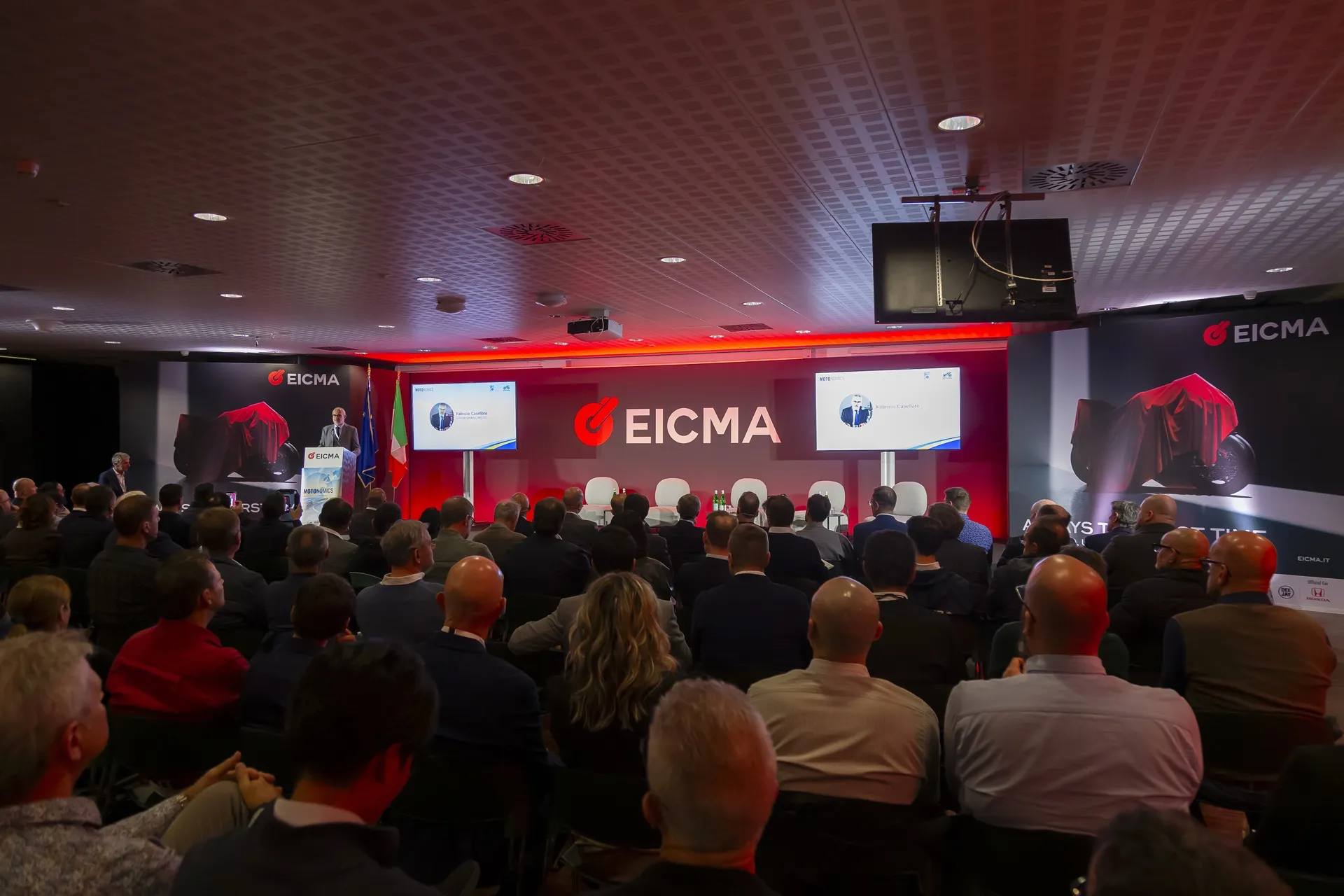
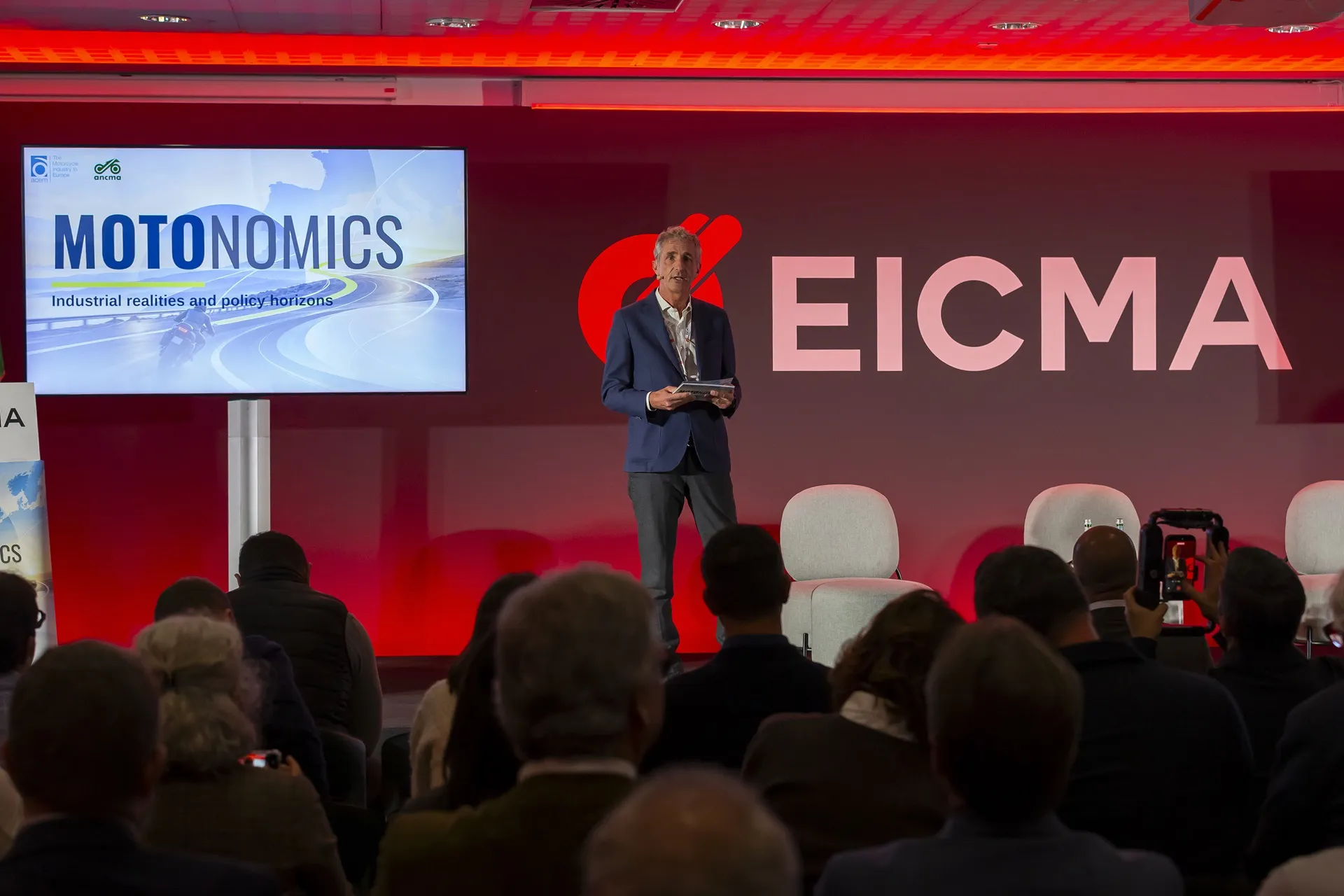
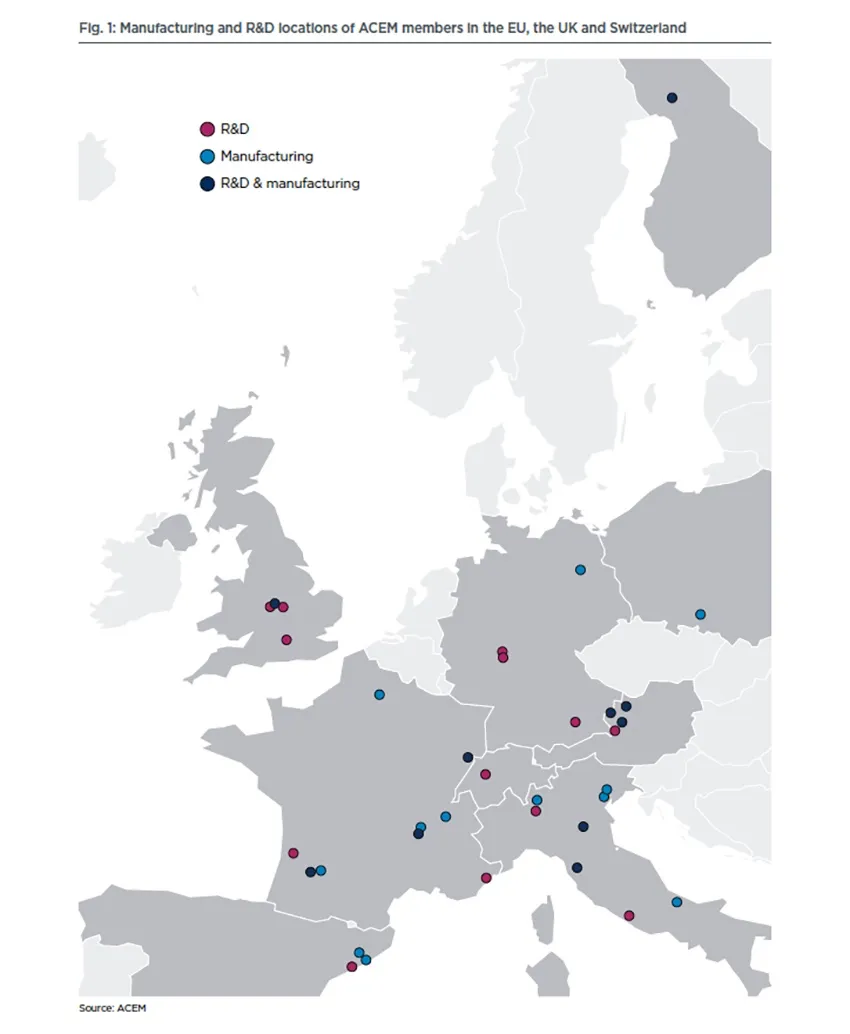
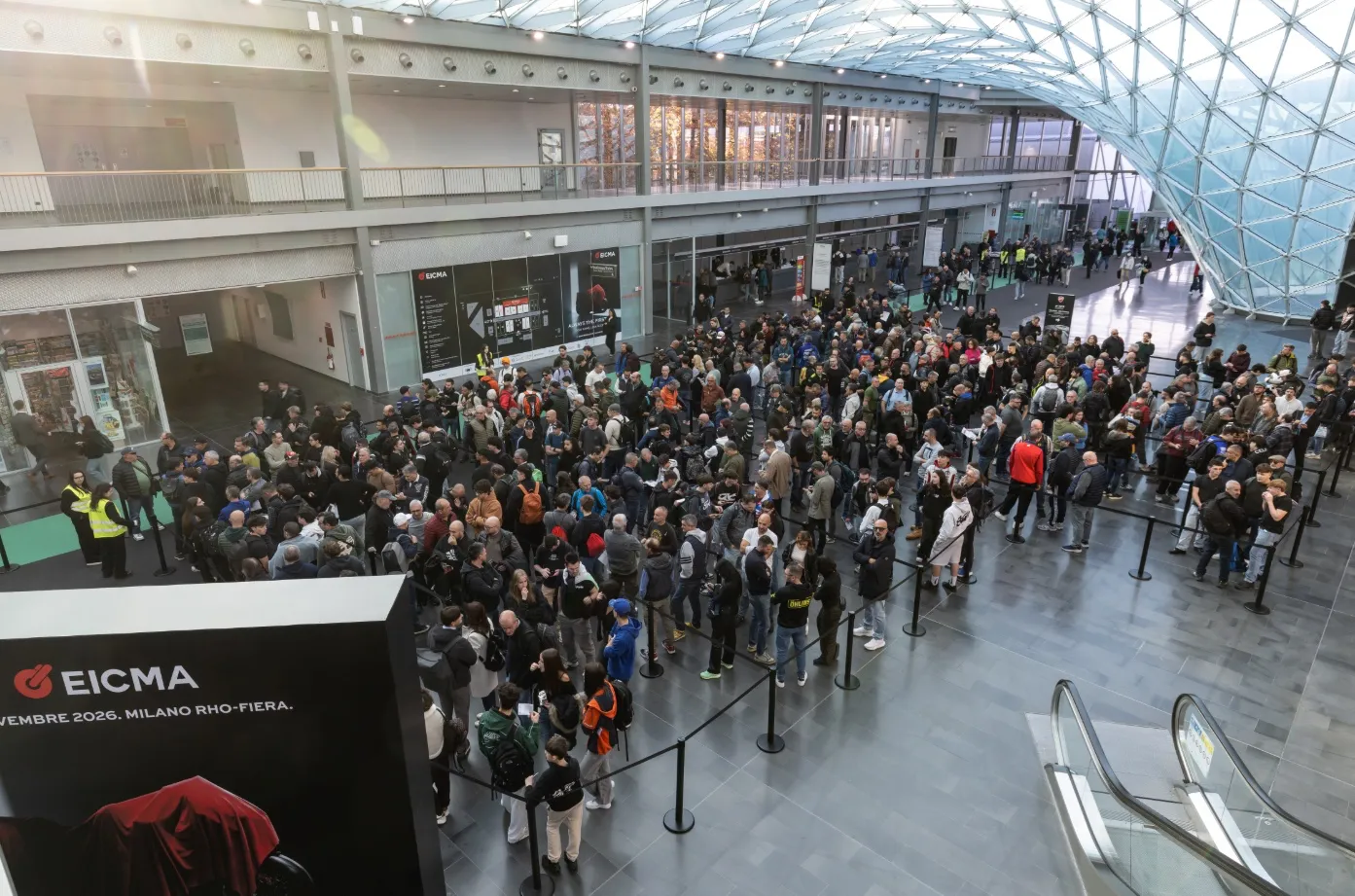
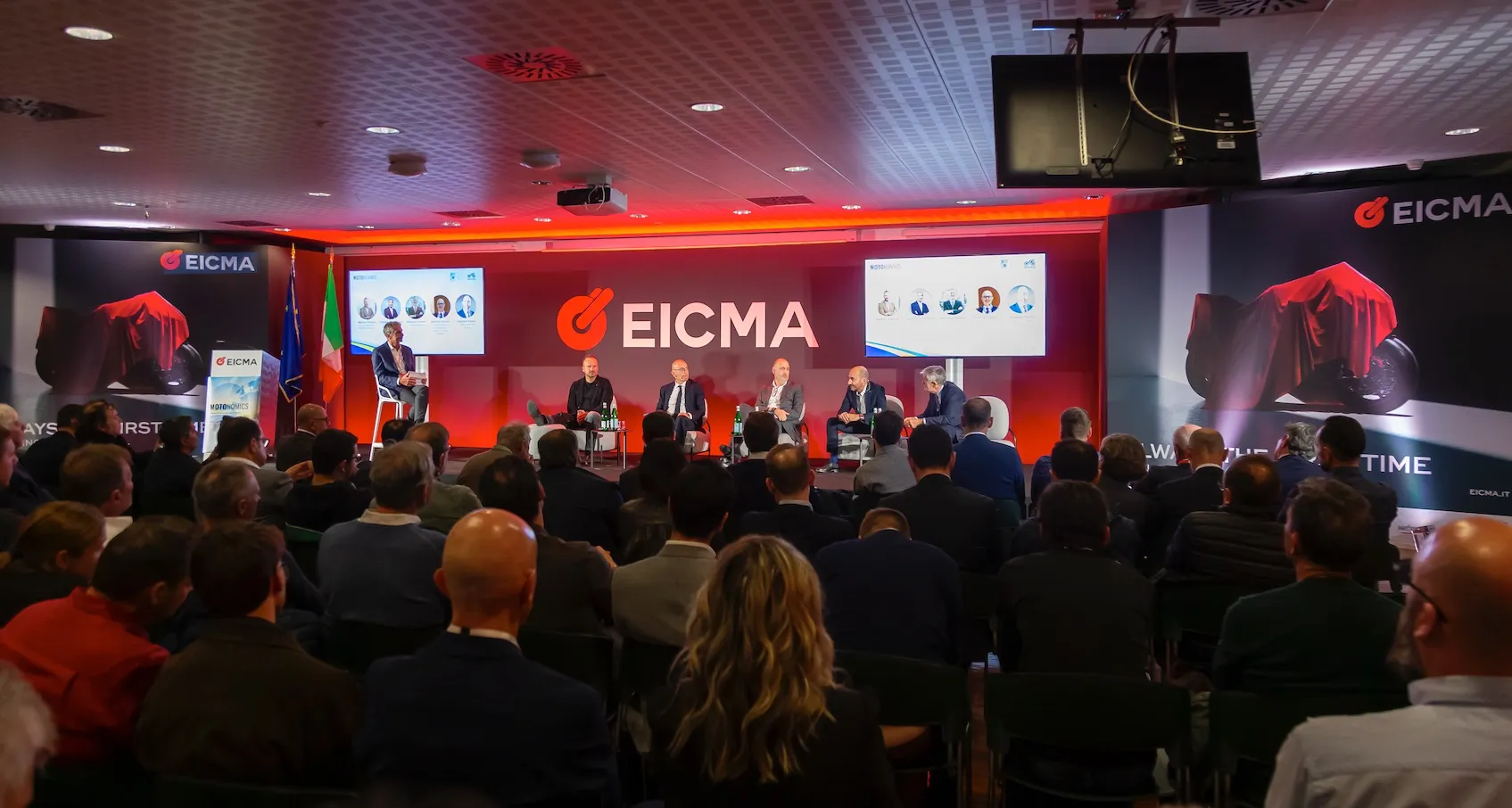
Milan, 5 November 2026 - During EICMA week, Milan is the capital of motorcycling, and there is no better place to bring industry and policymakers together to understand the economic weight of the motorcycle sector and its contribution to society. That was the aim of ‘MOTONOMICS: Industrial Realities and Policy Horizons’, a conference co-organised by ACEM, the European Association of Motorcycle Manufacturers, and Confindustria ANCMA at the EICMA fairgrounds.
EICMA photo courtesy.
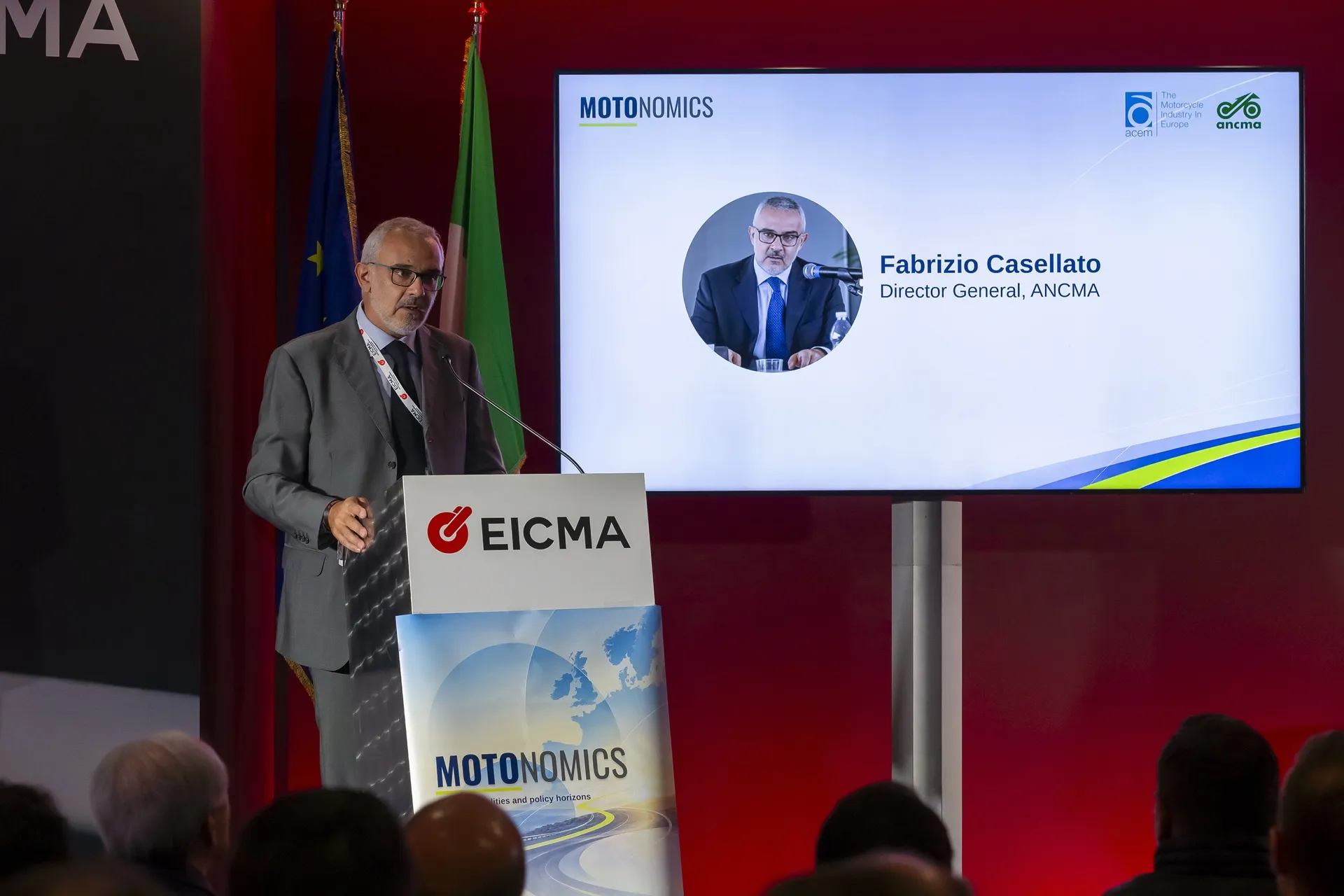
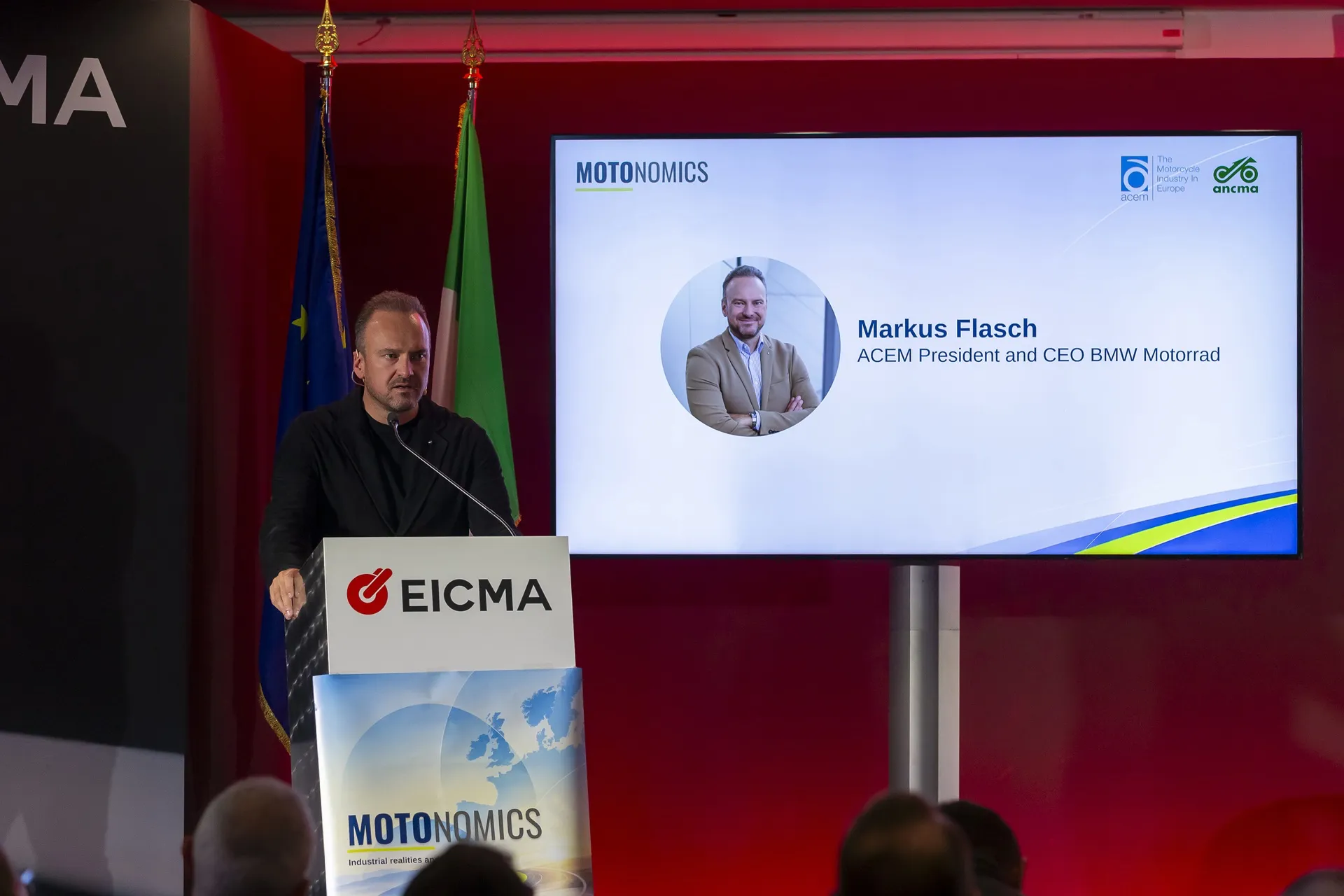
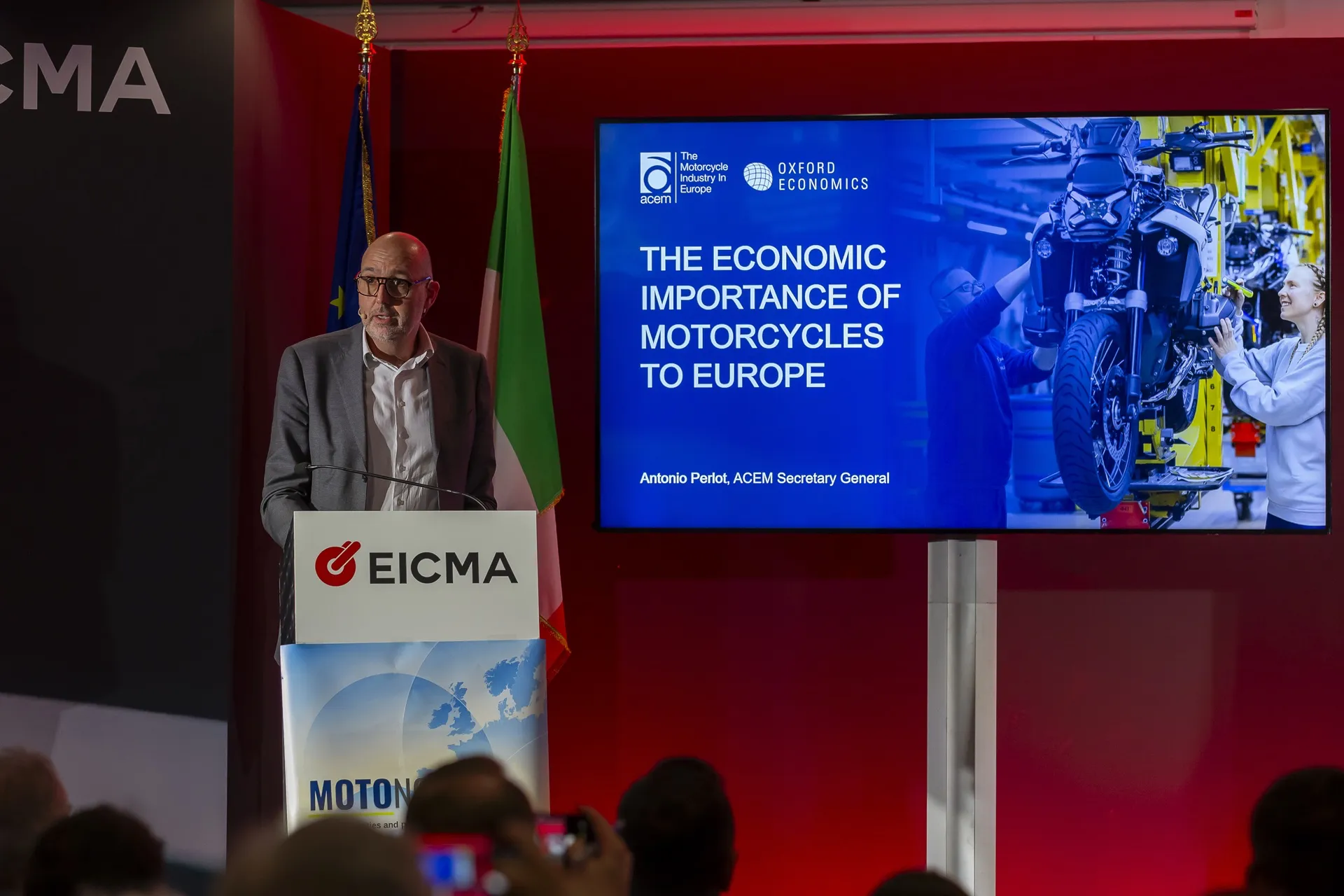
After a welcome from Fabrizio Casellato as Director of Confindustria ANCMA as host, ACEM President Markus Flasch, CEO of BMW Motorrad, gave a first preview of the industry’s new Vision 2035+, which puts competitiveness at its core and will be presented in early 2027. In his keynote, MEP Pierfrancesco Maran, Chair of the European Parliament’s Environment Committee (ENVI), highlighted the contribution powered two-wheelers make to cities. He also stressed the need for industrial policies that support manufacturing in Europe while keeping it competitive.
EICMA photo courtesy.
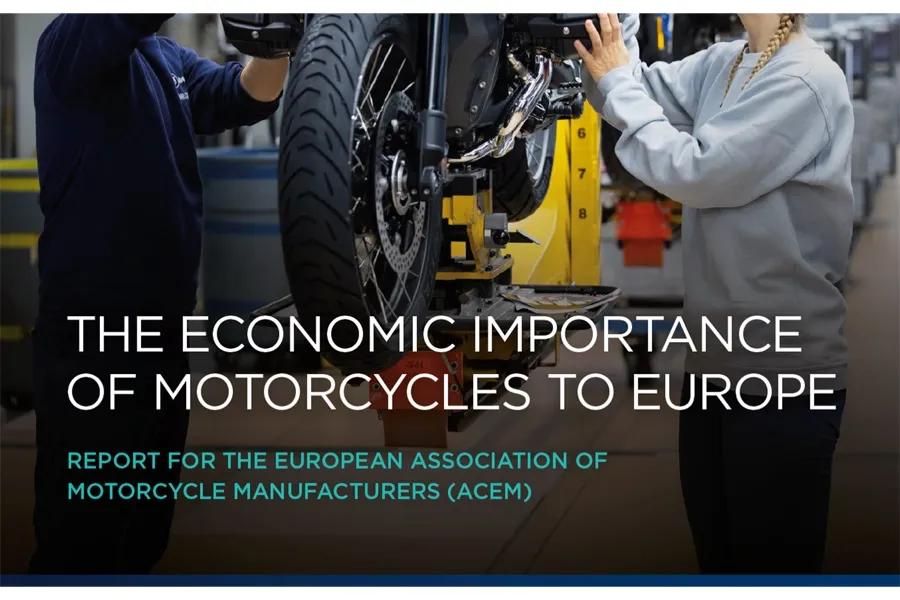
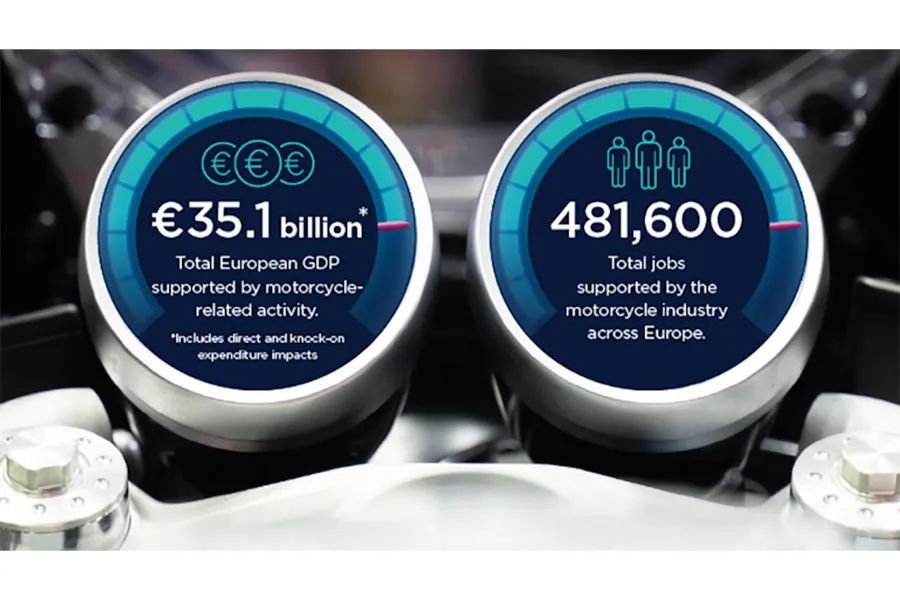
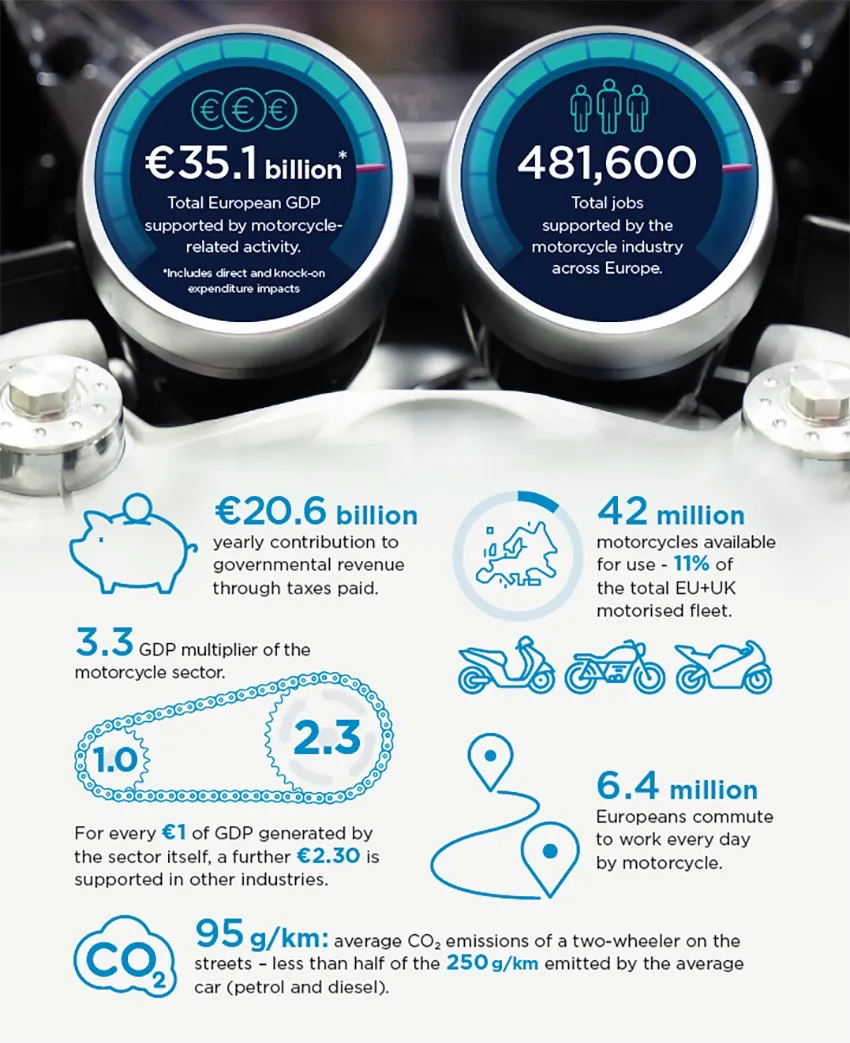
The study: €35.1 billion in GDP and 481,600 jobs. At the centre of the conference was the first presentation of a new Oxford Economics study - The Economic Importance of Motorcycles to Europe - by ACEM Secretary General Antonio Perlot. The study found that in 2024 the motorcycle sector supported €35.1 billion of GDP across the EU and the UK. It also supported 481,600 jobs and generated €20.6 billion in tax revenues.
Source: https://www.acem.eu/wp-content/uploads/2026/10/ACEM-Report-2026-PAGES.pdf
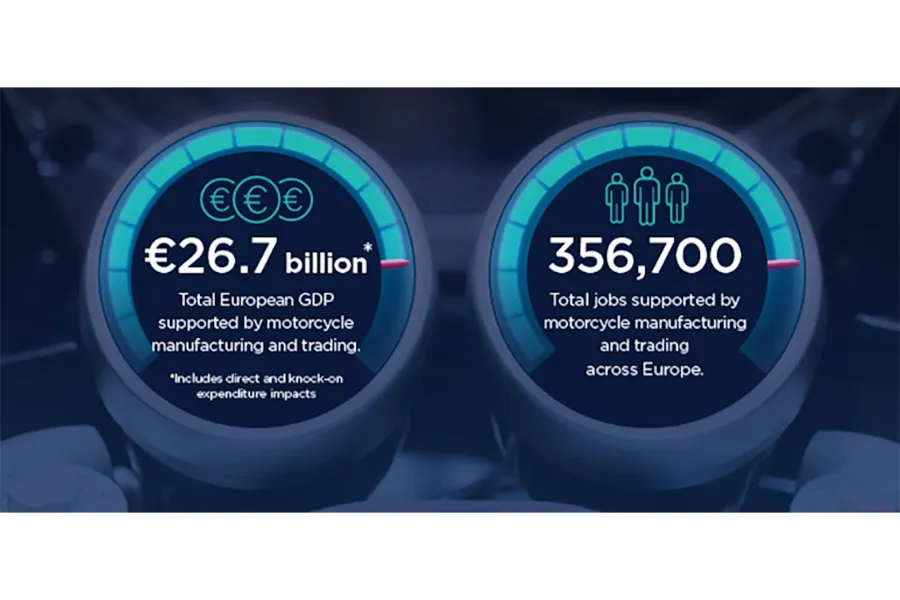
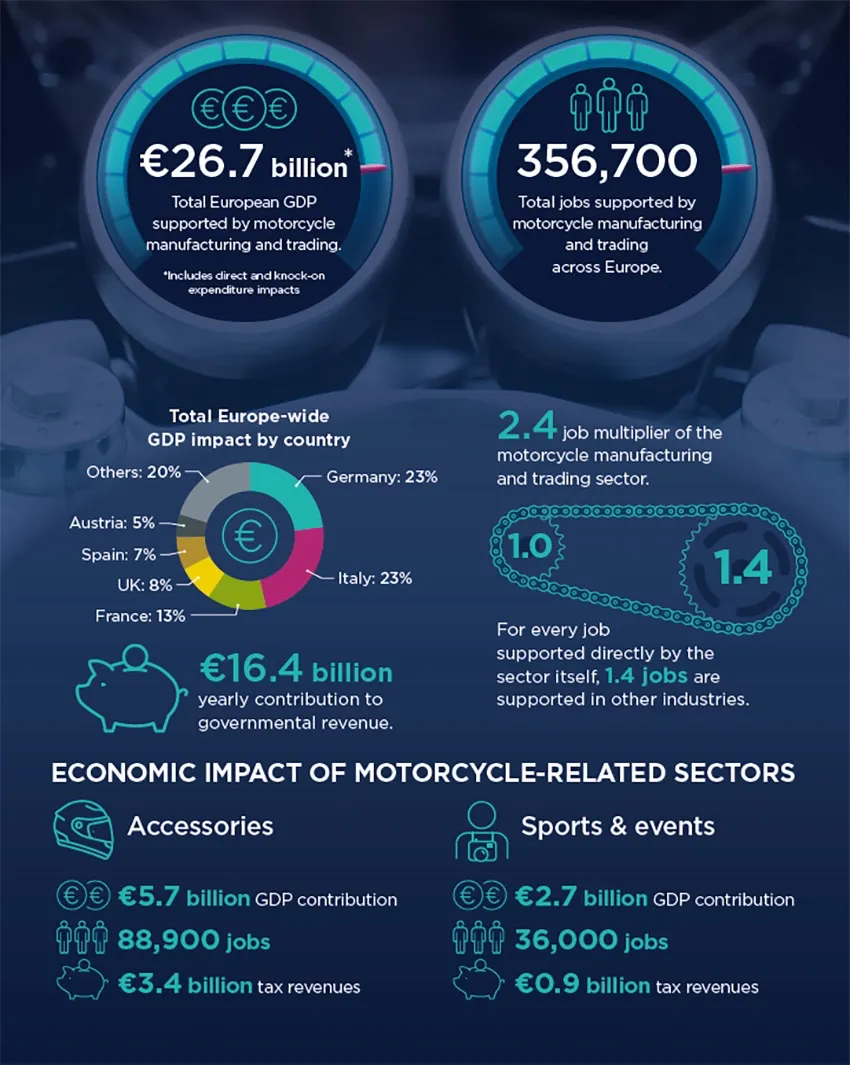
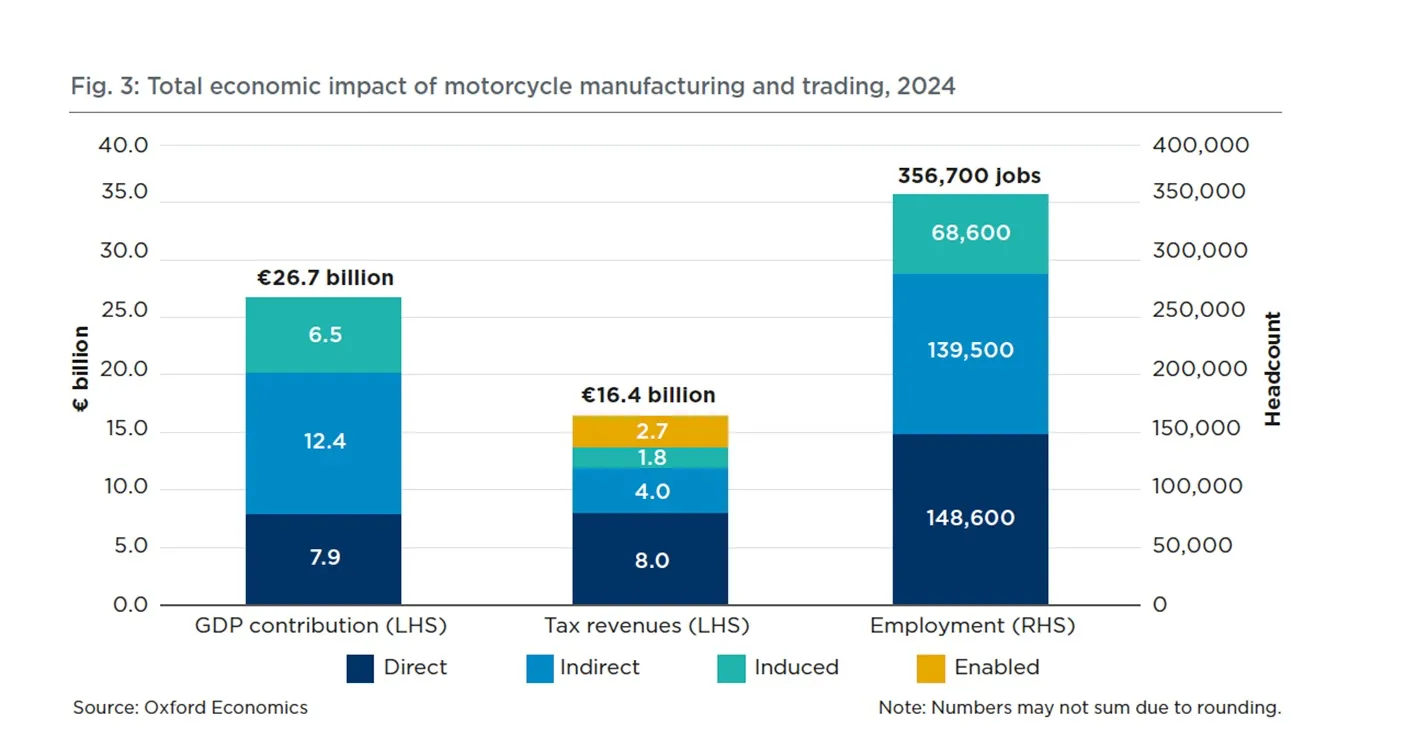
Three-quarters of this impact comes from the heart of the industry: making, selling and repairing motorcycles and their parts, which supported €26.7 billion of GDP and 356,700 jobs. Helmets, riding clothing and protective gear added €5.7 billion and almost 89,000 jobs. Races, trade fairs and brand events contributed a further €2.7 billion and 36,000 jobs.
Source: https://www.acem.eu/wp-content/uploads/2026/10/ACEM-Report-2026-PAGES.pdf
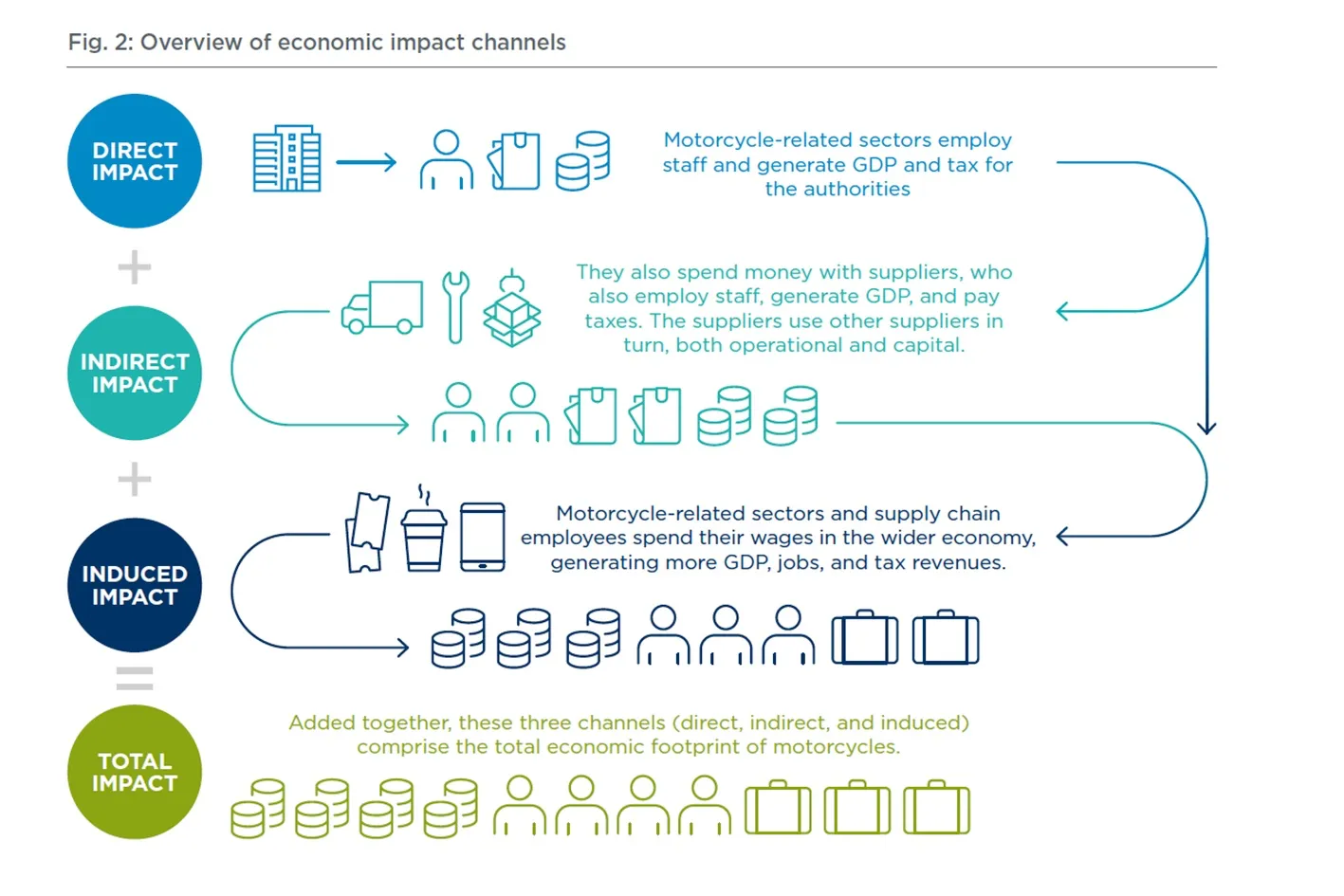
A value chain that reaches far beyond the factory. Of the 481,600 jobs, 208,900 are in the sector itself, from manufacturing to dealers and workshops. The rest come from a ripple effect that spreads well beyond the sector. Its own activity generates €10.6 billion of GDP directly.
In other words, every €1 of GDP the sector generates directly supports a further €2.30 elsewhere in the economy, and every job in the sector supports 1.3 more in other industries. For manufacturing, sales and repair, almost half of the value supported (46%) is created at suppliers.
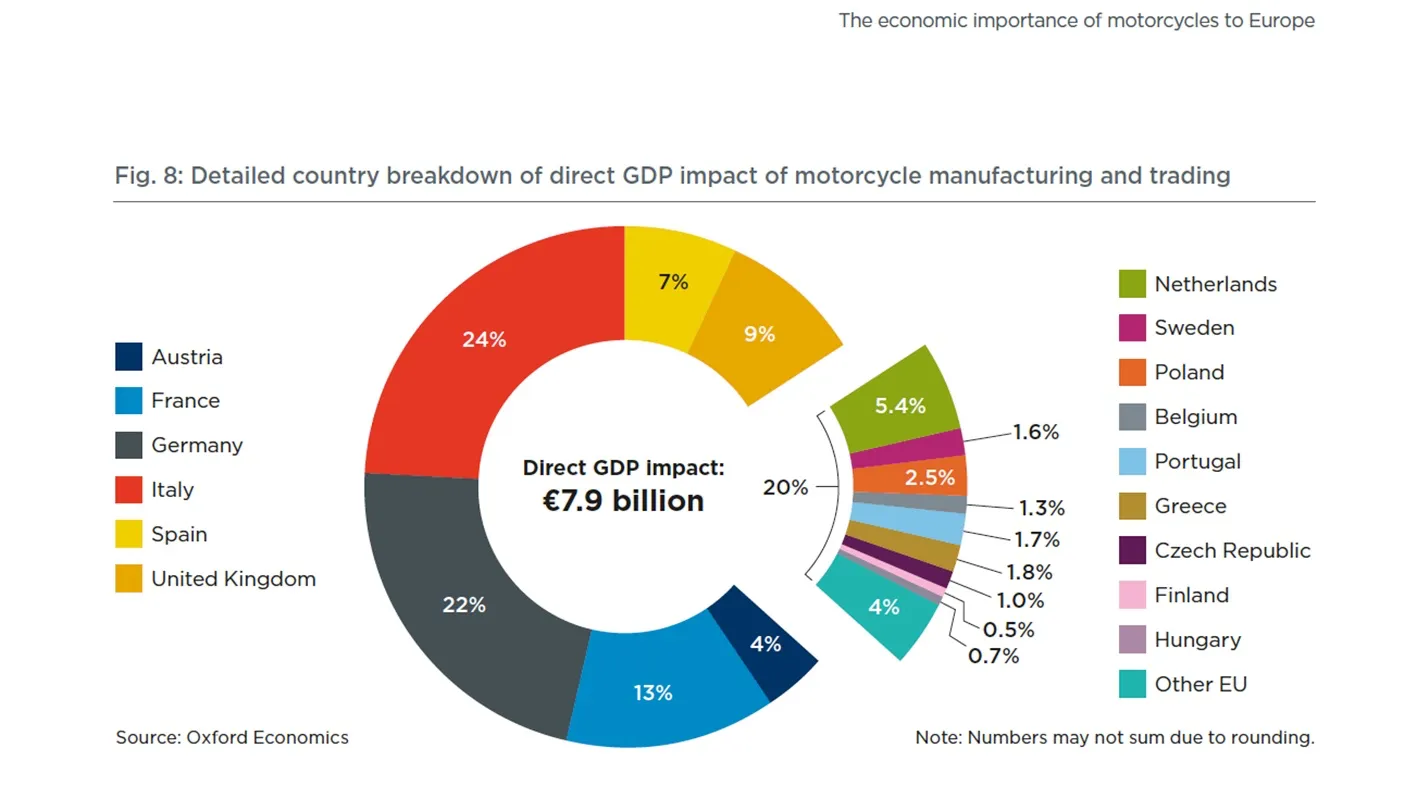
Italy and Germany each account for 23% of the total contribution, followed by France (13%), the UK (9%), Spain (7%) and Austria (5%). The figures are conservative given that activities such as motorcycle tourism, rider training, insurance and delivery services could not be counted.
Source: https://www.acem.eu/wp-content/uploads/2026/10/ACEM-Report-2026-PAGES.pdf
Trade: a 2024 baseline, and a tougher 2025. In 2024, around half of EU motorcycle and parts production was exported, up from 43% in 2019. EU exports reached €2.5 billion against €3.5 billion of imports, a trade gap of around €1.0 billion. The United States was the largest export market, worth €761 million, while tariffs in China, India and Thailand remained far higher than the EU’s and often non-reciprocal.
Source: https://www.acem.eu/wp-content/uploads/2026/10/ACEM-Report-2026-PAGES.pdf
Because trade conditions changed sharply after 2024, ACEM prepared an update with 2025 figures. It shows exports falling 22% to €2.0 billion and imports rising 12% to €3.9 billion, so the trade gap almost doubled to €1.9 billion.

https://www.facebook.com/PiaggioItalia/
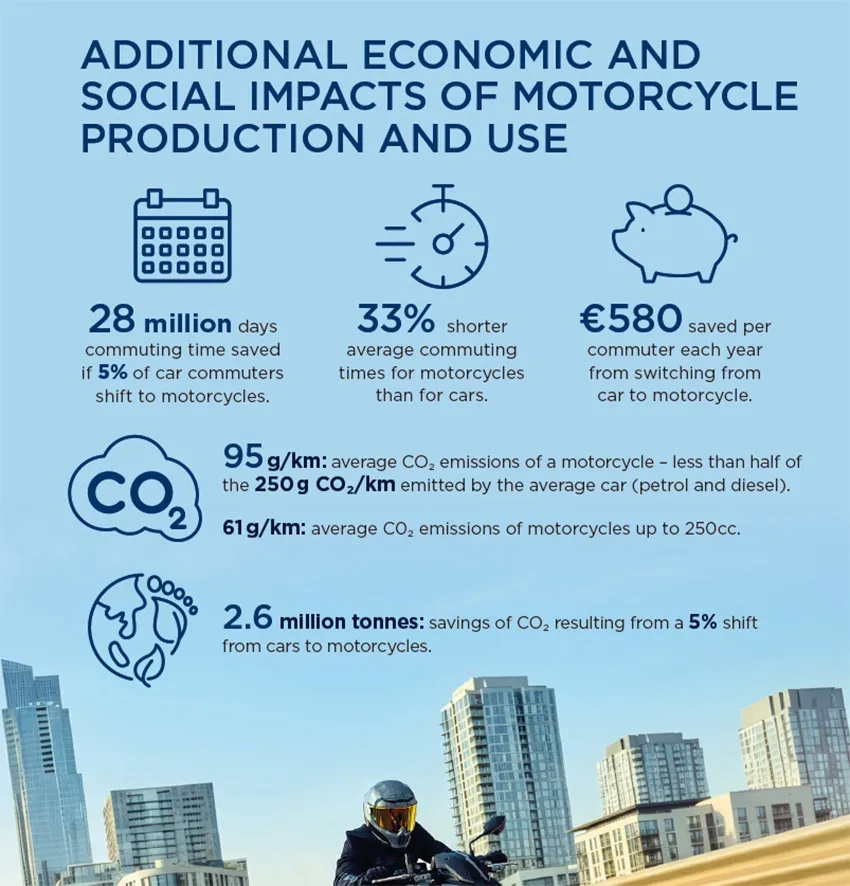
Part of the answer for cities. The study also quantifies the benefits for users and the environment. There are 42 million motorcycles on Europe’s roads, 11% of the motorised fleet, and 6.4 million people ride to work every day. Their commutes are a third shorter than by car, saving each rider around €580 a year. A motorcycle needs 2.9 m² of parking against 11.5 m² for a car, so four fit in one car space. Today’s motorcycle commuters already avoid around 2.4 million tonnes of CO₂ a year compared with driving.
The study also models what would happen if 5% of car commuters switched to a motorcycle. They would save 28 million days of travel time a year, worth €8.6 billion, and €3.9 billion in running costs. Europe would avoid 2.6 million tonnes of CO₂, and cities would free 124 km² of parking, the equivalent of more than 17,000 football pitches. Evidence from a congested Belgian motorway suggests that a 10% shift could cut congestion delays by up to 40%, benefiting every road user.

https://www.facebook.com/MotoGuzziItalia/?brand_redir=26116053655
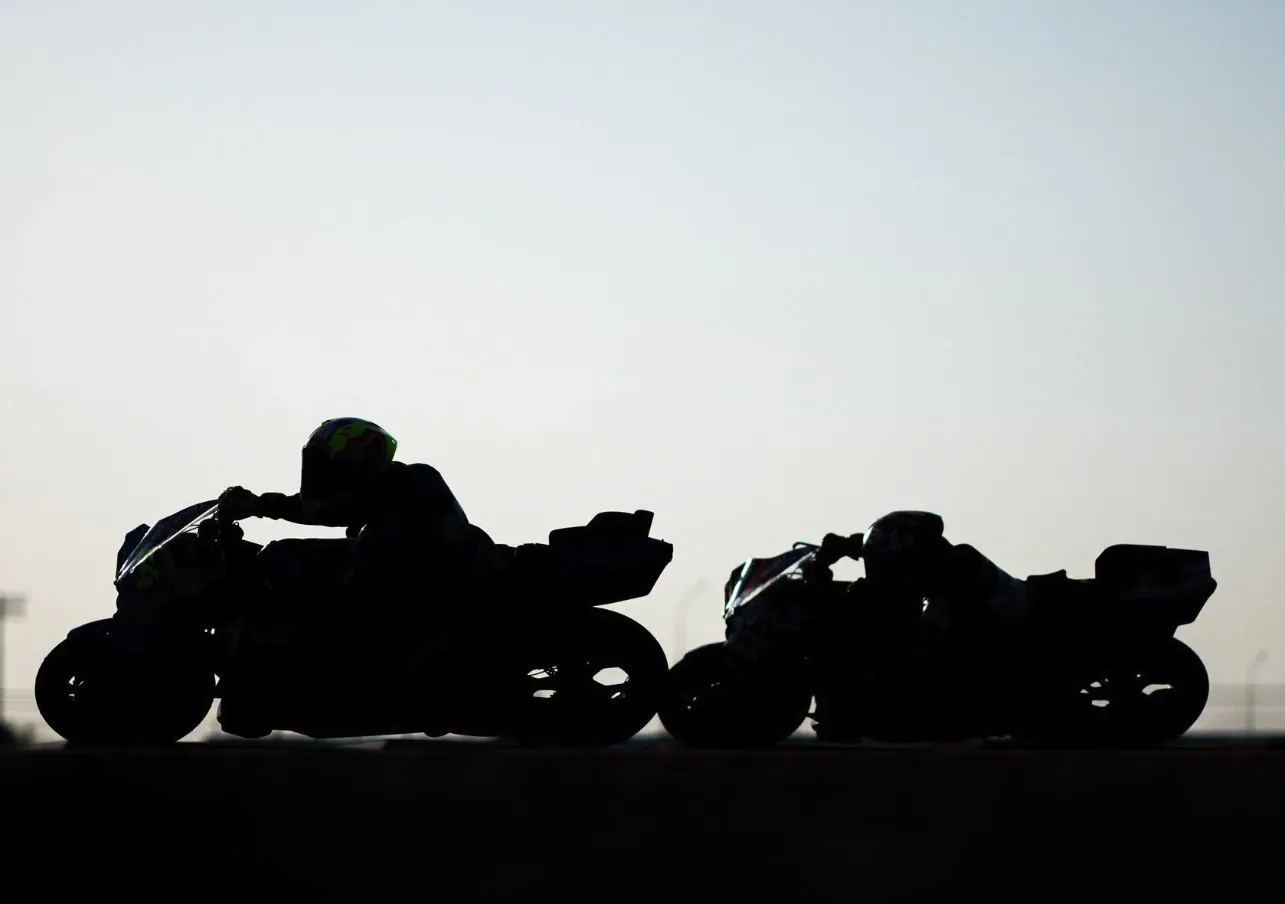
Leisure, sport and tourism. Motorcycling also means passion. More than 5 million spectators attended major motorcycle sporting events in 2024. Sports and promotional events supported €2.7 billion in GDP. Motorcycle tourism also brings spending to hospitality businesses, particularly in rural regions. The study could not put a figure on motorcycle tourism, so the sector’s real contribution is likely to be even higher.
EICMA photo courtesy.
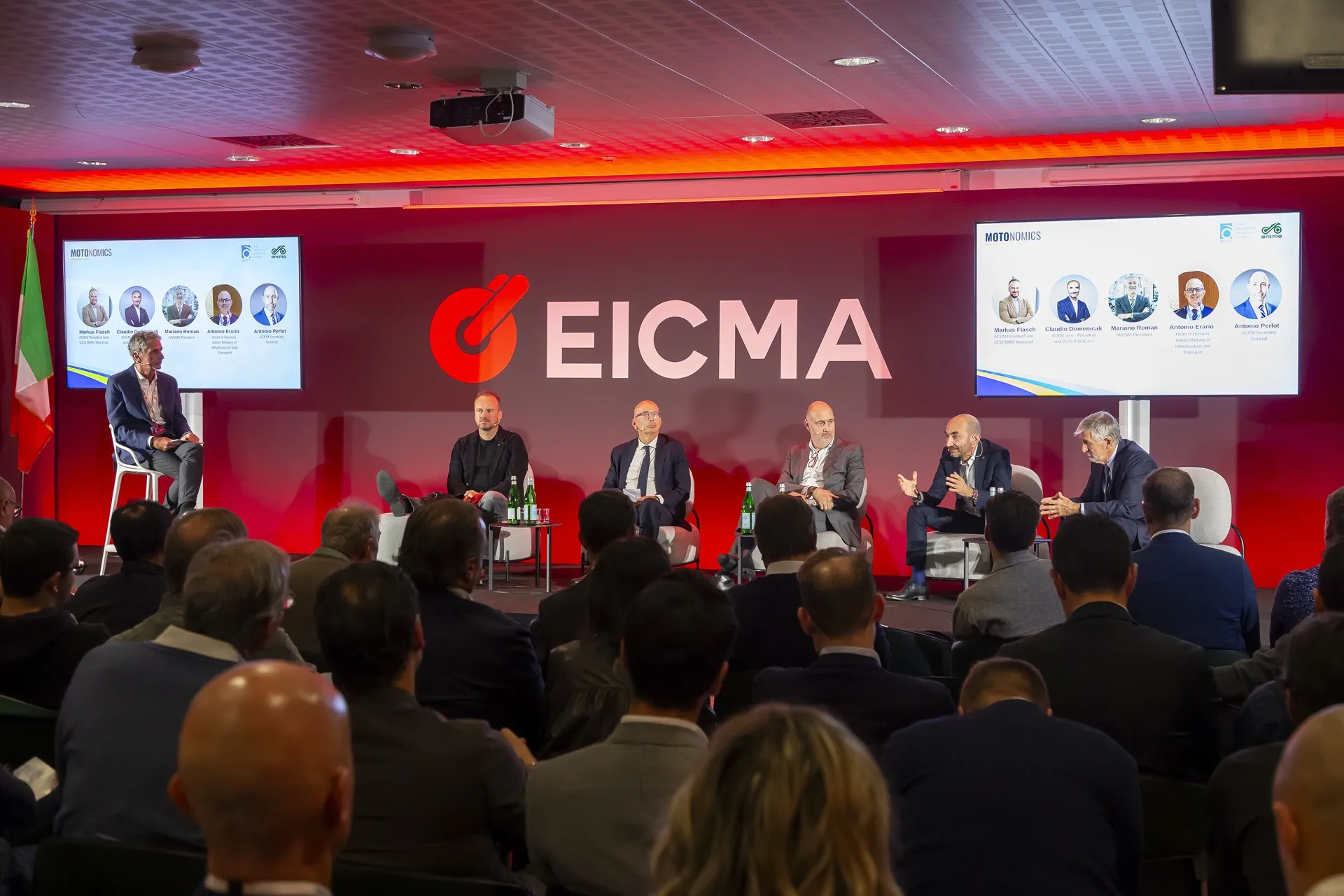
After the presentation of the study and using the figures presented as a baseline, the conference closed with a roundtable on competitiveness, trade and the future of the industry. Moderated by Federico Vitale (Confindustria ANCMA), with Markus Flasch (CEO BMW Motorrad and ACEM President), Claudio Domenicali (CEO Ducati and ACEM Vice-President), Mariano Roman (President, Confindustria ANCMA), Antonio Erario (Italian Ministry of Infrastructure and Transport) and Antonio Perlot (ACEM Secretary General), the panellists focused on Europe’s competitiveness in a changing and increasingly challenging global environment, particularly growing competition from China, and on the regulatory path ahead.
https://www.facebook.com/ApriliaItalia/?brand_redir=16273924161
Quotes: Antonio Perlot, ACEM Secretary General: This study gives us a complete picture of what motorcycling brings to Europe: €35 billion in value, almost half a million jobs and real benefits for the way people move in cities. But these figures cannot be taken for granted.. To stay competitive, European manufacturers need fair and reciprocal access to global markets, motorcycles fully integrated in urban mobility planning and, above all, conditions supporting manufacturers’ continued investment in Europe.”
Source: https://www.acem.eu/wp-content/uploads/2026/10/ACEM-Report-2026-PAGES.pdf
Mariano Roman, President of Confindustria ANCMA: “These figures confirm the value of an industry that creates jobs, skills and innovation, and in which Italy is one of Europe’s leading players. EICMA is its global point of reference: the place where the motorcycle industry presents its future and engages with markets, the public and institutions. Bringing this debate here means linking the sector’s economic and social value to the choices needed to sustain it. Growth in registrations does not automatically translate into higher production and profitability: to keep investing and innovating in Europe, we need clear and proportionate rules, reciprocity in trade and full recognition of two-wheelers in mobility policies.”
Source: https://www.acem.eu/wp-content/uploads/2026/10/ACEM-Report-2026-PAGES.pdf
The full study is available at The economic importance of motorcycles to Europe:
https://www.acem.eu/wp-content/uploads/2026/10/ACEM-Report-2026-PAGES.pdf
The 2025 Trade analysis prepared by ACEM is available at Annex to Section 4: Trade update 2025-2026: https://www.acem.eu/wp-content/uploads/2026/10/ACEM_Annex_Trade_Update_2025.pdf
Source-ACEM press release:
https://www.acem.eu/motorcycles-support-e35-1-billion-of-europes-gdp-and-nearly-half-a-million-jobs-new-oxford-economics-study-finds/
(G.T.).