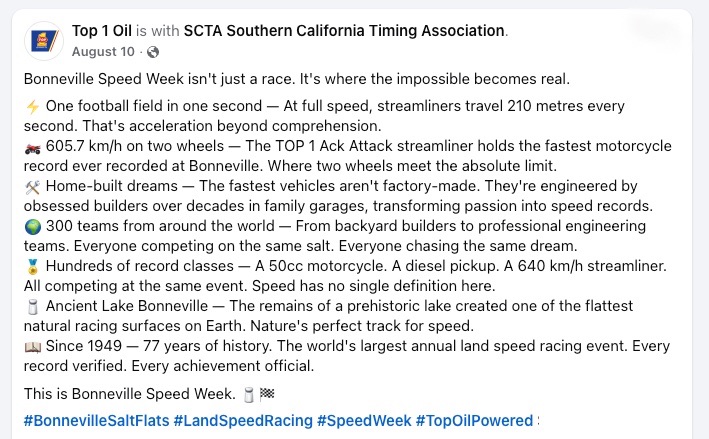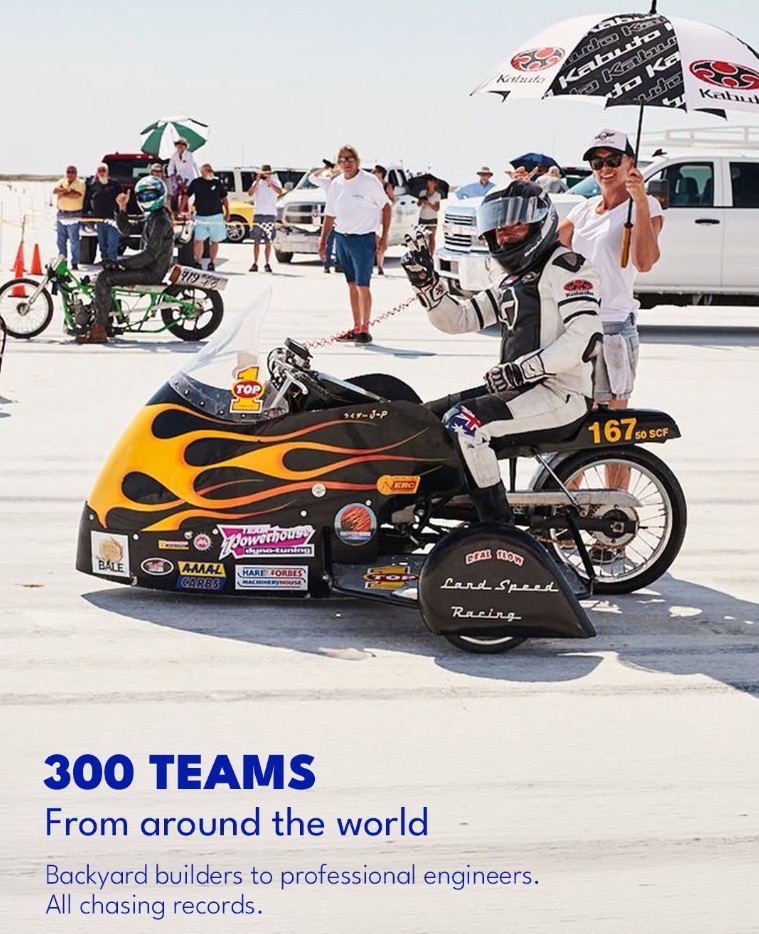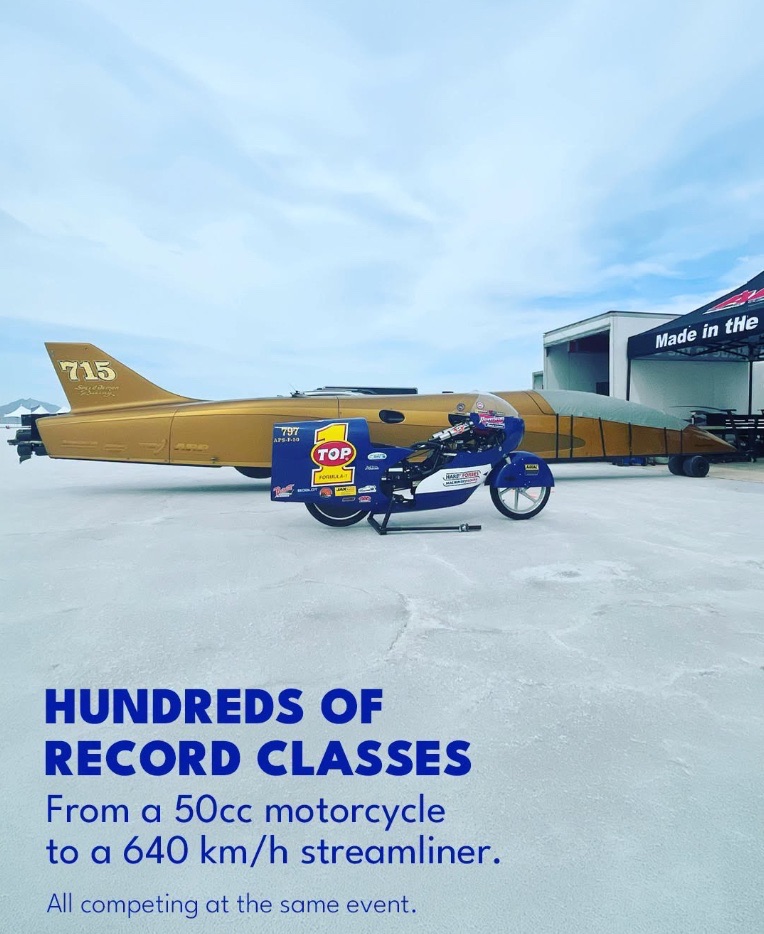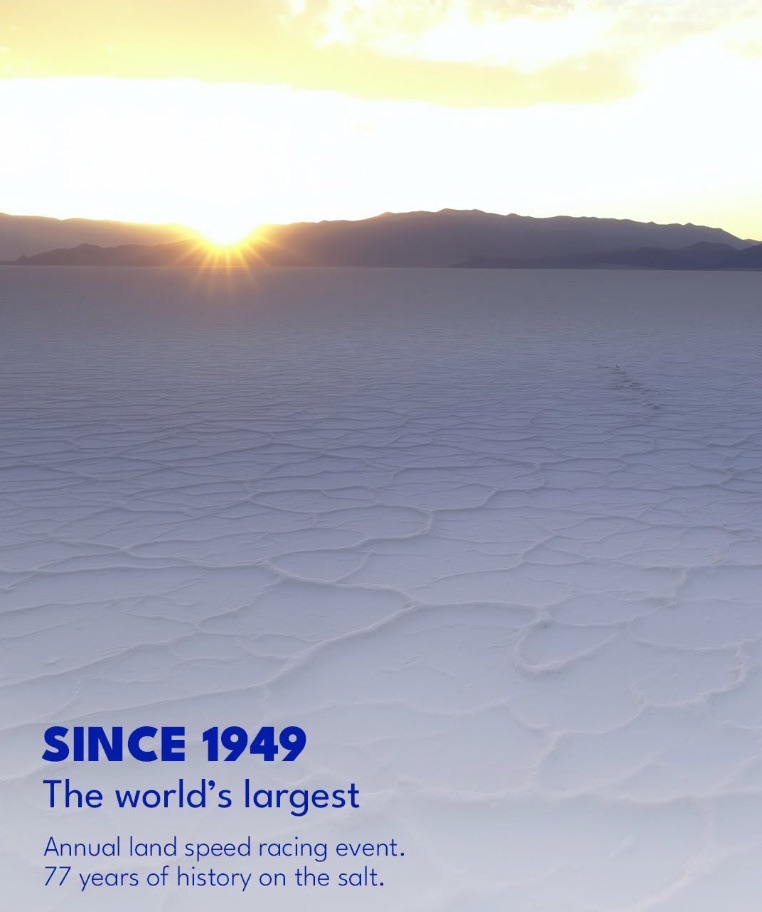
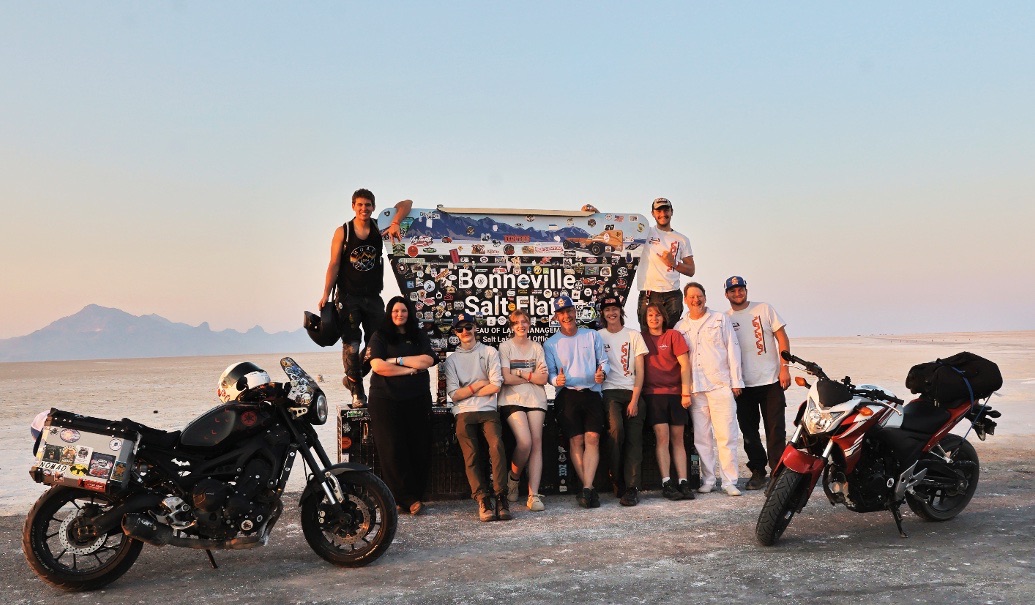
Entrance to Bonneville Salt Flats, Utah, USA (photo: Danny Sasser www.sasr.studio).
FIVE RECORDS IN FIVE ATTEMPS ON THE BONNEVILLE SALT FLATS.
BY JOHN “SPEEDY” GREEVEN AND WILL “SPARKY” ALLEN – GREEVEN-ALLEN LSR
October 2026 (G.T.) – By John “Speedy” Greeven and Will “Sparky” Allen — Greeven-Allen LSR.
Two years ago, Wide Magazine told the story of our Aprilia RS50 land-speed efforts at California’s El Mirage dry lake and the Bonneville Salt Flats. Those 2024 records were hard earned. Things did not always go according to plan, and much of the story was about solving problems, recovering from setbacks and simply refusing to quit.
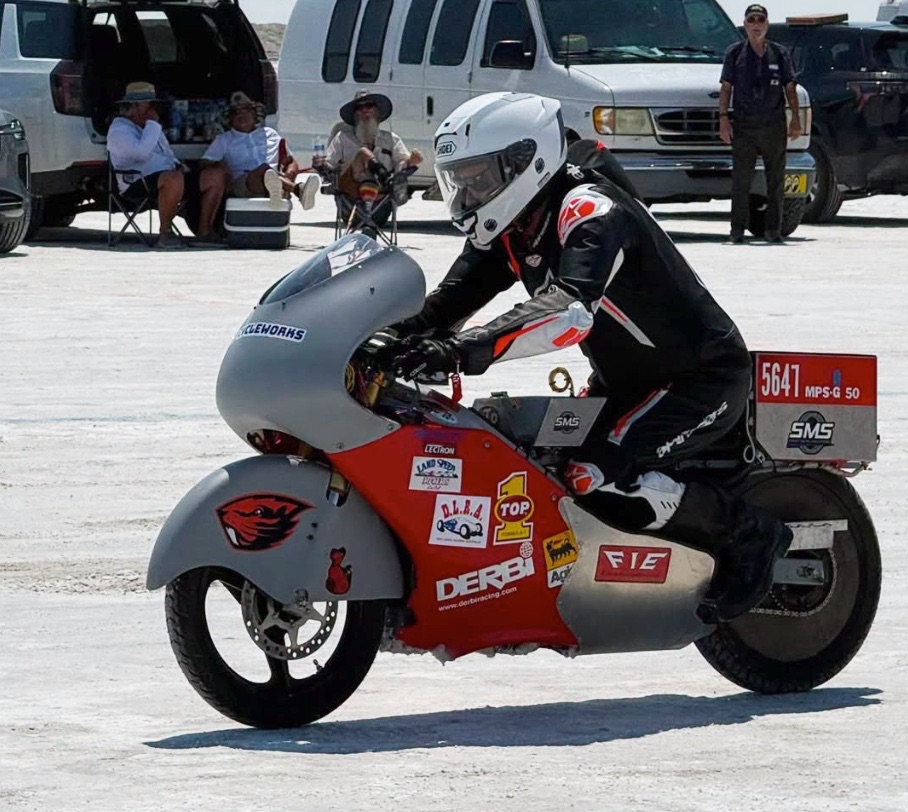
In 2026, we came back with a different motorcycle — and a very different story. Our new machine was a 2003 Derbi GPR 50, and we had spent months testing it, learning what it liked and trying to eliminate surprises before we ever reached the Bonneville Salt Flats. The goal was simple: make every run count. At Southern California Timing Association (SCTA) Speed Week, ten runs — five qualifying runs and five record confirmations — produced five new records in five attempts. This time, the lesson was not about recovering from adversity; it was about preparation, repeatability and execution.
A new motorcycle and a strong foundation.
The Derbi GPR 50 gave us a very good starting point. Its Derbi engine has enormous performance potential, and the motorcycle itself is slightly narrower than the Aprilia we raced in 2024.
At the speeds we are now approaching with only 50 cc, aerodynamic drag matters enormously. Narrower is always welcome.
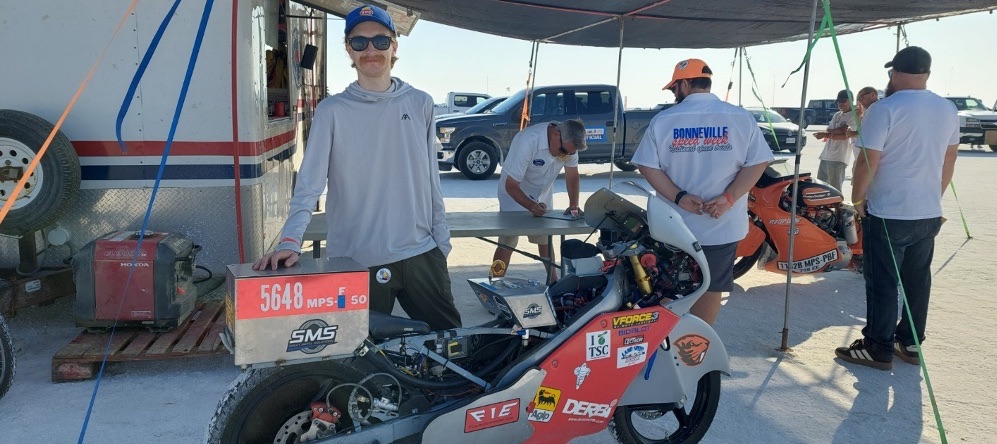
Inspections at SCTA Impound.
We completely rebuilt the engine and transmission for racing. Bidalot Technologies supplied the major racing components, including the crankshaft, connecting rod, piston, cylinder, cylinder head and exhaust system. At Bonneville, SCTA officials measured the bore and stroke directly, verified the displacement and sealed the engine for later record inspections. The engine uses a Moto Tassinari V-Force 3 reed system and a 29 mm Lectron Billetron Mini carburetor, along with a high-output PVL ignition using the Bidalot racing curve.
But perhaps the most important part of the preparation happened long before Speed Week: we tested, then tested some more. Early shakedown runs were made on rural roads at lower elevations. Later testing took us to eastern Oregon, where we could operate at density altitudes similar to those we expected at Bonneville.
El Mirage: proof before Bonneville.
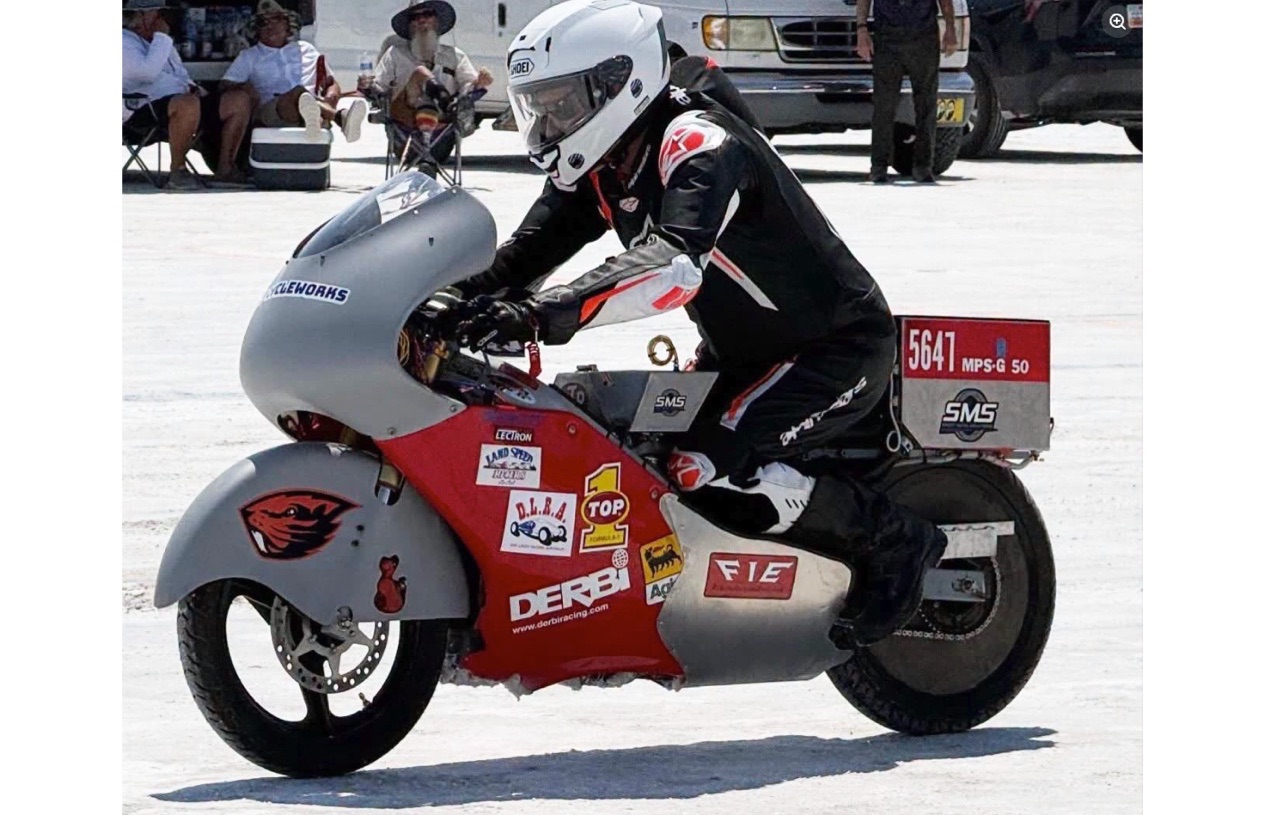
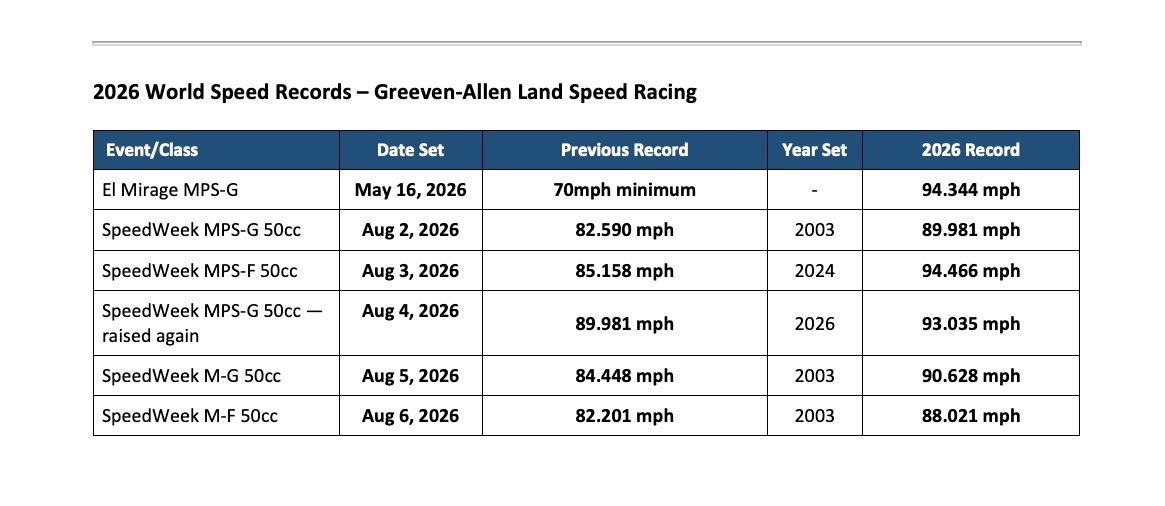
The first big test came in May at El Mirage, California. Speedy rode the Derbi to an official 94.344 mph record in the 50 cc MPS-G class — Modified Partial Streamlining, Gasoline. More important than the number itself was what the run confirmed: the motorcycle was fast, stable and reliable. Two full-speed competition runs also gave us valuable real-world gearing information before Bonneville.
The rear wheel carried another part of the project we were especially proud of. Oregon State Mechanical Engineering graduates Dillon Cambra and Ryan Wood designed and fabricated a hemp-composite aerodynamic rear-wheel disc. Direct Dimensions, with support from Michael Raphael and interns there, had previously produced a very accurate 3D scan of the wheel for the students to use in their CAD work. It was a nice example of students helping students — and the finished part went on to become record-setting hardware.
By the time we reached the Salt, we already had a very good idea of how the motorcycle would react to changes in altitude, weather and gearing.
Measure first, then tune.
We probably have more instrumentation on this little 50 cc motorcycle than anyone reasonably expects to see. We monitor engine speed, wheel speed, coolant temperature and exhaust temperature, and we record air-fuel ratio and local weather conditions including temperature, wind and density altitude. GPS, GoPro video and additional data logging give us several independent ways to understand what happened during a run.
The point is not to collect data simply because we can; it is to avoid guessing. Before Bonneville, we had already mapped how the Lectron carburetor behaved under different atmospheric conditions and had developed a good picture of the gearing the motorcycle needed.
That work paid off immediately. During Speed Week the density altitude changed daily by more than 1,200 feet, yet the Lectron required only very small adjustments to its power jet. Instead of arriving at Bonneville and trying to discover what the motorcycle wanted, we arrived with most of the possibilities already narrowed down. That became our pattern for the entire week: measure what changed, make the smallest adjustment necessary, then go race.
An ice bath instead of a radiator.
One of the more unusual parts of the Derbi is its cooling system. We removed the original radiator, mechanical water pump and thermostat, and a variable-speed electric pump now circulates coolant through the engine. Instead of using outside air to cool the motorcycle, we use something much simpler: ice water.
Behind the rider is a custom stainless-steel tank that also forms part of the rear fender. Before each run we fill it with tap water and roughly ten pounds of ice. A compact liquid-to-liquid heat exchanger transfers heat from the engine coolant into that ice-water reservoir, and when engine temperature rises, a second pump automatically circulates the cold water through the heat exchanger.
It sounds complicated when described in engineering terms, but in practice it became wonderfully boring. Once we had tested the system and found the right settings, we stopped worrying about engine temperature. Even when the desert air was brutally hot, the cooling system simply did its job. At Bonneville, anything you can stop worrying about is a major advantage.
Ten runs. Ten useful runs.
Bonneville record procedure rewards consistency and centers on a two-run process.
First, you make a qualifying run faster than the existing record. The motorcycle then goes into impound, where it is held for the next morning’s confirmation attempt.
The following morning, you make a confirmation run. The two speeds are averaged, and if that average is still faster than the old record, you have a new one.
At Speed Week we made ten total runs, and everyone exceeded the speed of the record that was standing when we made it. Five were qualifying runs and five were confirmation runs. There were no wasted passes.
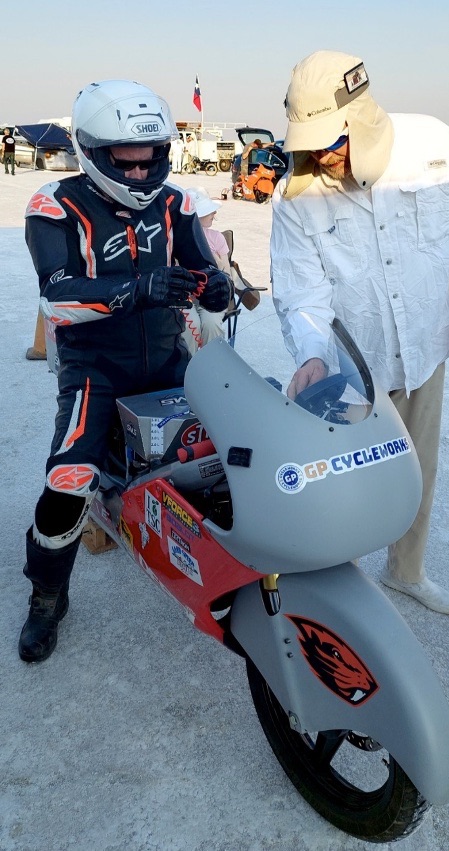
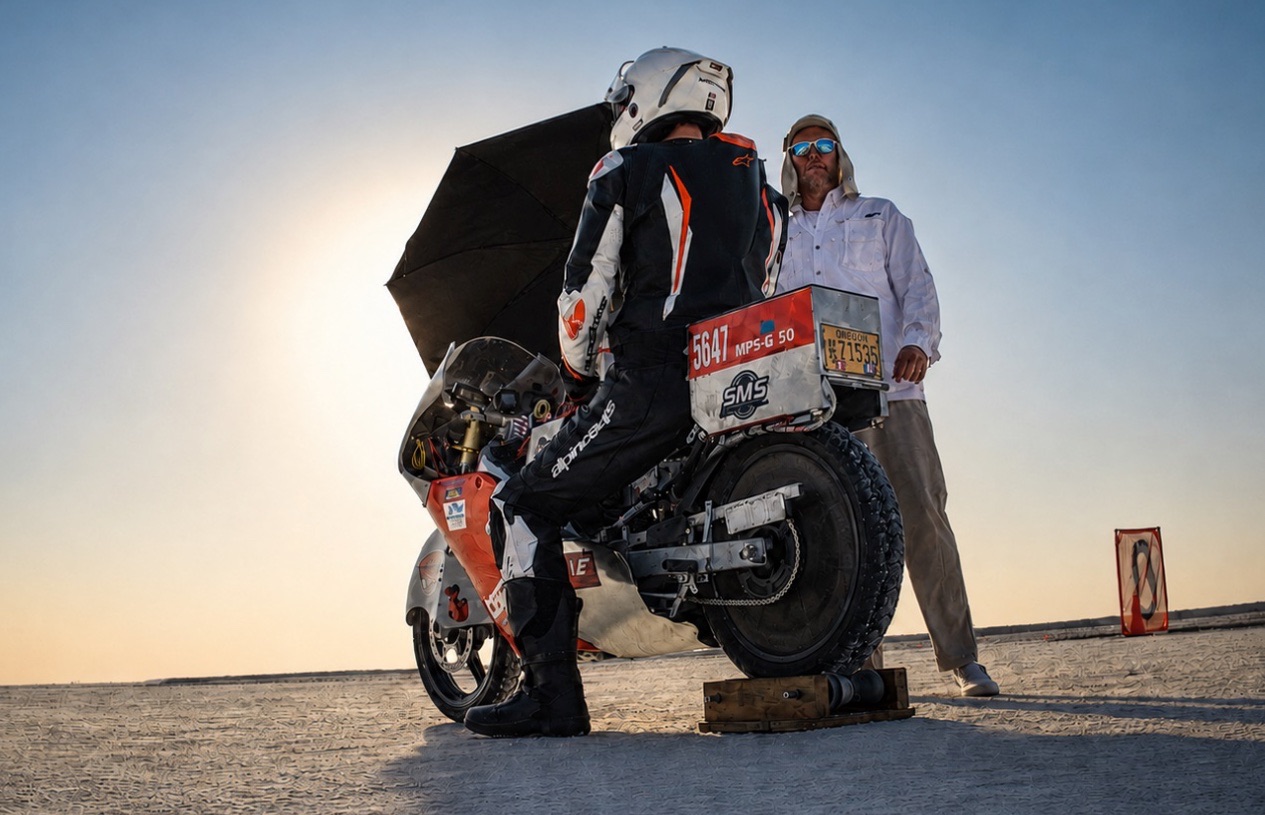
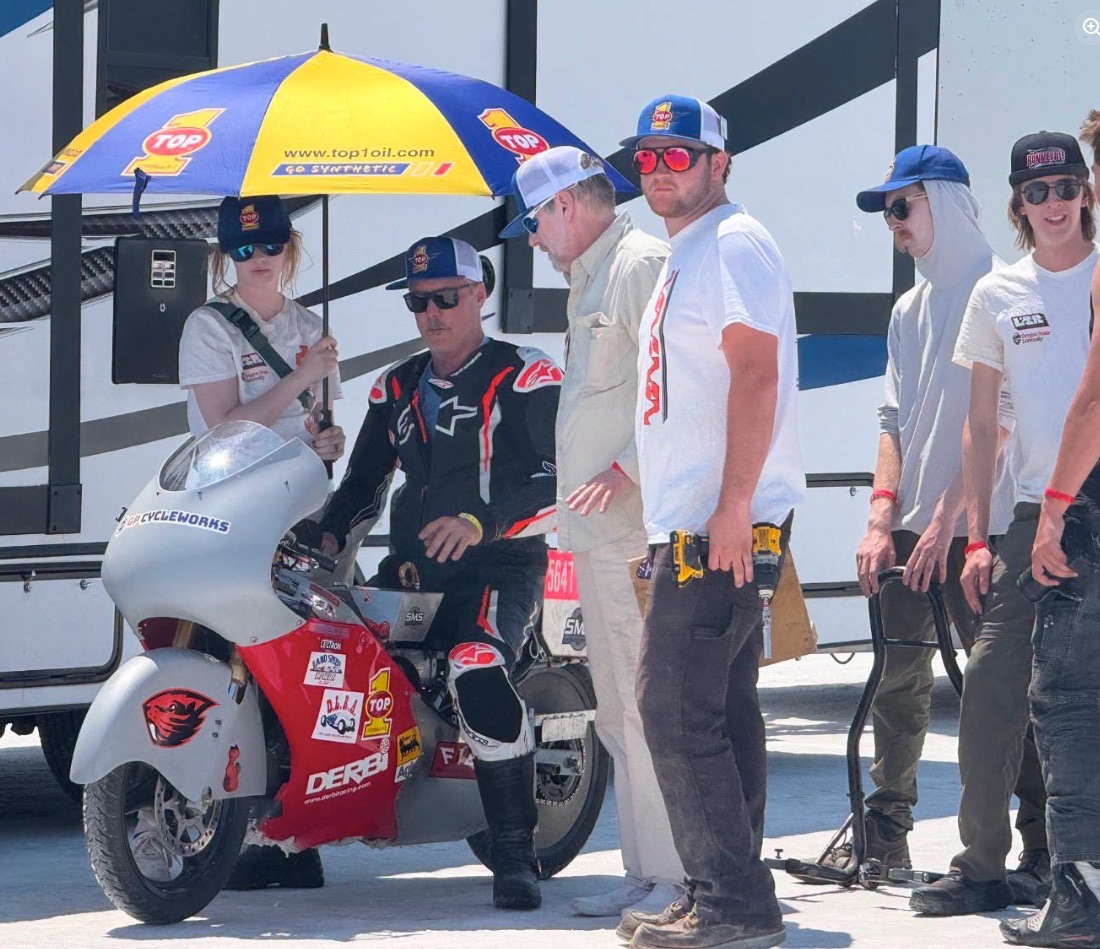
Sparky and Speedy prepare for a run.
Our first target class was MPS-G. The qualifying run on August 1 and the confirmation the next morning produced an average of 89.981 mph — a record, but with one slightly irritating detail: we had missed 90 mph by only nineteen thousandths of a mile per hour. That tiny gap gave us something to think about.
Next, we moved into MPS-F, the corresponding Fuel class. We continued to run the Derbi on Sunoco Supreme 112 gasoline mixed with Castrol A747 two-stroke oil. Our testing had shown that the motorcycle had enough performance to attack the Fuel-class record without introducing another tuning variable.
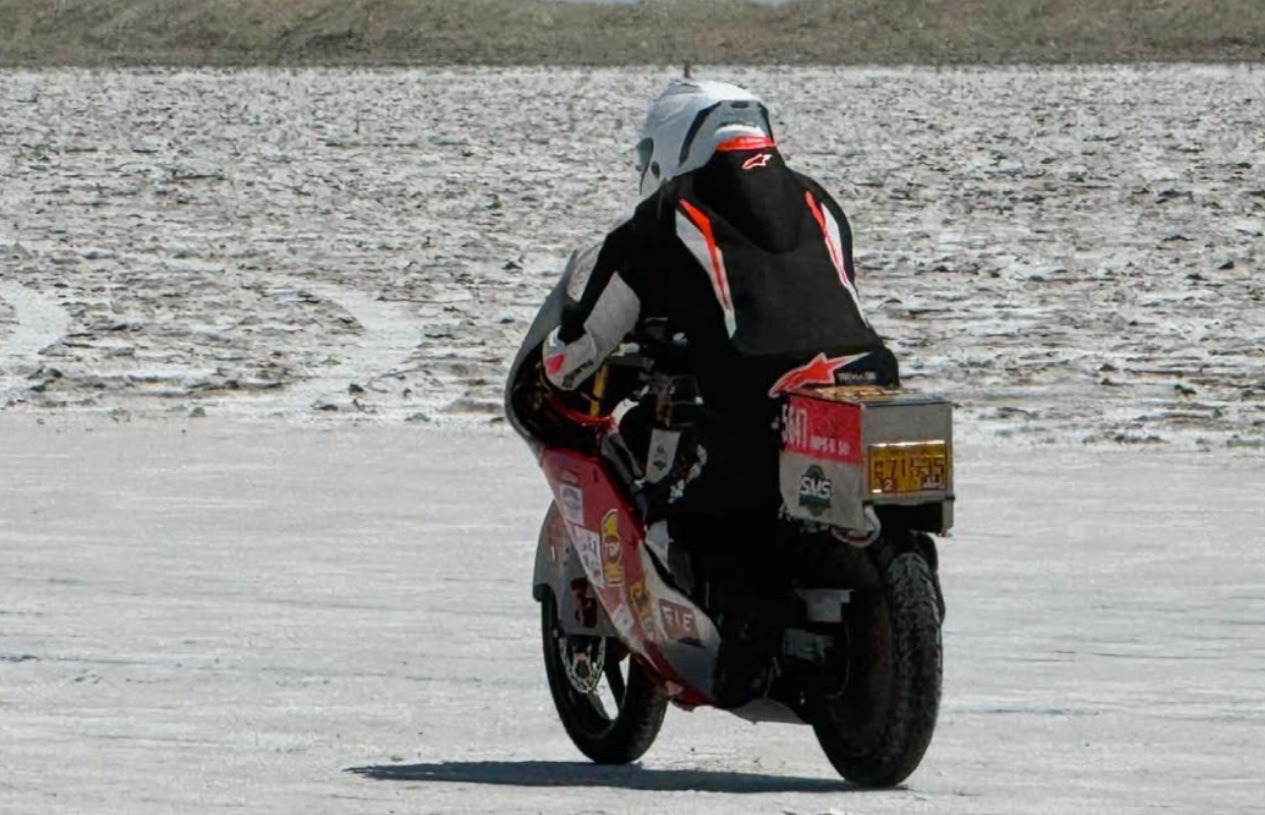
We made one very small power-jet adjustment and changed our shift points slightly. Then Speedy made the qualifying run: 95.662 mph. Suddenly our 50 cc Derbi was closer to 100 mph than it was to 90! There was favorable wind on the run, but seeing that number on the timing slip was still astonishing.
The next morning's confirmation run produced an official two-run average of 94.466 mph.
That record was particularly meaningful to us because it replaced the Bonneville MPS-F record we had set with the Aprilia in 2024 — the record previously described in Wide Magazine (https://wide.piaggiogroup.com/en/articles/racing/challenge-at-the-salt/index.html).
Then we went straight back to MPS-G.
Two days after setting the 89.981 mph record, we broke our own record with a new average of 93.035 mph. We had shattered the 90-mph barrier.
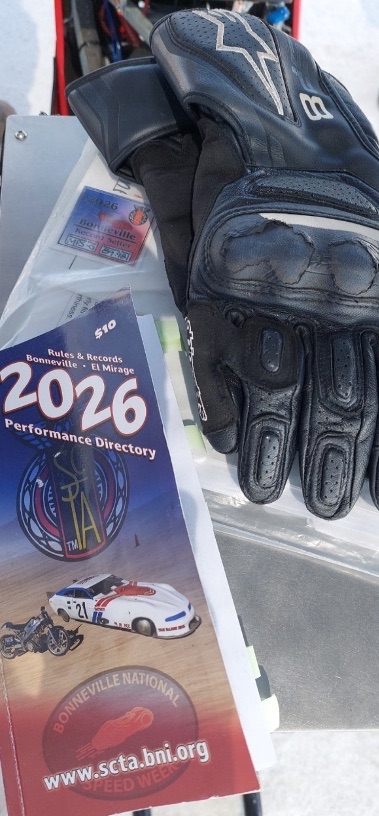
A quiet moment between runs.
(SCTA-Southern California Timing Association is a competition sanctioning body that maintains rules. Info, images and video on his official FB page: https://www.facebook.com/SCTASouthernCaliforniaTimingAssociation).
Editorial’s note.
“Just like practice”.
Before every launch at Bonneville we used the same reminder: “Just like practice.” The idea was simple. We were not supposed to do something extraordinary at Bonneville; the extraordinary work had already been done during the months beforehand. At the starting line, the job was to follow the routine, adapt to whatever small things had changed and let the motorcycle do what it had already done many times.
Of course, Bonneville has a way of making even simple things difficult. On our first day the temperature reached about 105°F, humidity was in the single digits, and the sun and UV exposure were intense. Much of our crew was camping in tents, so fatigue and dehydration required constant attention. Meanwhile, motorcycles and people were constantly moving between the pits, starting line, timing area, impound and technical inspection, with tools to organize, paperwork to manage, lines to wait in and a motorcycle that always had to be ready when its turn came. The engineering work is only part of Speed Week; staying focused is another.
We also learned not to become slaves to our instrumentation. One experimental Pitot-tube air-speed system proved unreliable, so we abandoned it. On some runs we decided that setting up every data logger simply was not worth the distraction. That was part of the process too: collect the information that helps, and do not let the rest interfere with execution.
Changing the motorcycle on the Salt.
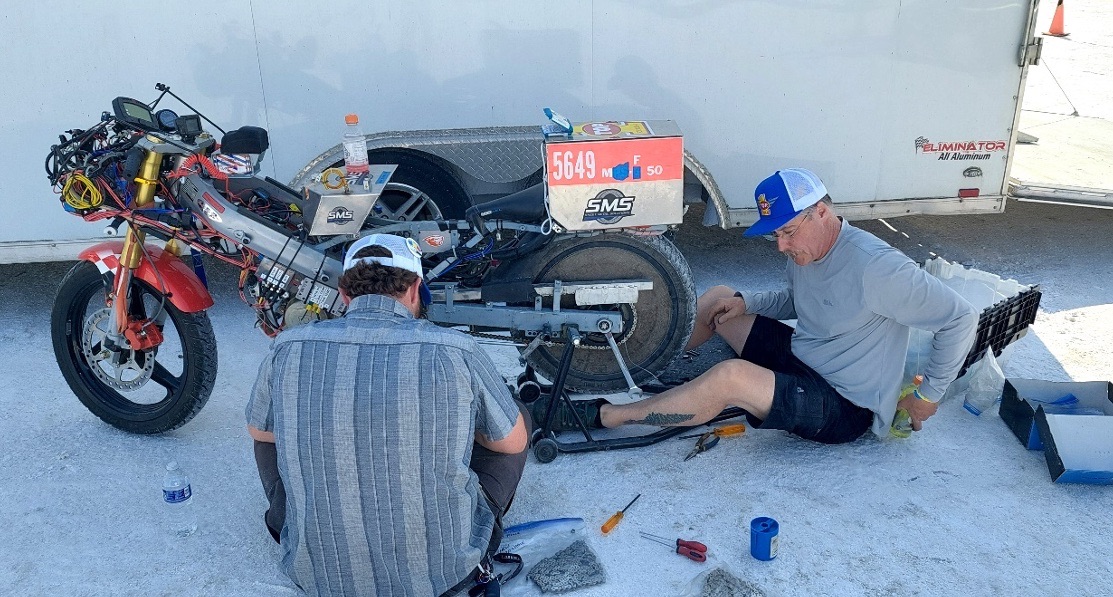
After setting three records in the partially streamlined MPS configuration, we decided to transform the Derbi into the unfaired M (Modified) configuration.
And we did it right there on the Salt. It was the biggest mechanical job of the week. The front forks had to be dropped so we could remove the MPS front fender and install the smaller fender required for the M class. We had created a custom fixture before the event to suspend the front of the motorcycle inside our trailer, which had become our mobile workshop, and the students provided much of the hands-on help. Within a few hours, the Derbi had been transformed, inspected again and returned to competition.
The first M-class run immediately told us something important: the gearing was not quite right for the change in aerodynamics without the fairings. As we had done all year, we used the data to calculate one gearing change. Oregon State student Thomas Blevins helped with the sprocket work directly on the Salt, and that single adjustment put the motorcycle exactly where it needed to be for the final three runs.
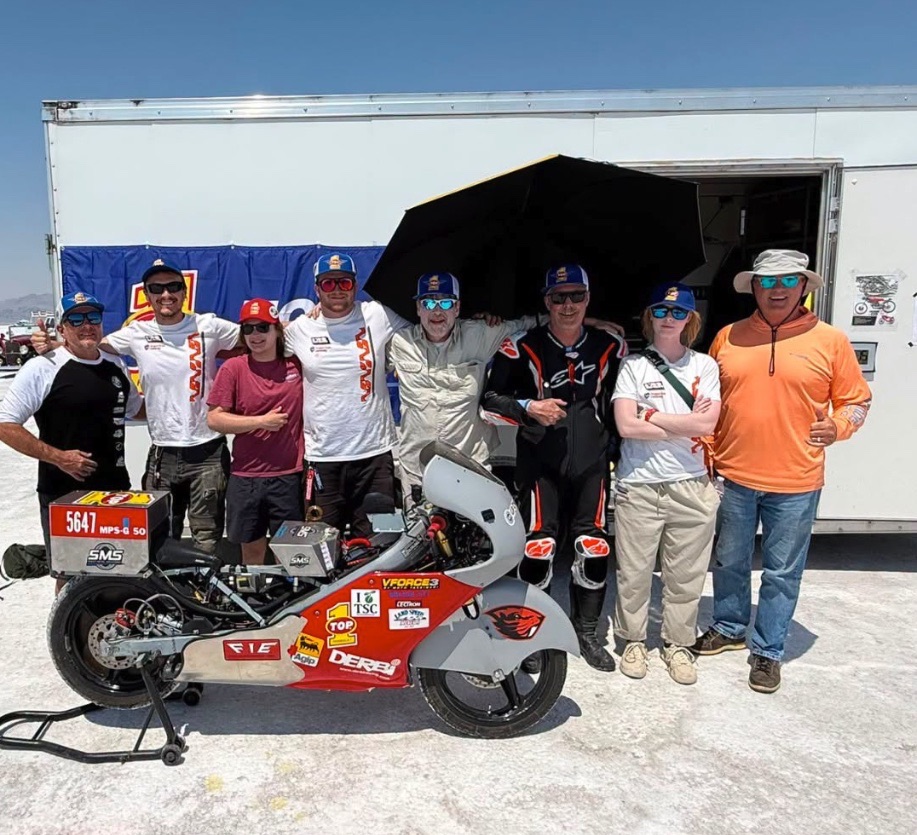
The result was an 88.021 mph M-F record — Modified, Fuel — on August 5, followed the next day by a 90.628 mph M-G record in the Gasoline class. Five certified Bonneville records, four different classes, ten consecutive useful runs.
Students were part of the race team.
The Oregon State students who came with us were not spectators; they were members of the race team. For months, students in the Oregon State Land Speed Racing Club had contributed to the project, and many then traveled with us to El Mirage and Bonneville to become part of the daily race operation.
They moved the motorcycle in and out of the trailer, replenished the cooling-system ice and water, shaded the rider, handled helmets and riding equipment, operated the starting equipment, recorded weather conditions, recovered the bike after runs and secured it for transport. At the end of a run, while Speedy cooled down and recovered, the students took over immediate management of the motorcycle. They also played a large role in converting the bike from MPS to M configuration.
Our student videographer, Danny Sasser, documented the experience, while Finance major Aspen Humphries helped lead a student project to design, print and sell Oregon State Land Speed Racing Club T-shirts at Bonneville — including working through the event approval process required to do it. The students contributed engineering, mechanical work, logistics, media and business skills, along with something much harder to quantify: a huge amount of positive energy.
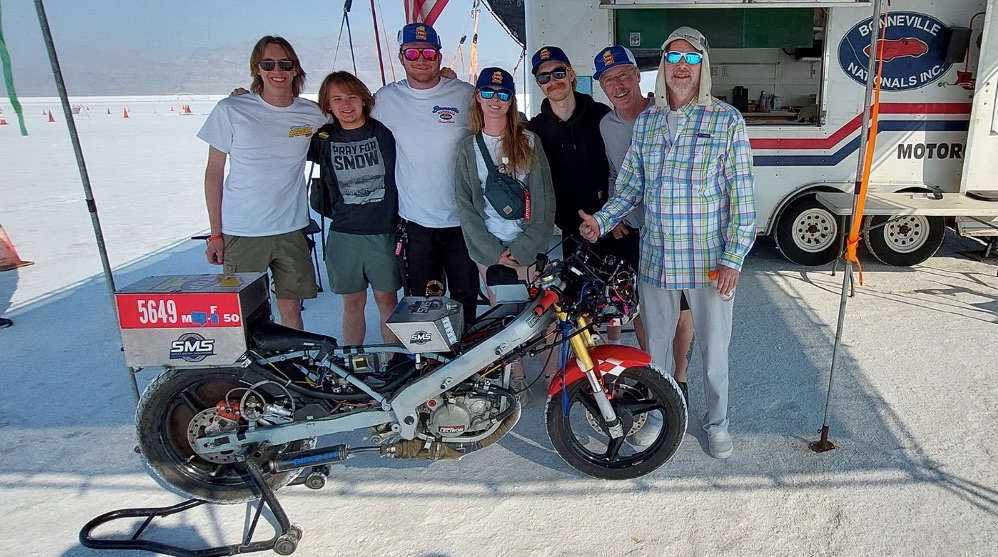
Part of the team at SCTA Impound.
The small moments still matter.
A successful week does not mean that absolutely nothing goes wrong. One moment at the starting line made that clear.
About ten minutes before every run, we normally performed a warm-up start, and those had been completely reliable. Then, when it was time for one actual run, the motorcycle would not start as expected. For a moment, Speedy thought the transmission might not be in the correct gear, but the real problem was much simpler: the electric drill used to power our student-built starter stand had been placed on the wrong drive roller. We spotted the problem, moved the drill, and the Derbi started almost instantly — after only about half a revolution of the rear tire.
Problem solved. That is what ten-for-ten really means: not that nothing happens, but that small problems stay small.
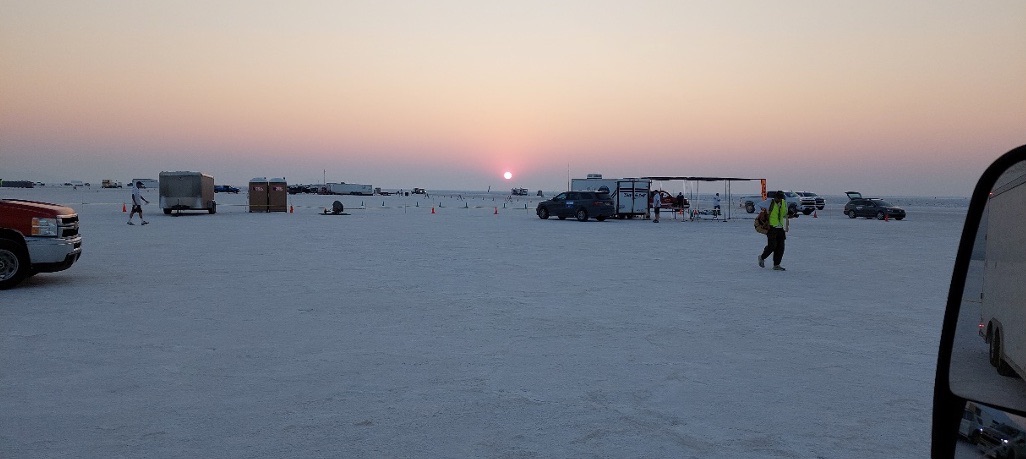
Sunrise over the Bonneville Salt Flats, another day of racing ahead.
We have developed a formula we keep coming back to: preparation + practice + engineering + science + process + some luck = fun + success.
In 2024, we struggled and eventually earned our records. In 2026, we arrived with a motorcycle that had already been stable for months, more testing behind us, a better-defined process and a crew that had practiced together. Perhaps we had a little better luck as well. Everything came together.
The quality of the hardware and the support around us mattered as well. Sheet Metal Solutions in Tangent, Oregon, fabricated two unusual stainless-steel structures we designed: the custom fuel tank and the combined rear fender/cold-water reservoir. GP Cycleworks produced the custom front fender, nose fairing and windshield used in our record-setting MPS configuration. Arnaud Bidalot and Bidalot Technologies supplied exceptional racing components and technical assistance, while Lectron and Moto Tassinari also supported the program technically, with Moto Tassinari already helping us think about what comes next.
Direct Dimensions and Michael Raphael made possible the precision scanning work behind the student aerodynamic wheel-disc project.
Oregon Powder Coating gave several components durable, beautifully finished coatings in Oregon State colors. TOP 1 Oil Products also supported the program and helped share the story of our Bonneville effort and the students behind it with a broader motorsports audience.
And we remain grateful to Piaggio Group and Wide Magazine. The two Wide Magazine stories published in 2024 meant a great deal to our team. They gave the students a real lift and helped us show sponsors, supporters and friends that this strange little 50 cc land-speed project had become something worth following. Doing it again in 2026 — this time with a Derbi — makes that connection especially satisfying.
Next: 100 mph!
We are not finished. In 2027, Greeven-Allen LSR plans to return to the Bonneville Salt Flats. As in 2026, the challenges are finding better aerodynamics and propulsion. We will leverage our record-setting motorcycle and proven processes to guide the student team, which is already hard at work developing improvements to test.
A week to Remember!
Most of our student crew had to leave Bonneville before the fifth day of competition, so not everyone was there for the final record. Those who remained were tired, happy and deeply satisfied. On the drive home we kept coming back to how remarkable the week had been. We knew from months of testing that we had a special motorcycle, but five attempts producing five records — with every one of ten runs doing exactly the job it needed to do — was more than we could reasonably have expected.
After everything we learned in 2024, and everything that happened in 2026, it felt wonderful. It felt like living in a movie.
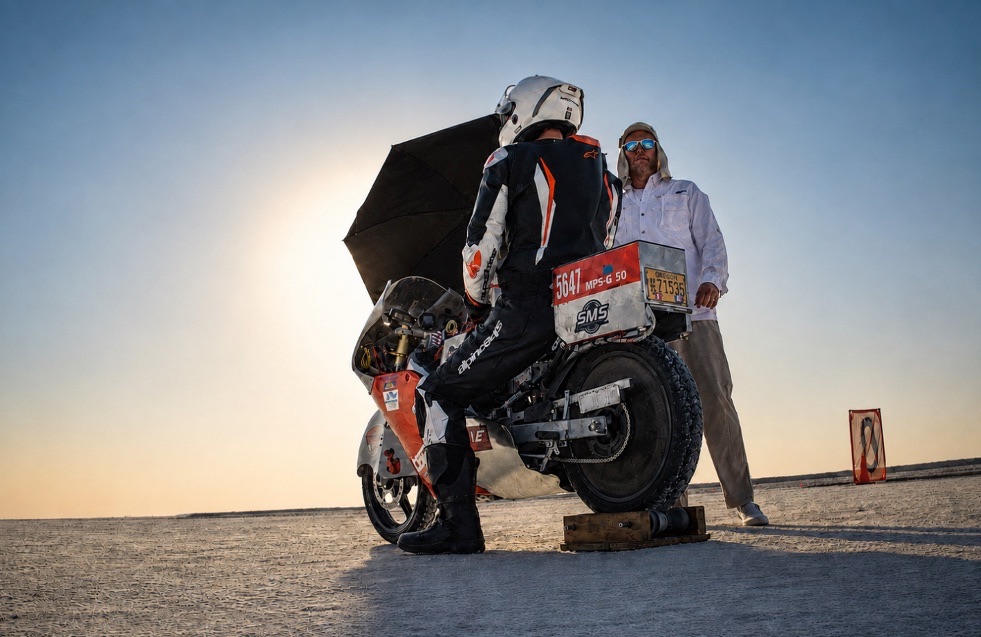
We’ll be back on the salt in 2027! (Photo: Danny Sasser www.sasr.studio)
By John “Speedy” Greeven and Will “Sparky” Allen — Greeven-Allen LSR.
SOCIAL CORNER – TOP 1 OIL OFFICIAL FACEBOOK:
https://www.facebook.com/top1oil
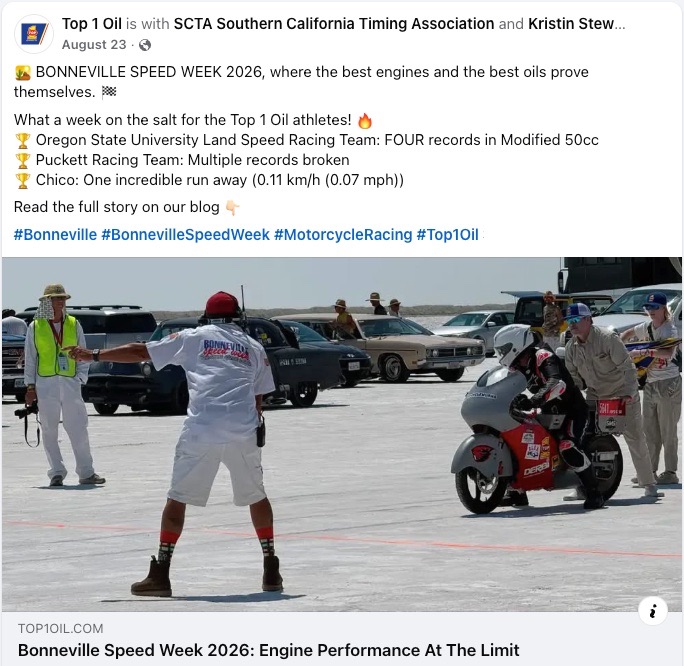
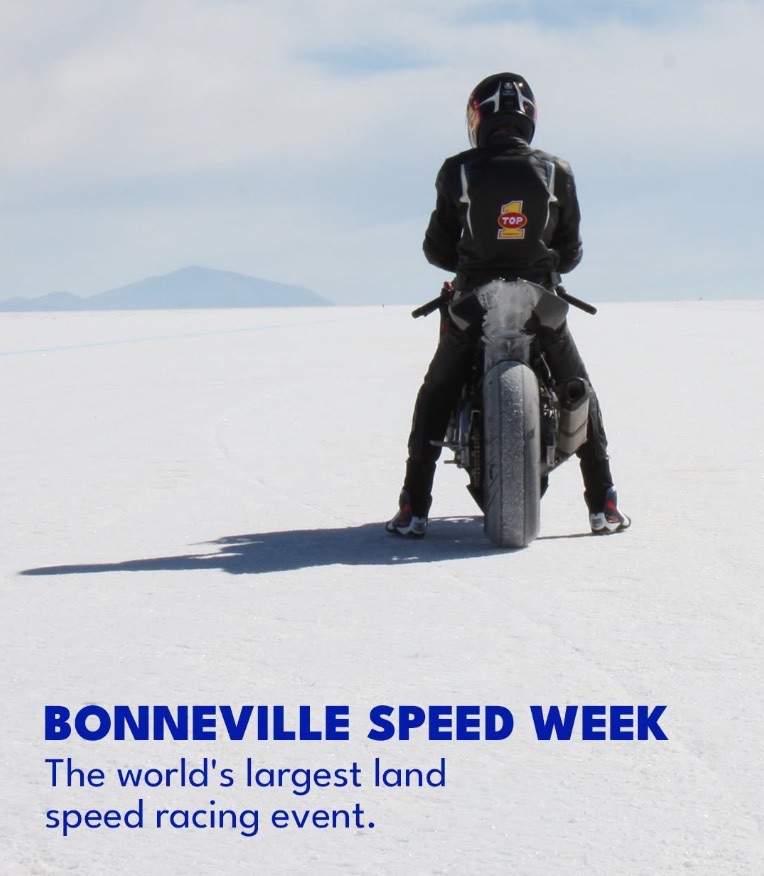
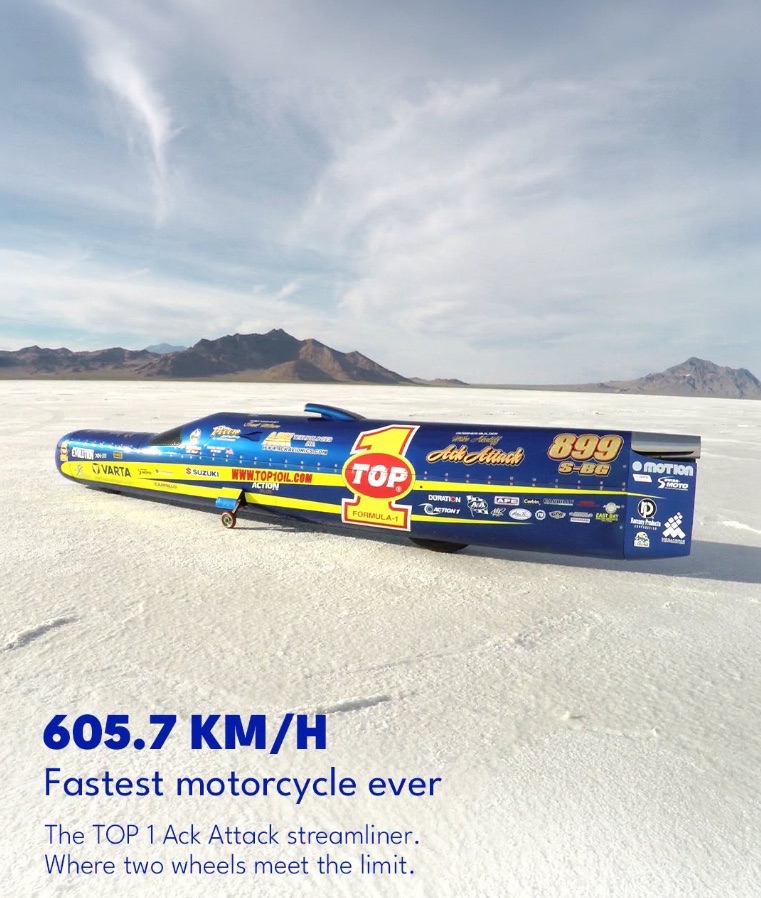
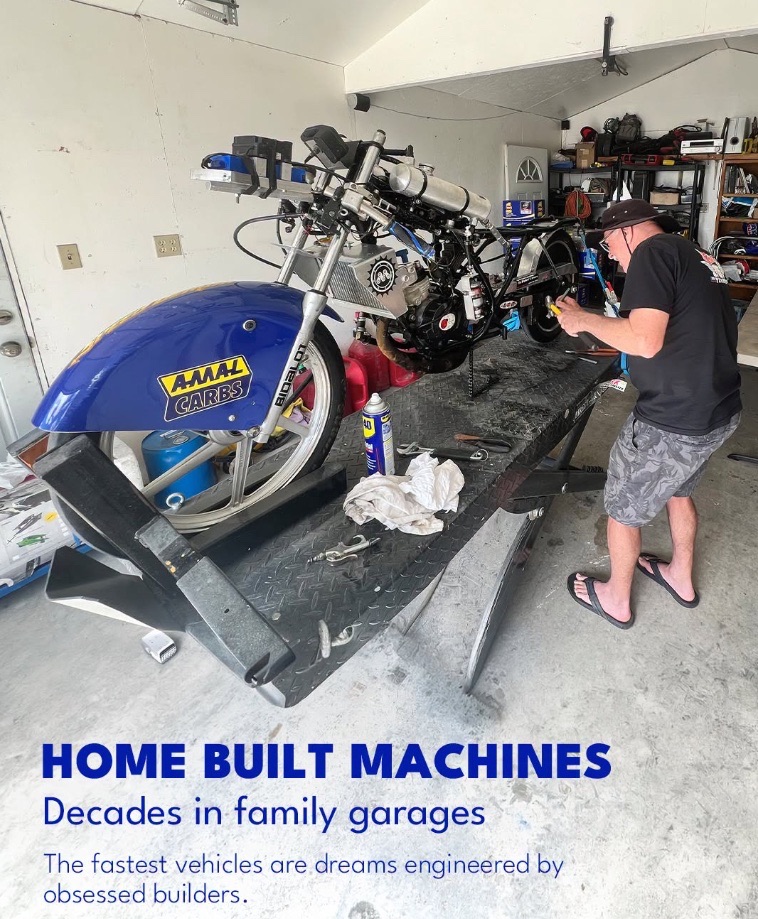
LIFE IS AN ADVENTURE. BONNEVILLE SPEED WEEK 2026 (AUGUST 1-7): WHERE ENGINES RUN AT THE LIMIT. TOP STORY FROM TOP 1 OIL:
https://top1oil.com/bonneville-speed-week-2026-engine-performance/
https://www.facebook.com/top1oil
ABOUT BONNEVILLE SPEED WEEK (https://www.facebook.com/top1oil).